


Fourteen-odd billion years ago, God snapped His large fingers and created the universe from nothing. In a time lapse so small it couldn’t be measured, the Big Bang expanded furiously, turning a soup of primordial particles into suns and galaxies. Earth emerged from stardust and the first life forms from stray water drops. Bacteria evolved into great apes—with branch-offs like octopi and cockroaches—to which we belong. Our brains got bigger, so we stepped down from trees. Our posture was bad, so the cosmic doctor advised us to walk erect. Finally, we invented fire and other useful stuff like guns and candles and it became pretty clear that we had the spark.
It’s been a long way, with ups and downs—like that one time we invented agriculture—but God deigned to grant our plea nevertheless: “What if I put some thinking into their brains?” He thought. Whereupon He bestowed upon us enough intelligence to explore the more interesting question: What if we take the brain out of our thinking?
As you might have noticed from the all-time low PISA scores, the fall of award-winning literature, or the fact that starting this year, no human will seriously consider a career in math ever again, we’re on a quest to do just that. The late sir Ken Robinson, expert in education, used to say that schools kill creativity—it’s for that reason than everyone’s tiktoks look the same, by the way—and so we have no choice but reach out to the most unspoiled minds of all: those of the youngest kids.
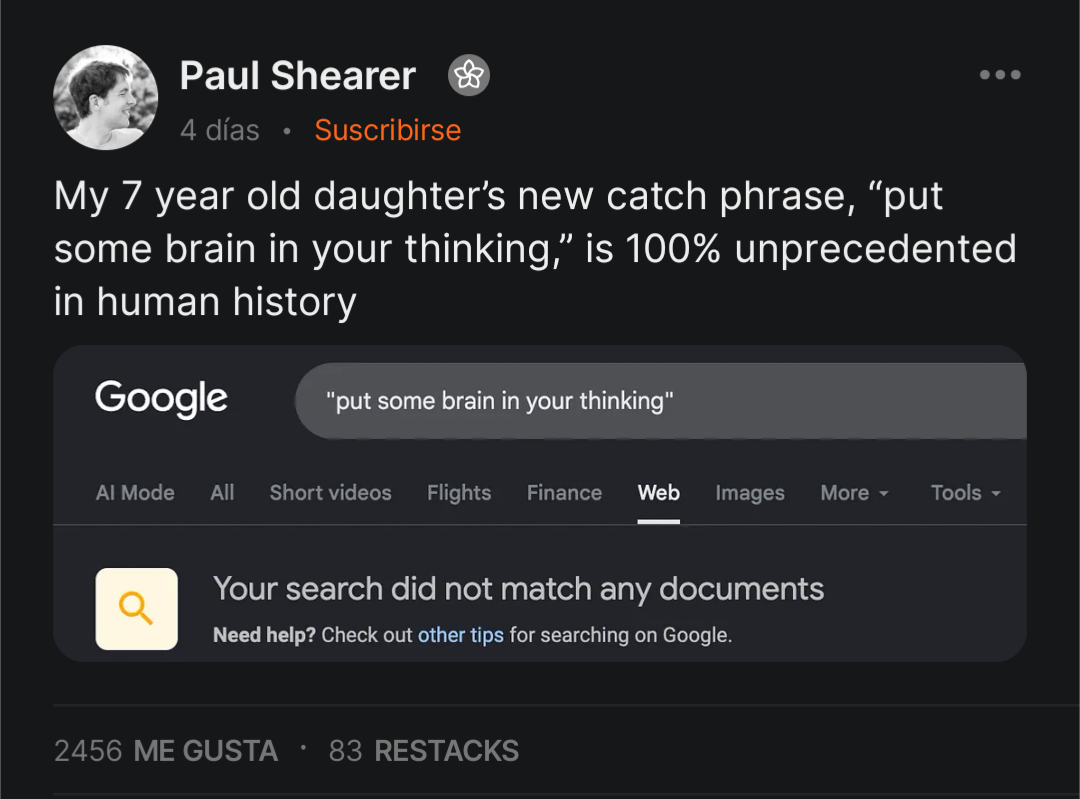
Paul Shearer’s seven-year-old daughter’s “Put some brain in your thinking” is up there in the all-time great aphorisms list with “I think, therefore I am” and “Know thyself.” It took a little girl to write the best six-word story since Hemingway, one that captures both the malady of our time and its solution; “Put some brain in your thinking” is as terrifying as “For sale: baby shoes, never worn,” but actually useful.
More credit to this budding philosopher for inventing the sentence. Google doesn’t register it. The very possibility of diagnosing the world with a brand-new coinage suggests the dawn of an era: even if its constituent concepts existed before—not thinking much (a dumb person), or lacking a brain (a dead person)—the synthesis (thinking without a brain) is unprecedented.
She’s not just a literary genius but, more importantly, native to the fact that brain and thinking are now disconnected. Substrate and activity go naturally hand-in-hand for us adults, but not for a member of Generation Alpha. There’s an interesting mix at play between pre-socialized innocence and post-AI birth. To us, ChatGPT is recent and the brain inextricable; to her, both have essentially existed forever and so they’re swappable ingredients of the thinking recipe.
She sees a truth that eludes our mature gaze: that although thinking happens by default, the brain is now an option among many in a growing catalog. Notice her syntax: put some brain in your thinking is to your eye a grammatical mistake because brain and thinking are synonymous. To her, however, this isn’t a clever inversion but natural speech.
In a world where thinking and brain are LEGO bricks, adding the brain back into the thinking is not an ontological argument about the human mind but pure practical advice. Like one says a salad could use more salt and pepper.
It’s in this sense that the brain has become a luxury input; an expensive spice you’d have to smuggle out of Arrakis. And so, just like tasty food and unsavory food are both food, the brain and AI are both thinking. Naturally, as a result, people will tend to overseason their thinking with AI. But unlike salt and pepper, the brain expires: they will carry it around as one does a vestigial organ. They might disengage their brains from life and work, but they can’t just take it off. They will become a forced cyborg and AI, a wheelchair for their shallow minds.
The fact that this split condition between brain and thinking is a novelty makes it all the more surprising that it’s also common.
I can stand a brainless human, but I hate to be a peerless one. ChatGPT follows me wherever I go and now you will, too? At least you flatter me by contrast: My skull does not house an NVIDIA H100 SXM5 80 GB HBM3 989 TFLOPs, but a cabbage made of neurons. My brain feeds my thinking and in turn I feed it by reading books, essays, and papers. Like this one by Graphite: “the number of articles published on the internet that are primarily AI-generated (50%) is equal to the number written by humans (50%).” The internet isn’t dead but you are definitely torturing it, hemorrhaging humanity out of it prompt by prompt.
These considerations are matters of vanity, however, and we have no time for that; when an isolated malaise turns into a pandemic, we must to ask a different question: can we undo it?
Yes, kind of. Cognitive atrophy is reversible like attention is reversible: it requires itself as the engine of reversion. It’s hard to stop scrolling because scrolling kills its antidote. Likewise, you might be too far gone. Are you reading what I say or have you instructed your agent to distill this essay into bullet points for easier digestion? Or are you perhaps listening to the voiceover of a generated transcription? Can you hear me at all—or are you already too braindrained?
Anyway, let me offer some ideas. A worldwide ban might work: let’s all deport these geniuses to the datacenter-shaped country they came out from. You can also move forward. Embrace “friction-maxxing,” a trend that travels parallel to “cognitive surrender” but in the opposite direction: let’s populate our lives with daliy chores to forgo convenience and buildup tolerance for discomfort. Let’s pay homage to the domestic sublime to avoid sliding into death’s maw. Alternatively, if neither the collective nor the individualistic options suit you, we can take our chances with a dictatorship: let’s entrust politics to kindergarteners and set up an age of minority.
I’m afraid none will work.
A kid might not be strong enough to enforce the toughest policies; friction-maxxing is itself an indictement of its thesis, for it rests on itemizing serendipity; and, finally, the AI race prevents any attempt at global pacing. Besides, in case you haven’t noticed, those who could actually do something did not fall ill: how else do you explain that they still write their essays?
Substack tried to be a sane voice amid the anarchy of this quagmire. Partnering with an AI company to detect AI writing sounds like an oxymoron but a crazy world deserves crazy measures. A witch hunt, however, would only fuel a different kind of mindlessness: just like there are people who only have AI inside their skulls, there are people who only see AI outside of them. To be clear, I’m not sure I prefer to deal with a solipsist rather than a bunch of philosophical zombies.
I therefore accept we’re on the verge of a drastic class schism, a seasoning schism.
Those who find the optimal amount of each ingredient will rise above the tides. Those who fail to put some brain in their thinking will succumb, barely superior to the bots replacing them. And so the course of action I propose is to weaponize this phrase. Turn it into a slogan, into a battle cry.
I already have. Before, when people left AI comments on my writing, I used to “AI;DR” (it’s AI, so I don’t read) or insta-block them, but those are band-aids on a cancer. From now on, I will just comment below: “put some brain in your thinking.” I let them know that I can tell, as Sam Kriss would say. Don’t hesitate to spread the word.
In case you need convincing, let me tell you that, as an insult, it’s unmatched. If I call you a “stochastic parrot,” chances are you don’t know what stochastic is, or conversely, think it as a compliment. If I say you’re a “slop cannon,” you will say slop is in the eye of the beholder. . If I say you’re “as conscious as Claude,” you will respond, proudly, that “Claude is as conscious as you.” But if I instead tell you to put some brain in your thinking, by the time you understand the inversion you will have already proved my point.
If you’ve reached this far I have good news. You have enough brain left to read above 12th grade and enough attention to read 2,000 words. And, more importantly, I’ve convinced you that your thinking is nevertheless missing some brain and you want to put it back. I’m glad you asked because I have exactly what you need.
First: take action.
Stop reading essays about how your brain is gone and delete your AI apps for a week. Let’s see whether you make it to next Wednesday. You think you’re faster at work, but are you better? Have you stopped to consider whether you’re more productive or just busier? Does your AI spending translate into outcomes or you’re just gambling at the token casino? Don’t ask ChatGPT to do your emails; don’t write code with Codex. Write an essay by hand. Read a book that’s not audio. Lift weights without using an industrial crane.
The second thing you will do, you won’t like. I’m only slightly disappointed that it took an OpenAI staffer to formulate the mechanism: “a lot of you would benefit from doing less and thinking more.”
In a world that over-indexes on high agency, you can get ahead by exercising your birthright as a member of the human species; make God proud by putting His gift to good use. Introspect a little. The reason why you scour the model market in search of replacement parts, is because you’re terrified of yourself. You’re terrified of realizing that, in a world that’s emptying itself of interesting things, you are not sufficiently interested yourself.
But trust me when I say this: you will be if only you put some brain in your thinking.

Even the ticking of keyboard keys for more than 30 seconds at a time gives me hope.
I noticed your typo, indivudlaist first btw. Maybe I'm not too far gone yet, yay!