


Hey, Alberto here! 👋 I publish long-form AI analysis covering culture, philosophy, and business. Paid subscribers get Monday how-to guides and Friday news commentary (back soon). If you’d like to become a paid sub, here’s a button for that:
Last week I published an optimistic article about a post-AI world. Today’s essay comes from a more pensive and somber place. How to deal with what’s coming is the most important question right now, and it deserves a full treatment: the light and the shadow.

I.
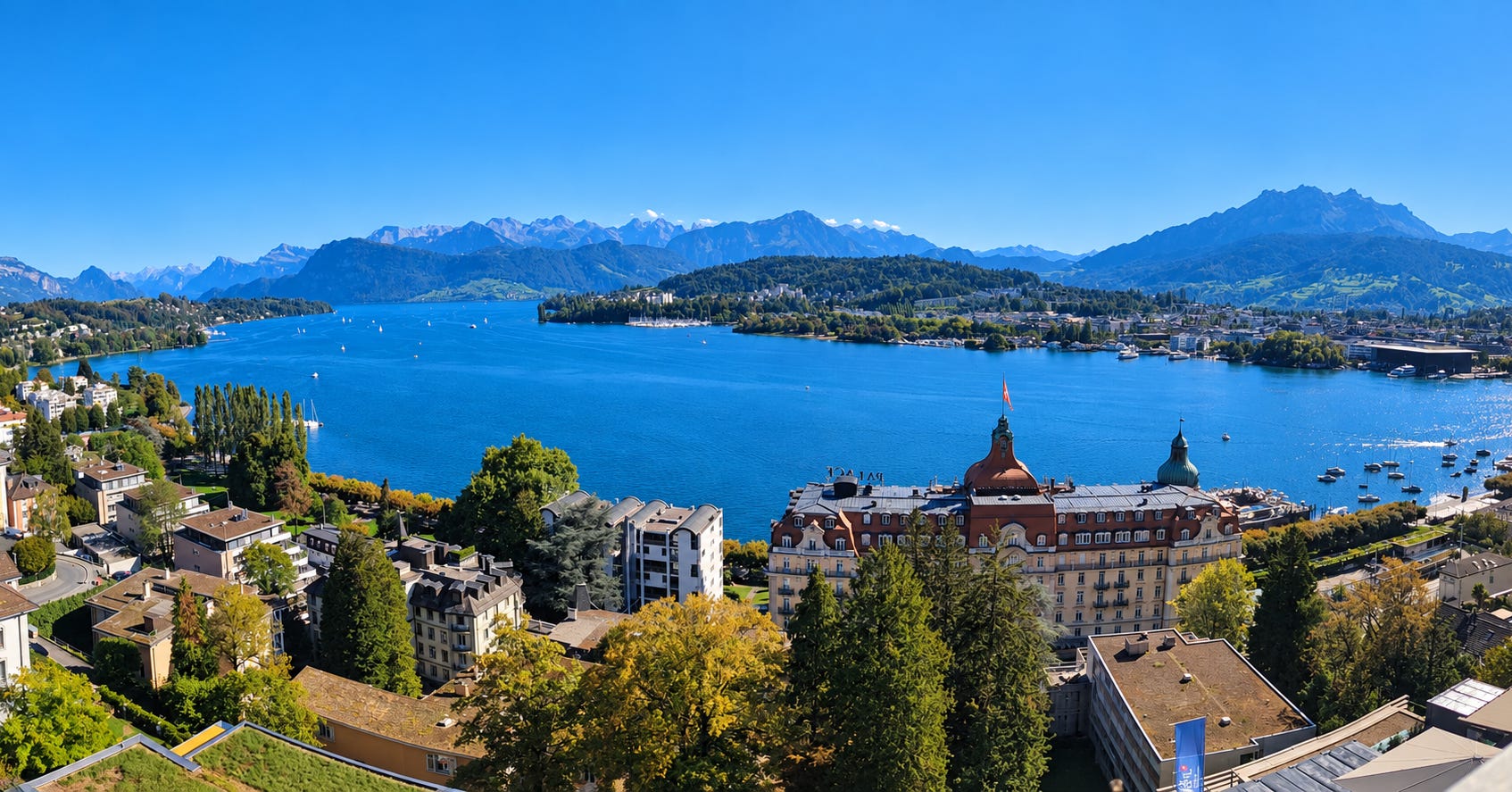
I am standing on the fifth-floor balcony of my hotel room in Lucerne. It is as beautiful as it is old, two traits buildings tend to accumulate together until the latter kills the former. Before me, the Lake of the Four Forest Cantons; large, but not so large as to conceal from me the lush sweep of its quiet shores. Below: swans, coots, mallards, and cormorants swim blithely. In the distance, the Alps.
I look at their majestic stillness, peaks posing for an eternal-exposure photograph. They are unmoved by the scarce clouds snagging on their serrated ridgeline, by the wind waving green with all its trees, by the dance of a timid sun and a crescent moon. They are a snapshot of the past. And of the future, too. A million years ago they stood there and in a million years—when the Montana hotel will have long crumbled down the hill into the ruins of Lucerne, the lake will have dried out into a rocky bed, and the conifers and waterfowl will have turned into some strange new forms of life—they will stand there, just as impassive.
Lately, I feel mountains are among the very few things of which I can say that.
The world is changing. So said everyone across the ages; it always has, of course. Don Quixote thought himself born “by Heaven’s will, into this our age of iron, to restore within it the age of gold.” Ovid, more cheerfully, thanked his luck: “Let others praise the olden days; I am glad I was born in this present age.” Nostalgia or enthusiasm, the premise is the same: one age gives way to another. But the size of the clock is different now. Historical change used to be measured in millennia, perhaps centuries, sometimes generations. I am talking about years. I am talking about months. It is “weeks where decades happen” all the way down now.
The world is changing faster than any person can absorb the change; we can barely pay the interest to a growing debt of existential proportions. Planet Earth was never built to metabolize humanity at this scale—see the Industrial Revolution and its consequences—and likewise the human animal was never built to metabolize technology at this speed.
I go for a walk through the city with my girlfriend to welcome the arrival of autumn, already visible in the orange, brown, ochre, and yellow of the fallen leaves and in the fact that I’m not wearing shorts. The cosmos keeps to its usual rhythm, but I find myself amid the unfolding of something extraordinary. I see the people passing by, smiles on their faces as they leave the old town. I take my phone out to take a picture but open Twitter instead due to years of conditioning. My timeline is a jumble of calls for governments to take AI safety seriously, employees at the labs warning that we have no idea what’s coming, and model after model after model keep coming out, as if the whole thing were a Victoria’s Secret runway. I snap back into the tranquil cityscape and the smiles are still there. What. My screen is melting away into chaos and you are smiling? I feel a sudden urge to scream.
I contain myself and put the phone back in my pocket. With my hand still wrapped around the metal slab, a sudden sensation takes hold of me: I’ve been caught at the edge of a black hole. One hand already past the event horizon, stretched thin into the dark; the other still here in Lucerne, with the impossibly high Alps as a backdrop, waving summer away.
II.
People call this frantic pace of change the Singularity or the exponential or a takeoff or a Cambrian explosion. I do not particularly care what it is called. Nor, for the purposes of this essay, do I particularly care whether the cause is a successful Bay Area cult leader or some primordial force such as gravity or capitalism.
I am more interested in what it is like to be a powerless person carried along by it.
I say it hypothetically—like one asks “what is it like to be a bat,” for instance—because the changes do not affect me. I write about these events with the dispassionate detachment more befitting a chronicler hovering over the world (or a guy on vacation) than a peasant about to be swept away by the tide. How could it be otherwise? AI mastered software but I have never coded professionally. It took over the white-collar economy but I am not a designer, nor do I work in the corporate world. Even mathematics, for which I have a more particular affection, lies far outside my own preoccupations. The other day I wrote, with vicarious astonishment, that OpenAI solved Navier–Stokes but I did not feel it under my skin because today I can write about the Alps and I rest assured they will be there for me.
Insofar as I present myself as respectful of the grief of others—soon to be the majority—perhaps that empathy has been cheap: I can afford to spend my time thinking about them at all. I even allow myself a certain smugness because I spend my afternoons and sleepless hours in a discipline that seems to resist AI. Taste cannot be verified or trained against, I say to myself. Claude was given a human name, but it wasn’t given Nabokov. And though my work is, nominatively, an “email job,” the parasocial relationship you guys have with me is irreplaceable. You’re the Alive Internet Theory.
But I know exactly the trick I’m playing. I’m professing safety on the grounds of ignorance. It’s from not knowing that I sleep full nights. It’s from obliviousness that I can walk around Lucerne as if I had nothing else better to do like, say, invest in an offline bunker. Am I really beyond all this trouble? I still have room for preparation, sure, but no longer for skepticism.
Others who, like me, have skeptically seen AI take over one thing after another except their own, have finally come to terms with the truth.
Scott Aaronson writes in a recent essay that, if we are “intellectually honest,” there’s no denying that we’ve crossed some significant line sometime in the past year: “you’re no longer being asked to believe in arguments and extrapolations, but only in the front-page news,” he writes. He’s correct; GPT-6 Astra is too good. Opus 5.5 is even better. GPT-6.1 will be better still. And so on, in perpetuity. Insofar as you want to remain a useful skeptic, you have to work harder to deny the reality being published every week than they have to work to solve the next Millennium Problem. You may use the help of a chatbot to beat the future shock of needing a chatbot to help you.
Aaronson makes an important qualification, though. “The singularity has already started,” he writes, but it’s “wildly unevenly distributed.”
III.
I’ve made that point before.
AI is a strange technology for one reason above all others: its general-purpose nature means that its capabilities are distributed unevenly along many dimensions at once. In other words, AI can feel like a nothingburger to your mom and like the end of history to you.
Here are some specifics. Access is uneven. Model quality is uneven. Money and compute are uneven. So are technical knowledge, frequency of use, willingness to delegate, familiarity with the domain, and confidence in what the technology can do. The result is that someone at one end of this distribution—perhaps your mom, occasionally dipping in short chats with the free models, displaying little savviness or trust—inhabits a radically different reality from someone at the other: you, with deep knowledge of both AI and the field of application, constantly deploying swarms of agents on an on-premises server.
This is the opposite phenomenon I alluded to in the beginning: the Alps are, across many times, one; we are, within one time, many.
It is is the familiar idea that “the future is already here, just not evenly distributed,” except that AI multiplies the effect. When Aaronson says that the singularity itself is unevenly distributed, he is pointing to the fundamental axis: tractability. The labs have mastered the elusive art of raising the ceiling of AI capabilities but can’t seem to learn the basic practice of raising the floor. You have an Einstein in your hands one moment and a random two-year-old the next. You have fully saturated benchmarks but 2% GDP growth. Etc. Etc. The shape of AI is a spiky star.
But it might not always be like that.
That’s what we have to come to terms with. The singularity might turn AI’s shape into a perfect circle, engulfing all domains as if they were all equally easy. As if Moravec’s Paradox was a temporary artifact of anthropocentrism. As if Einstein being two or fifty-five made no difference at all. As if judging a monkey or a fish for its ability to climb a tree was just as damning. As if William Shakespeare and Alberto Romero were indistinct names.
Could the future be forever as jagged as AI models are today? Sure! But although I have the hope, I don’t have the certainty.
Everything **around me—the lake, the angry swans, the Church of St. Leodegar, the Alps, the moon, my hands—looks exactly like it did in 2000. Will it tomorrow? “The ultimate test is reality,” I wrote, but what if reality folds?
It’s in this sense that the wall behind which I take shelter is precarious. I’m waiting for a siege fierce enough to break it, with a terror so deep it cannot express itself as terror but as cope. To the extent that the coping mechanism is working, I sure praise the wall: it’s made of non-verifiable domains, it’s made of a real world that’s tougher than paper tests wilting in the mildest storm, it’s made of superhuman AI falling short of omnipotence, it’s made of the Alps standing immutable for a million more years. It’s made, ultimately, of meat. But what if I’m wrong. What if the wall is brittle, short-lived, not tall enough, made of granite, scalable.
I’m terrified that I’m wrong. Scott Aaronson, former skeptic, is likewise terrified:
My position on AI is merely the conservative, skeptical position of 2006, updated with intellectual honesty for the reality of late 2026. And that position, if you need me to spell it out, is as follows:
AAAAAAAAAAAAAAAAAAAAAAAAAAAAAAAAAAAAAAAAAAAAAAAAAAAAAAAAAAAAAAAAAAAAAAAAAAAAAAAAAAAAAAAAAAAAAAAAAAAAAAAAAAAAAAAA
IV.
As I scream alongside him, I lift my head from his essay and the indifferent moment hits me in the face. I somehow arrived at a café on the banks of the Reuss. My girlfriend is sitting in front of me. She smiles at me. What are you reading, she asks, you seem tense. She doesn’t know the world is ending. I smile back. Look at the river—it’s just so pretty, I say. Everything looks abnormally beautiful; there’s a sort of domestic sublime to abandoned boats and floating debris when the end is nigh.
The Chapel Bridge is to our left; to our right, free-tour crowds wander past, literally and metaphorically. A woman has just left the table beside us. She smoked an entire pack of cigarettes in ten minutes. Sensible woman, I think. Perhaps her body knows she will not have many more opportunities. Perhaps it’s the exact opposite: she knows smoking is the only thing left for her to do. In any case, she gets up, and a lame pigeon takes her place.
One of its legs is rotting. Every few steps it lowers the ruined foot to the ground, just long enough to catch its balance, then carries on pecking at the breadcrumbs left on the plate. I watch it for a while and can think of little else. One good leg, the other nearly gangrenous, something close to a death sentence written onto its body, and still it pecks away without pause or restraint. A flock of sparrows awaits at a distance. I imagine they are respecting her fierce hunger, or are perhaps aware of her imminent demise, and are instead respecting her last supper. It’s a brief yet profoundly courageous existence, that of the pigeon; visibly failing and yet not a second surrendered to what has already been decided for her.
I look at her and feel an eerie recognition. The pigeon is me. The pigeon is all of you, minding your own business—pecking away at the crumbs you have left—with one fewer hand and pretending nothing ever happens. Don’t get me wrong. We are not pigeons in the literal sense (although I have quite a sizeable audience now so one can never be sure). It’s just that we might as well learn something from this pigeon in particular. Acceptance maybe, as Aaronson seems to suggest? Or is it resilience instead that I hear in its steady pecking: here, here, here, here, here.
Morsels are on the menu today and forever so you might want to adapt your appetite; just like the one-legged pigeon lives in a frail relationship with necessity, now we do, too.
Annie Dillard—RIP; thankfully she didn’t have to witness an actually terrifying total eclipse—writes that “it would be well, and proper, and obedient, and pure, to grasp your one necessity and not let it go, to dangle from it limp wherever it takes you.” In our times more than in hers, that means to fully indulge in what you love and not look back, for the silicon invaders intend to erase the already feeble importance of all considerations other than love.
There are no interesting things, I wrote in September 2026, only interested people.
We will always have the kisses, I wrote in July 2024. We will only have the kisses.
V.
It is from a position of love that Erik Hoel—who, being a writer like me and a scientist like Aaronson, has remained skeptical due to AI’s suspicious inability to write good prose—says we should not surrender to an unwritten fate.
In March, Hoel wrote that “it’s been six years since GPT-3, and there has been no ‘move 37’ moment for writing.” Move 37 refers to a move played by DeepMind’s AlphaGo against Lee Sedol in 2016. AlphaGo would go on to win with a devastating 4–1. The game became an inflection point in the imagination of the AI world: a machine had “produced” a play that expert commentators initially found baffling and later described as creative and ingenious. Go had long been considered a much harder target for AI than chess, largely because of its vast search space; could AI do the equivalent in writing and outperform the best men of letters today? Not by a long shot.
Other writers have echoed the sentiment, even those who take AI seriously. Jasmine Sun says the unlived life is not worth examining: AI “cannot live, cannot feel, cannot smell, cannot taste, cannot sense” and so it can’t have an authorial voice. Adam Mastroianni says AI “can only read the cookbook; it can’t taste the meal,” or that its writing is “all necklace, no neck.” Sam Kriss writes that, “However bad a writer you think you are, you are not worse than AI.”
I agree. I believe Hoel does, too. But he, like Aaronson, just published his attempt to reckon with the reality I speak of here. He writes:
Maybe I’ll be back to the more skeptical side in the future: e.g., math and programming are both verifiable domains, and it’s suspicious that the first blatantly superhuman AI progress is in those. Maybe aesthetic taste and research taste, truly novel ideas, and continual learning, are all difficult-to-replicate hallmarks of human consciousness. But am I 100% certain? How certain could anyone be? Are you sure OpenAI won’t set aside a hundred million dollars in compute, and have their swarm of a million agents think for the internal equivalent of a million years, and at the end it spits out a way to better render domains like “taste” verifiable?
I suspect he’s speaking out of respect toward the unknown rather than deference toward the industry’s forecasts. After this belief update, Hoel flew to Washington to support a ban on superintelligence. His point is clear: death before disempowerment. We are better as ashes in a pot than as the pets of a bot. He won’t help hyperstition the industry’s preferred future into existence by treating it as inevitable.
VI.
I stand with Hoel.
I find both his reluctance to accept that the ineffability of taste can be reduced to binary—we’ll see about that—and his defiance of the machine appealing: “In a future with actual superintelligence, brilliant young people wouldn’t be the ones to start companies, or make discoveries, or decide the fate of their world. It would all be done by humming banks of machines out of sight with immense influence.” Let’s keep humanity in-the-loop! Otherwise, this prediction I made in March of 2023—more with analytical neutrality than chauvinistic loyalty—will become real:
Computers will keep running toward the unknown long after we won’t be able to recognize our fate anymore . . . soon, we’ll be just spectators, mere observers of a world neither built by us nor understood by us. A world that unfolds before our eyes—too fast to keep up, and too complex to make sense. . . . It was bitter to accept that, after all, we might not be the key piece of this puzzle we were put in. It’ll be bitterer to finally realize that we’re not even worthy enough to partake as sense-makers.
A perfect game of Go is unintelligible to any human and humans just go about playing Go as if nothing happened. So why should a discovery or a company be any different? Simple: a game of Go, however immaculate, does not aim to build reality on your behalf.
Some argue that this is a ridiculous prospect. Daniel Litt, mathematician, says AI will neither “make us stupid” nor “obsolete us.” So did David Hilbert, mathematician: “We must not believe those, who today, with philosophical bearing and deliberative tone, prophesy the fall of culture and accept the ignorabimus. For us there is no ignorabimus, and in my opinion none whatever in natural science. In opposition to the foolish ignorabimus our slogan shall be Wir müssen wissen—wir werden wissen (’We must know—we will know’).” Hilbert was well-intentioned but ultimately wrong. Terence Tao, mathematician, asks: “What if an AI tool generates a lengthy proof that nobody—not even the original humans prompting the AI—understands?” Tao asked that on July 26. On September 8, OpenAI made it real:
[M]athematicians say that, so far, humanity has learned very little from the solution [to Navier-Stokes] the company’s AI model purportedly found. Although they believe the proof to be technically correct, the dense, 166-page manuscript drafted by AI is proving to be a difficult read.
AI can kill the bottleneck of human stupidity, but in the process, also erase our role in this cool story: once travellers of the cosmos we’ll be relegated to cosmic luggage. Aaronson wonders what his kids will do when they grow up—his 13-year-old daughter said, rather hilariously, that if “she wants to become a mathematician, it now looks like she has maybe two more weeks”—but he nonetheless advocates for acceptance. Hoel, for resistance.
Shengyu Liu exists in between.
VII.
Liu differs from both Hoel and Aaronson in the sentimentality of his posture, the country of origin (China—uh oh), the fact that he was never a skeptic, and, crucially, in how far he’s gone into the lion’s den: he’s an industry insider.
As a kernel engineer at DeepSeek—if I’m correctly interpreting his role and measuring the importance of his contributions to this freak show—he’s one of the main guys responsible for AI getting so good. His work involves tinkering inside GPUs to make the models be so efficient, so cheap, and so fast, that OpenAI and Anthropic are genuinely terrified China might catch up. So much so that Dario Amodei is willing to include China by name in his proposal for a global pacing effort.
Liu wrote an essay on how AI has affected his job and himself personally. Here’s a relevant excerpt (translated by Teortaxes and Astra and reformated by me for clarity):
When everyone is this determined to engineer their own obsolescence, I have little choice but to join this brutal arms race. . . . When the day really comes that AI is better at writing kernels than I am, what will happen to me then? My own judgment is this: I probably will not lose my job, but I will have to change what I do. I should still be able to make a living. But I may no longer have the chance to do the work I once loved.
. . . there is something genuinely painful about having the thing you love taken away from you. That quiet contentment of sitting at my workstation, settling in, and spending an entire afternoon writing kernels may sing its swan song this summer. I have no choice but to bury my talent in yesterday and become a mech pilot. There are more gears in my hands now, but fewer rhythms in my heart.
Love is a powerful force, sure, but perhaps not one available to everyone in a post-AI world.
Like Annie Dillard, Isaac Asimov told us to do “whatever we wish,” but unlike her, he accurately factored in machines’ conquest of human pursuits. We could become aristocrats. Life would not lose its meaning, because the idea that work is what gives life meaning is relatively modern and, in some sense, antithetical to human nature: we’d would rather play and gossip. This is what Alex Imas and Clara Collier, among others, argue. “After work,” Collier says, “we’ll have each another.” How wonderful. The real treasure really is the kisses we give along the way.
But it does not always seem to be enough. Liu does not want to be an aristocrat. He wants to turn gears. And though he now has more in his hands, his heart mourns the lack of rhythm.
VIII.
To Liu—and Aaronson, Hoel, me, artists and mathematicians and many others—life and work are two sides of the same coin. It is easy to say “do it as a hobby and stop whining!” but AI is forcing him to split up his life.
He had found a way to combine into one the thing he’s good at, the thing he’s paid for and the thing he loves. Isn’t that everyone’s goal? Isn’t that the life we all would like to have? Isn’t that the life we are desperately trying to achieve? Insofar as you’ve given up it is because you find it unattainable, not because you wouldn’t like to switch places with him. People who don’t love what they do will never understand the size of his tragedy: yes, he can do what he loves on the side, but he will hate his job and won’t have as much time for his lover.
Just like most people, right? That’s what Liu grieves, not the loss of his ability to tinker with kernels. He grieves having been expelled from an earthly paradise. He committed the unforgivable sin of finding a way to enjoy an existence that’s otherwise quite crude. Thankfully, those who, like him, were having a good time in this our only life are now as miserable as the rest of us.
He also grieves the loss of thymos in Fukuyama’s sense: he won’t be able to channel a subpar tinkering into a larger purpose, much less be recognized for it.
At first glance, this anxiety makes little sense from a historical perspective. Did progress not free us from the fields and the factories? There was surely some skilled people there. The best plowman in 10th-century England is no more an argument against modern agriculture than Liu is against whatever AI does next. So why not let progress free us from this too? From GPU kernels. And from math. From everything. I get the idea: progress has undoubtedly improved human life, and since we have no reliable criterion for knowing when we have reached the “optimum”—the point of balance between having a life worth enjoying and actually enjoying life—perhaps the best course is simply to keep going.
But taken to its limit, the logic breaks down. It is like reasoning that because a little water cleans a wound, we ought to drown ourselves in the lake. It is failing to realize that if you start sanding down a mountain’s rough edges you will have a nice hill at first but if you never stop, eventually you’ll find yourself facing a plain. Not knowing where to stop does not mean there is no point beyond which we have gone too far. A “push-button marvel,” as Noah Smith puts it, sounds wonderful. But Smith doesn’t realize that push-button marvels are an oxymoron. As I wrote elsewhere, “Just like heroism is self-destroying—it needs a dying world to save—the ‘modern world of push-button marvels,’ which accurately describes what happens when you prompt ChatGPT with ‘do a breakthrough’ and it does, is self-perpetuating.”
To be clear, my position here is not “stop today.” Nor tomorrow. Nor should we have stopped last year. Nor after cancer is cured. Nor before that, surely. The problem with drawing any arbitrary line is that, once you draw it, it becomes impossible to feel entirely satisfied with its placement. My point is simply that never stopping is just as bad as stopping too soon. I don’t claim to have an answer here. I do not even know whether this dilemma has an answer at all, but I do not think ignoring it is one.
IX.
Perhaps my aspirations are hopelessly romantic; perhaps it isn’t warranted for an overgrown ape with a propensity to enjoy its own reflection in dirty puddles to want to be as eternal as the Alps. With them as witnesses, I am listening to the swan song of the birds swimming oblivious in the Reuss. Summer is over. For the first time in my life, I am grateful to be finite. Alongside Liu, the swans, and Lucerne, I weep.
It has started to rain. It pours, in fact.
Where only a moment ago the warm September sun shone, clouds fully cover the sky and heavy raindrops stipple the river’s skin. It is one of those sudden showers that arrives without warning. No starting gun or pleasant introduction from any of the organizers. No welcome and no permission. Exactly what happened with AI in 2022. The storm is, essentially, an omen or maybe an echo; if I believed in the cloud-gatherer, I would no doubt be able to read its message all over the formless gray sky.
I open the umbrella that I had the sense to bring with me this morning and realize that nobody else seems to have one. They were not expecting the tempest. I see the startled crowds take shelter beneath the great wooden bridge. There are too many people. The rain is getting heavier. How many can fit? How much can the bridge withstand? Do they think a few planks thrown together can resist the wrath of a god?
I’m afraid they will soon learn the answer. I, in turn, retreat behind my wall up the hill. Back at the hotel, I sit on the balcony. The view is captivating: the mist has swallowed the lake, the valley, the entire city. Even the Alps, normally magnificent against the sky, have been reduced to the faintest outline. It seems that, in the end, not even the mountains will remain. It is appropriate, I suspect, that today is the last day of my trip.
Your writing is usually great and this piece is no exception. However, I think some therapy might be in order…
They say nostalgia is the pain of an old wound. What do you call the pain of a wound that hasn’t come yet?
Especially if it’s being anticipated WAY prematurely. Someday, in the far future, this utopian/dystopian world might come to be. Probably will. But really, in reality, no time soon.
Let’s take the world of software. Has AI really conquered it? I see no evidence for that proposition. Where are the new killer apps? The new categories of computerized logic that serve a useful purpose and didn’t exist before? Where are all the software engineers collecting unemployment checks because they have been replaced by machines?
Let’s take every other field of human endeavor. Every year, the end is declared to be nigh by the end of the following one. Every year, the horizon recedes yet again.
The world always has a job for the guy waving a placard that warns about the coming oblivion, whether caused by atomic bombs, or AI, or lotus leaves, for that matter. It’s too bourgeois and boring to just keep keeping on. It’s much more romantic to gaze at the hills and predict the tragedy that soon will come.
Oh well. Well written though!