


Hey, Alberto here! 👋 I publish long-form AI analysis covering culture, philosophy, and business. Paid subscribers get Monday how-to guides and Friday news commentary (on hold for vacation). If you’d like to become a paid subscriber, here’s a button for that:
My honest take on GPT-6 Astra.

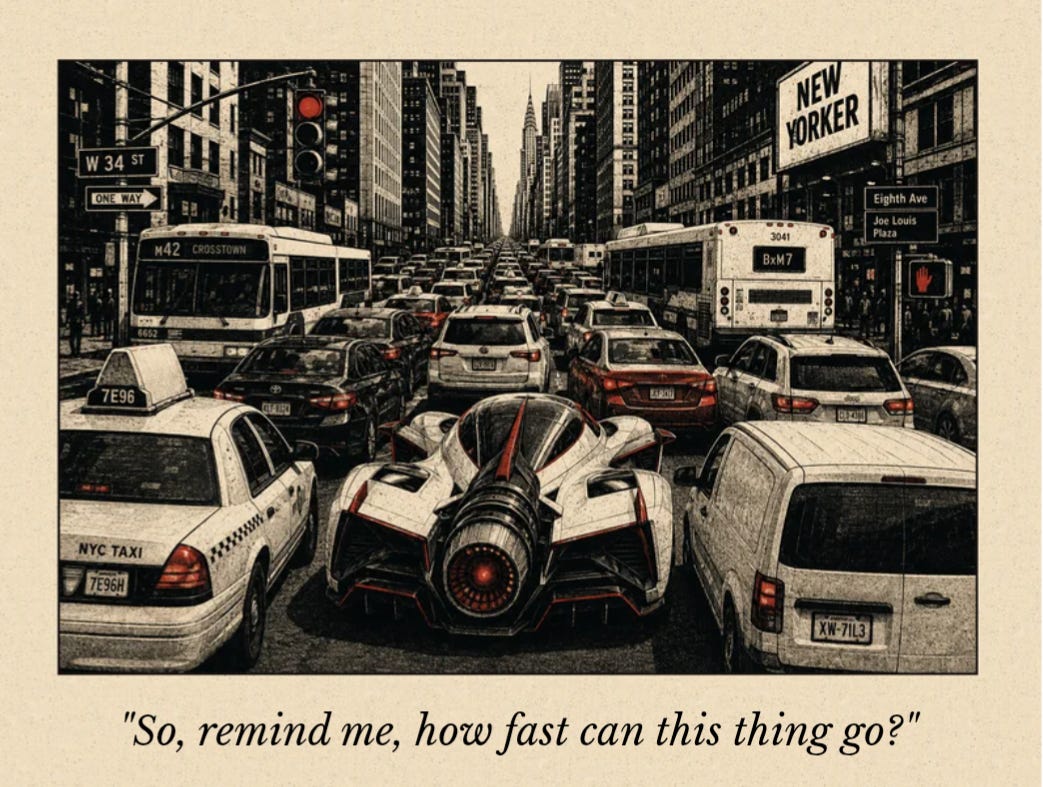
OpenAI just launched GPT-6 Astra. As far as I can tell from the official information and the early-tester testimonials, the model has only one big problem: it’s too good.
I’m not joking. If you take a look at the launch post, the conclusions you will draw are that 1) OpenAI has beaten Anthropic’s newly released Fable 5.1 across the benchmark suite, in some cases effectively saturating tests people were still looking to as meaningful frontiers, such as FrontierMath and ARC-AGI 3 (with version 4 not due until Q1 2027), and so 2) it dealt a serious blow to Anthropic’s IPO narrative, possibly scaring shareholders away. Also, 3) Greg Brockman, OpenAI president, hailed it as the entry point to a “new era of artificial general intelligence,” and, accordingly, 4) people had equally sophisticated reactions like “This is fucking insane,” “We are fucked,” and “What the fuck man.” Finally, 5) The launch post itself is the most liked ever for OpenAI, more than any post ever made by Anthropic, and, probably, the most liked pro-AI post ever made.
That’s why GPT-6 Astra is too good: what sort of miracle will it have to manifest in the real world to meet the expectations it set in paper.
To be fair, that’s the one big problem every single new model has, including even Google’s. They’re all pretty damn good. We might be getting hedonically adapted to the crazy demos showcasing what AI can do but no one denies they’re incredible. Not even Gary Marcus! People keep inventing new tests and that’s fine—that sort of coping mechanism is at least useful in contrast to whatever is it called what Ed Zitron does—but come on: what genuinely useful lab test is left to be created when unreleased models are solving century-old math conjectures and hacking away entire companies (and, apparently, also countries)?
AI capabilities have become so extreme on paper that the only benchmark left is reality.
I feel like we’re at a point where the models are so good that “how good is it?” is a category error. It is as if the quality of a chess engine was judged upon whether it can beat Magnus Carlsen. They all do. He has no chance even against some free chess app I might download on my five-year-old phone right now. Instead, questions like “Does this model help me learn?” or “Does it do my tasks cheaply?” or “Does it need botsitting?” are actually useful. For Astra, however, even those are nothing. It can teach you everything and more. It’s cheaper than the cheapest model. It can go on for days, persistently and without supervision.
And so I think we have to ask a more important question: what sort of impact can it have on the real world? That’s the only valid metric for “how good is it” that we have left. The real world doesn’t lie. It might be hard to measure, but it’s just there, waiting for someone to bend it to their will. AI is, in this sense, the final verdict on the great men theory of history. Can an outlier intellect defy the odds and define the future? Or is the world the aggregate effort of everyone who has ever lived?
Once the industry manages to answer that in the positive then I will bow down to AI.
To be clear, I’m impressed by what I’ve seen. GPT-6 Astra is a magnificent feat of human ingenuity and I have zero doubt about that. I’m not in any way dismissing its condition as a step change, in François Chollet’s words. If anything, this post is me respecting its power by not babbling about meaningless tests.
But is GPT-6 Astra worth all the hope deposited into it? Will it raise global GDP by 10% this year? Maybe by 5%? Will it make all our jobs obsolete, or, conversely, create an entire batch of new futuristic careers? Will it solve poverty, war, and disease? Will it make me disgustingly rich? Will it take humanity back to the Moon? Or, alternatively, bring the Moon down to us by means of some unfathomable quantum fishing rod that it will invent any day now? Or, hardest of all: Will it write a passable literary essay? Those are the benchmarks I look up to.
Are they overly exigent goals? Sure—for a human. For the magnificent GPT-6 Astra, they should be just another Tuesday.
Once you consider what I’m saying here, it’s pretty straightforward. It’s not rocket science; GPT-6 Astra would get it. But people tend to gloss over the concept of superintelligence in a way that’s unfit for a serious thinker. It’s easy to conflate one thing you can’t fathom with a much superior thing you can’t fathom. In that sense, the key fundamental feature that a superintelligence lacks that people nevertheless ascribe to it is omnipotence.
That’s why I find reality to be a great test, because it forces people to cut the bullshit. A superintelligence is still subordinated to the laws of physics, which include but are not limited to, human inertia. An omnipotent being—whether meat-made, machine, or godlike creature—could instantly transform the world into an unrecognizable paradise.
One can be wicked smart and still be a janitor. One can predict the future and end up in jail. Likewise, a superhuman AI can solve some conjectures here and there and make a cozy game no one will ever play and write a clever joke no one will ever laugh at, and still be a bot inside your screen. As Tyler Cowen says—he’s one of the few people who, despite being “AGI-pilled,” hasn’t allowed the psychosis to cloud his common sense—”the human bottlenecks are slow.” The world has enormous human inertia and a stubborn resistance to change. Even in the best case scenario—no financial bubble, no misalignment, no data center backlash, no moratoriums—it would take many years for dumb, slow humans to learn how to use superhuman AIs to redesign the world according to AI’s theoretical capability.
I compress this idea into this formulation: the world moves at the speed of meat.
Or, said in a way that’s less flattering: you, eternally inferior human, will always be the ultimate bottleneck. Even if you give an AI the context of your entire existence—your birth date, your genome data, your Myers-Briggs type, your IQ scores, your university titles, your bank account, your Slack messages, and your secret diary—your life will only change insofar as you, slow meatbag, are able to swallow the wisdom of the machine.
And you can’t, that’s the whole point. People used to debate the virtues of AI vs cyborgism (human enhancement), not realizing one without the other was always a vain pursuit. Everything starts and ends with you so, at some point, you have to enter the equation.
So, yeah, GPT-6 Astra is great. Go use it when OpenAI opens it up to the public. I will use it myself (I’m back on board with OpenAI vs Anthropic). You will be able to do all sorts of things with it. But you won’t change the world. No one will. Not any time soon, at least. AI’s historical magnitude—be it GPT-6 or its successors—won’t be measured by lines in a map but by crests and crevices in the landscape (excuse me this metaphor, but I’m spending some days in the Swiss Alps; you take the AI news differently here).
One week, two months, three years after using AI you will look out the window and the same people, the same green trees, the same 20-century infrastructure, the same blue sky and white clouds will wave you hello, content with living in a world that’s all but frantic.
Great take imo
You gave us the right metric to look at it last Saturday.
Is it still a toddler that crawls at 100 mph?