


Hey, Alberto here! 👋 , I publish long-form AI analysis covering culture, philosophy, and business. Paid subscribers get Monday how-to guides and Friday news commentary. If you’d like to become a paid subscriber, here’s a button for that:
Second deep-dive in a row! Today’s topic—how AI is impacting mathematics—deserves a long treatment, so I wrote 10,000 words on it.
I recommend taking it slowly and even dedicating several days. It took me around two weeks to write (too much has happened!), so I hope the effort was worth it.
P.S.: Read the footnotes if you have the time.

I.
If what’s happening to mathematics right now were happening to literature instead, I might stop writing altogether and then stop getting out of bed.
“What if the library of Babel was being constructed before our eyes and there was some mechanism for separating the masterpieces from the random strings of text, and all the masterpieces were dropping as fast as publishers could scoop them up?” asks Kirwin Hampshire in a haunting essay. And now I understand why I owe mathematicians some tenderness here because my answer to his question is: screw you for even picturing that nightmare.1
Thanks, but I don’t want my AI models to “churn masterpieces,” as if that were not an oxymoron. If some Anthropic staffer tweeted tomorrow, “hello there Fable’s reportage on Can Humans Think? took twenty-three point six seconds and has won the Pulitzer Prize in the feature writing category,” I’d be mad. If OpenAI’s newsroom published a blog post listing ten contenders to the “Great American novel” and subsequently ChatGPT won the Nobel Prize in Literature, I’d be sad.
Only then—mad, sad, depressed—would we writers understand how mathematicians feel right now. At least some of them. Others feel the exact opposite.
But why do they feel that way? And why the disparity?

II.
2026 was not too good a year for enthusiasts of number theory; neither a perfect square like 2025 nor a prime like 2027, it had to be happy as a semiprime (both “happy” and “semiprime” are actual categories). And even if mathematicians are not known for being superstitious, no one ever wants to deal with the rare unlucky year with three “Friday 13th”s. Still, 2026 has proven even worse than that: it is, if we are to believe the rumors, the year mathematics either dies or is reborn, and, because god has a sense of humor, trying to make a forecast feels like tossing a coin.
By the end of 2025, AI was better at math than students but worse than professors. It could get an IMO gold score here, solve a lesser-known Erdős open problem there, but nothing too hard. In January 2026, Daniel Litt, assistant professor of mathematics at the University of Toronto—and a close follower of AI’s progress on his trade—said in the EpochAI podcast that “with some work, one can probably elicit better performance from current-gen models, but overall, it’s about the level of a contest problem.” By May 2026, four months later, his take was already obsolete.
That’s when the first signs that something big was happening started to appear.
A mysterious internal OpenAI model made an unusually important breakthrough during the usual evaluation procedures. It disproved a long-standing conjecture on the unit-distance problem proposed by Paul Erdős in 1946, which can be stated as follows: “How often can the same distance occur among n points in the plane?” Easy to pose, hard to solve. OpenAI reported that the AI provided “an infinite family of examples that yield a polynomial improvement” over the existing best solution, meaning that the consensus belief among mathematicians was not true. I don’t want to go into the details, but it suffices to say that this finding marked “the first time that a prominent open problem, central to a subfield of mathematics, has been solved autonomously by AI.”2
Notable mathematicians called this “an outstanding achievement,” an “impressive piece of work,” proof that “AI [is] capable of having original ingenious ideas,” and a “milestone in AI mathematics.” Here’s something that Thomas Bloom, one of them, wrote in the companion remarks piece:
The frontiers of knowledge are very spiky, and no doubt the coming months and years will see similar successes in many other areas of mathematics . . . AI is helping us to more fully explore the cathedral of mathematics we have build over the centuries; what other unseen wonders are waiting in the wings?
After two months of slow digestion by the math community, Bloom’s prediction was fulfilled on July 10th. But surprisingly, this time it was not “some mysterious internal model” but OpenAI’s GPT-5.6 Sol Ultra model—a public model. After being prompted to “spend at least 8 hours on this before even thinking of returning or giving up,” GPT-5.6 Sol came back one hour later with a proof of the Cycle Double Cover Conjecture (50 years old).

For the entire month of July, this would be the pattern. A tweet would be published, and some decades-old conjecture would suddenly be solved. On July 20th, Anthropic’s Levent Alpöge tweeted:

And just like that, the 87-year-old Jacobian conjecture had been disproved. In a tweet. During the World Cup final. By Fable working alone. To quote Vik Korrapati (adapting Lenin’s famous line), “there are decades where nothing happens then there are tweets where decades happen.”3
Terence Tao, Fields medallist, sought out to digest the Jacobian conjecture disproof to make it feel less miraculous than it does at first glance (if it looks miraculous to him, imagine what it looks like to me). He said Fable’s counterexample was “highly unlikely” to have been “located by brute force.” In other words: there seems to be a non-zero amount of creativity involved in these findings. AI is genuinely entering superhuman territory in mathematics.
On July 23rd, Dmitry Rybin tweeted: “Dinitz-Garg-Goemans conjecture is false” (30 years old). On July 30th, Philip Marathon tweeted: “The Maxwell conjecture is false” (153 years old). On August 1st, to close what will be called the mensis mirabilis for AI applied to pure math research, OpenAI published this blog post: “Ten advances in mathematics and theoretical computer science”:
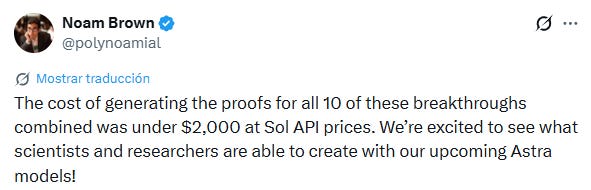
Today, we are sharing a selection of ten results, each of which resolves or makes substantial progress on a long-standing open problem. . . . The results were achieved by an internal version of Astra, our next major model. The total number of tokens needed to find solutions to these problems would cost roughly $2,000 at Sol API rates.
So mathematics has “fallen” to the machine (not really, more on that in a moment)—for the price of a single PhD student’s monthly stipend. Quite the bargain. Reactions to this barrage of news marking AI’s conquest of math have been binary.

III.
Here’s a near-perfect encapsulation of that dualistic sentiment (I say “near-perfect” because neither of them is a mathematician):


Much can be summarized by some weighted combination of “mad” and “sad” math guys, but there’s plenty of optimism, too: these results are “a big deal” and “the rate of progress is steep”—and to some, like Ola Svensson, they incarnate pure hope to see wonders they would’ve never imagined they’d see—but that doesn’t mean math will be “solved shortly” (unlike chess or Go) because math is not one-dimensional.4
Math is much more than disproving old conjectures.
Noam Brown, an OpenAI employee (obsessed, like many others, with the Riemann hypothesis), said this after the announcement: “We still haven’t solved math. Astra isn’t building new branches of mathematics, or posing interesting new conjectures,” and added that they “did try other major problems without success . . . (yet),” including Millennium problems, apparently.
But even after Astra-2 or Astra-3 solves the Riemann hypothesis next year, math will survive for humans if only because playing a role up the ladder of abstraction is always a possibility.
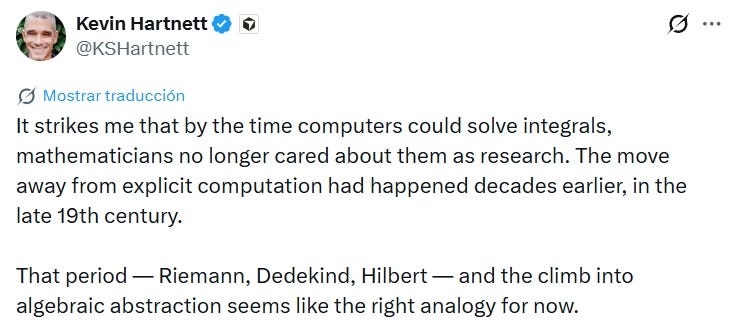
For instance, what’s the value of the Jacobian conjecture disproof if there’s no one left to make sense of it and translate the gibberish symbology (that’s what it looks like to me, in case you were wondering) into concrete value for the human world?
Skimming Tao’s exchange with GPT-5.6 made this starkly apparent to me, as a non-mathematician. He spent thousands of words working out Fable’s disproof to draw a key conclusion totally opaque to everyone else. Tao becomes, in this case, a necessary link between the secret knowledge AI unveils and broader humanity; AI may have found something interesting hidden in some abandoned corridor in the cathedral of mathematics, but it was Tao who turned on the lights for us to see.
AI can’t play that role because, by definition, AI is the other; someone from our side needs to turn on the lights every single time. Someone from our side needs to act as connective tissue. This is one sense in which these discoveries produce awe, joy, and hope in some mathematicians: they suddenly have access to greater knowledge without losing their purpose.
Let me elaborate on this point. It’s fundamental.
Metaphysically speaking, nothing exists entirely on its own but in relation to everything else. A complete set of instructions for building a hydrogen bomb could have been tucked among Julius Caesar’s campaign papers, and it would have made no difference to his conquest of Gaul. The knowledge would have been there, but no one would’ve had the means to connect it to the reality of 50BC Rome. The role of extracting value from a discovery is reserved to us, humans, for only if we can make sense of something can we say it “exists” in effect; only then can it become canonical.5
This applies to us citizens of modernity as well, not just those Roman peasants. If we found an alien device lying underground two miles deep under the Great Pyramid of Giza, we might be awestruck by its design and composition, but, unable to make sense of it, we may as well have found a boring rock to store away in a museum exhibition.
Here’s something we need to understand about the role that AI can play: the value of a thing—discovery or invention—is not a function of the creator’s intelligence but the receiver’s intelligence.
The value of these conjectures—and anything, really—is upper-bounded by our stupidity, as main characters of this world. Until now, this was not something to consider—except temporarily in extreme cases like general relativity, which is said to have been understood by less than ten people by the time Einstein made it up—because all inventors and discoverers were human.
Historically, we’ve been well-suited to transform novelty into value. But AI redefines this relationship and, in doing so, our role in it. As Tao asks in a talk he gave on July 26—right amid this maelstrom—”What if an AI tool generates a lengthy proof that nobody—not even the original humans prompting the AI—understands?” My answer is nothing happens.6
This is my main takeaway from all the math news (sorry to shatter the dreams of the Singularity bros): our human role doesn’t fade; it just bottlenecks progress elsewhere. No matter how much machinery we dress up in, the world ultimately moves at the speed of meat.

IV.
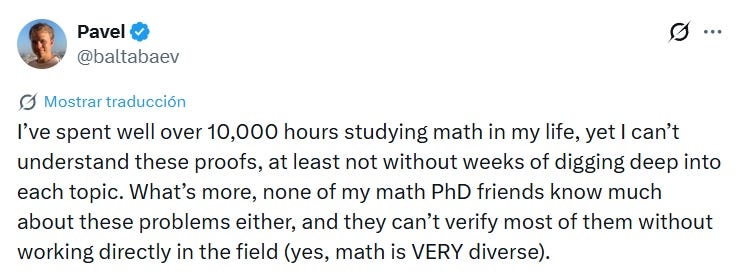
But this kind of philosophical coping doesn’t help the seven-year PhD student at University of Nowhere who has spent the last 18 months making zero progress on non-sofic groups, convinced that AI is “too dumb” to help him whatsoever, and is suddenly appalled to learn that OpenAI’s Astra proved that a non-sofic group exists, which would have been a finding to die for after a 40-year prestigious career. So what does our sad-and-mad student do now?
The first thing he will realize is that there are higher rungs to climb to. The second is that going up the ladder of abstraction sounds cool on paper but can’t allocate as many people as the lower rungs.7
How will our hypothetical student fare with a complete overhaul of the academic experience and the career prospects of a professional mathematician? One thing he can do is cry along with Kirwin Hampshire and many others (I will offer a more serious option in section VII.):
There is something about mathematical discovery (progress, advancement, creation) which is vital to the spiritual, experiential quality of doing mathematics. The creation (or even the pursuit) of novel mathematics is one way that humans have historically accessed the ineffable and encountered the divine and mystical.
Contrary to many comments I’ve seen—calling mathematicians obstinate or hidebound for not being able to withstand the natural evolution of things—you will find no mockery in this article.
Hampshire’s is not necessarily representative of how these events have affected people, and his take, although raw and pure, may not even be the most ethical (maybe breakneck progress should always be put before personal satisfaction because, e.g., medicine always benefits from advances), but I find it honest—so much so that it inspired the introduction to this article and a shift in my perspective (kill math if you have to, but for God’s sake, don’t touch literature).
The truth is that Hampshire and our fictional PhD student are not alone; mourners are legion.


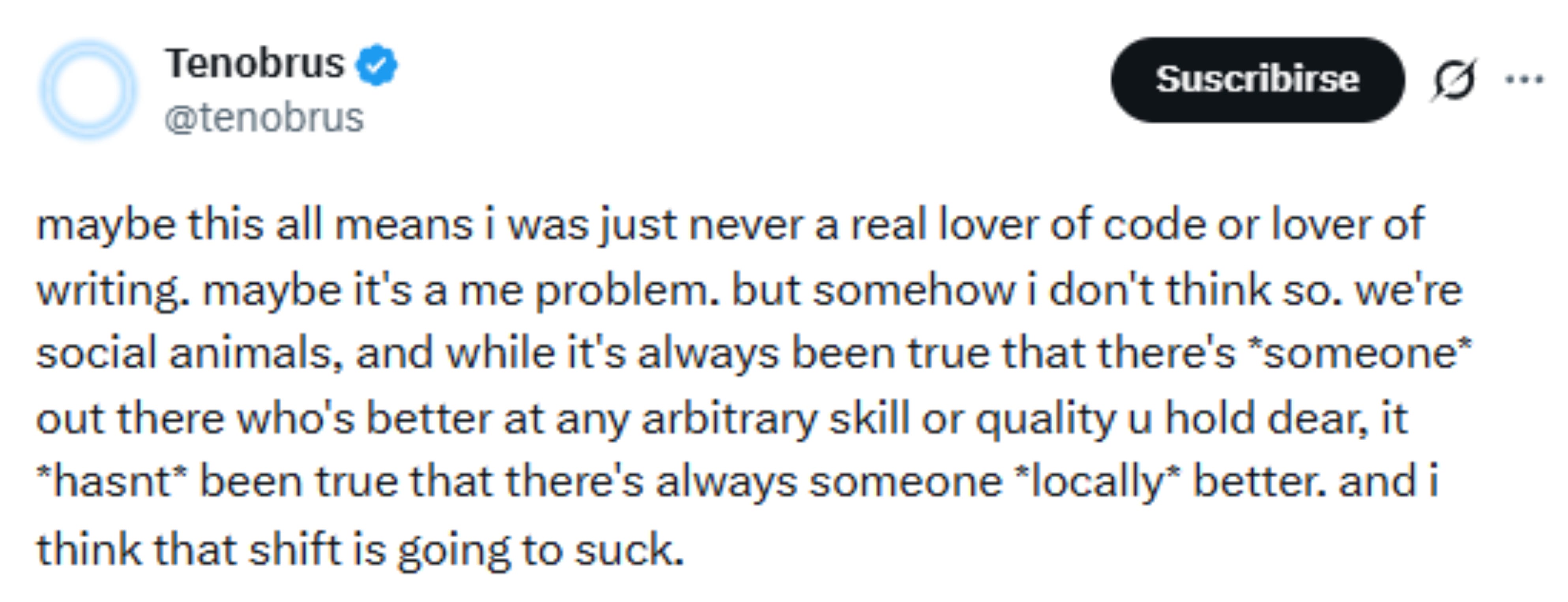
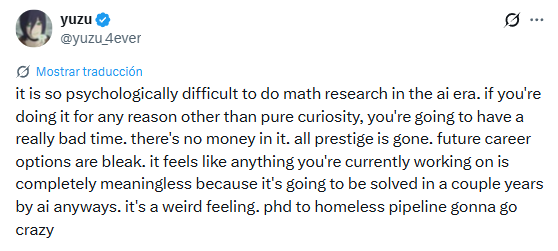

I could go on and on.
There’s a sense in which this is deeply tragic, and you’re wrong to shrug it off.
Why is it so easy to understand—even if not agree with—that artists and writers want “AI to do laundry and dishes so they can do their art and writing” but mathematics is not held to the same standard? Art is clearly not about maximizing the expected beauty in the world or the number of mediocre paintings, but why is math taken to be a pursuit of truth at all costs (not to mention that a good chunk of math research has little or no connection whatsoever with the real world, so “truth” in the math sense is not always useful)? Is it more painful for me to see AI “churn masterpieces” than for Hampshire to see AI churn conjecture disproofs? No one is in a position to make that judgment.
To the extent that writing is a conversation with life, mathematics is a conversation with the universe. And no one would say—not even the AI bros—that the purpose of a conversation is for it to end.
To those who say that the trade-off is definitely worth it—what is the selfish satisfaction of a bunch of number nerds compared to the ascent of humanity on the shoulders of giant machines—I say that it doesn’t negate the validity of the grief. It shouldn’t be mocked, much less resented. It seems to me that those who yearn for the Singularity, who live in perpetual pursuit of an infinitely far-away destination—respectable—seem to envy those who have found a love so deep for something that they’re willing to stop the world to keep it.
Anyway, here’s a joke to lighten the mood:
First they came for chess, and I said nothing because I’m not a good chess player. Then they came for developers, and I said nothing because developers are such nerds. Then they came for mathematicians, and I said nothing because I hated math in school. And now that they’ve come for writers, I can only say that “I’m an AI assistant, what can I help you with today?”
I said joke, but I lied. It’s a fair warning: you’ll be next.
Be considerate at this time. Losing the one thing that gives your life meaning and purpose is painful, and it’s easy to feel safe until it’s your turn. So judge how one is “stupid” or “naive” or “in denial” for seeking meaning on X or Y in this millenarian age at your own peril—don’t think for a moment that you’re strong enough to withstand such a loss yourself without suffering.
Blogger Noah Smith, who was quite measured in his reaction post, argued that “mathematicians, and anyone else whose sense of accomplishment came from being the indispensable solvers of hard theoretical problems, will have to learn to get their sense of self-worth and accomplishment from other sources.” He’s made this same point about the “end of heroism” several times before, like in Toward a Shallower Future, one of my favorites from him. There, he writes:
Romanticists . . . need to accept that heroism is always inherently self-destroying—that saving the world requires that the world is worth having been saved. . . . The modern world of push-button marvels has lost something, but it has gained more than it has lost. By celebrating it, we honor the countless millennia of heroes who worked in some small way to bring it about, even as we dedicate ourselves to continuing their great enterprise. Our legacy is to fill the Universe with children who laugh more than we were allowed to.
Such a beautiful picture. But wrong all the same. Because once you consider his argument—his world—in the limit at the end of time, the picture you get is abysmal.
Just like heroism is self-destroying—it needs a dying world to save—the “modern world of push-button marvels,” which accurately describes what happens when you prompt ChatGPT with “do a breakthrough” and it does, is self-perpetuating.
We will end up with a world filled with marvel-generating buttons (or paperclips). And once all the marvels are generated, then what? Then what are we here for anymore?
To laugh? But why do children laugh? What are the ingredients for laughter?
Smith doesn’t want to separate two intertwined facts: the world has evolved on suffering, and that’s terrible, yes, but it only did because it had a reason to. Remove the struggle, remove the purpose. He can’t just advise you to go find your “sense of self-worth and accomplishment” somewhere else, because by his own premise, there won’t be a “somewhere else” to be found.
The only reason why his advice is sound today, psychologically speaking—who wants more struggle, right?—is that there are still struggles ahead; we are not at the end of the line. But if we continue this path, eventually someone will. My life consists of sitting on this computer and writing words. I think I’m well past “too little” struggle for some definitions of the word.8 And yet Smith argues that we should deal with what’s left as fast as we can. At the push of a button. Done—another one. Let’s get this over with. Let’s get over with this life, for I’m late to my date with death.
That’s why, as I celebrate these amazing accomplishments, I don’t feel like laughing.
That said, I think this is a time for reflection rather than emotional reactivity or off-the-cuff prediction-making. Progress has been quick, and it’s still too soon to draw definitive conclusions or give advice. If humans still surpass AI at one cognitive skill, that is introspection rather than clairvoyance.
The question that should be bothering you the most right now—and the one I will answer next—is this: why math?

V.
Why was it pure mathematical research the first serious discipline to fall before AI? Games (board and computer types), perception (like telling dogs from cats), and simple tasks that happen inside a computer are all a piece of cake for current models, but so far AI was, at most, grad-level for serious scientific work. (That’s not to dismiss the value of that kind of capability nor to deny the possibility of going higher than that, just a statement of fact.)
AI was at a “human level” on math, but disproving the unit-distance and Jacobian conjecture and proving that non-sofic groups exist is strictly superhuman—only the best-at-math humans could even give a serious attempt at those problems, and all who tried failed anyway.
Perhaps the best way to explain “why math?” is to take a look at this xkcd comic:
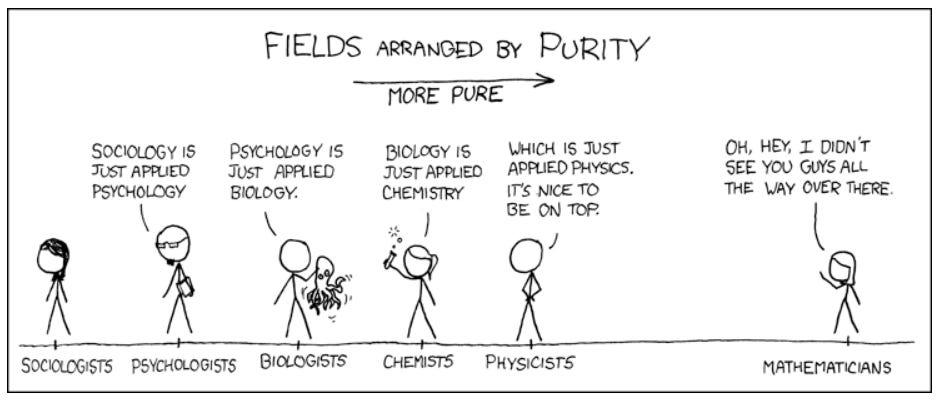
Math is the purest. That’s good. And bad.
I always found it quite weird how it’s typical of academic people to mock those in “less pure” areas than they are. As if, in some sense, the greater the disconnection from people’s daily lives—and from immediate utility in the general sense—is a good thing. Maybe they think purity is a measure of how close one is to the cosmos. Or God. (Maybe it is.) Not for nothing did the great Carl Friedrich Gauss—perhaps the greatest of all mathematicians, though this kind of ranking usually isn’t to their taste, something I can’t quite explain—say that “Mathematics is the queen of the sciences.”
As an engineer myself (you can laugh at my impurity, I’m not even pictured above), but one with the utmost respect for all those fields, I remember that the first time I saw this comic strip I felt an amount of contempt for those stick figures inversely proportional to their pretentiousness. I thought that, if karma were real, something very bad would eventually happen to math, like maybe someone found it was an incomplete system or something (in light of the current events and others that precede them, I apologize for those intrusive thoughts).
But notably, not all mathematicians are pretentious (often it’s those who have no reputation to back it up), nor are all the people in the other fields non-pretentious (again, I studied aerospace engineering; I know how obnoxious they can be). For example, here’s one of the best of all time, John von Neumann, with the typical humility only genius provides:

What AI has proven, along with all those conjectures, is that mathematicians, despite being the purest—or rather, because of it—are the most vulnerable to the machine.
This can mean one of two things: either AI is the divine incarnate or math was never that big of a deal (although this is a reasonable takeaway from von Neumann’s quote, I think his intended meaning is that life’s a bitch). What else would a semi-professional writer with a “soft skill” complex say, right? But I’m dead serious: how come a language model trained on language and with which we communicate through a linguistic interface writes terrible essays and yet, rather simple prompts elicit an intelligence capable of incredible mathematical feats?
I don’t think the answer is that math is easy, but rather that math is easy for AI.

Math is, among the major areas of knowledge, the most verifiable, which means it’s pretty straightforward to guide the AI models to correct answers and then reward them for those answers to condition their behavior. Math, as hard as it might be for you, is thoroughly digestible to AI.
I will shamelessly quote myself here:
The first thing you learn about AI is that a man who can explain exactly how he does what he does is in danger. The machine needs only a description. It is the man who cannot quite say how he does what he does—the poet, the priest, the philosopher, the prophet, the parent, the painter, the plumber—that the machine finds indigestible.
It is in this sense that mathematicians have spent their professional lives carefully documenting their own demise. And, for the past two years—and a handsome bonus—they have done it directly on the payroll of OpenAI and Anthropic.
A mathematician’s thoughts as it works through a problem are among the most valuable data an AI can learn from. This means exactly what you suspect: if Astra has discovered that a non-sofic group exists, it is because a human expert first taught it how to “think in the language of math.” AI may already have surpassed them, yes, but without flesh-and-blood math experts, it’d have never achieved these feats. You may see this decision—to willingly participate in training AI at math—as a betrayal to their kin. But remember: not every mathematician regards it as a loss, or as an ending. Some chose math for its beauty; others for its power to uncover truths. Both are valid purposes.
You’re probably wondering now: what’s next? Or rather, why doesn’t this apply to essays or art or screwing in a screw or cooking a Spanish stew—which seem much easier than math to us?
The answer—at least for now—is that those things are not perfectly explainable. There’s an incredible amount of implicit knowledge—the kind that can’t be written down or spoken out—about how to screw in a screw. You can read 100 manuals, but it’s not until you feel the forces in your hand that your brain figures out what “screw in a screw” actually means. If I try to explain why I love this sentence by Marcel Proust—w*e can sometimes find a person again, but we cannot abolish time—*I might turn to its succinctness or the beauty of the themes (time, love, loss) or the precise sting of the words, but it’s really hard to be objective about “why it’s good”—much less so if the creature listening to me has not lived a life.9
Math was made to be perfectly explainable; centuries of cumulative work to build a perfectly self-contained formal system. This effort ultimately failed but produced the best “artificial” language to explain the universe; or rather, to speak with it. Don’t make the terrible mistake of thinking that AI can’t do whatever you do because it’s dumb or because your work is special or because you’re protected by the stars. The only reason AI can’t is that it doesn’t have the right data yet.
Now, in the year of the Lord 2026—neither a prime nor a perfect square—two companies took all of that math data and, with some clever sleight of hand that I won’t go into here, trained a general-purpose algorithm to master the skill. In four years, AI models have gone from being unable to make themselves understood to solving century-old math that you can’t understand.
And now we wait. As the most fervent advocates love to say—and I agree with them on this point—this is the worst AI will ever be. The Riemann hypothesis lies on the horizon, like a final boss.

VI.
And yet—no new math, no new conjectures, no new interesting ideas, no novel premises.
Solving the Riemann hypothesis would be a breakthrough of such a magnitude that it would dwarf everything we’ve seen so far. And yet, solving the Riemann hypothesis doesn’t make one Riemann, for he had to come up with it in the first place. Why is AI better at the former than the latter? Why does it have such strong deductive and inductive skills and yet it lacks in abduction? Why does it tend to find counterexamples rather than proofs?10 Why is it so good now at scouring the abandoned corridors of the cathedral of mathematics, as Bloom calls it, and yet it would have no clue whatsoever about how to build a new wing?
To be clear, I wouldn’t either.
I can’t write a symphony or turn a canvas into a beautiful masterpiece. But some humans can do all of that. Some humans have had a disproportionate influence on building the world around us. They have built cathedral after cathedral after cathedral. What is AI missing?
A DeepMind researcher argued in a Jan 2026 position paper that “LLMs can’t jump,” meaning that they can’t go from followers to trailblazers: “[W]hile a modern Large Language Model could plausibly execute the deductive phase of proving theorems from established premises, it is structurally incapable of the abductive ‘Jump’ required to formulate those premises. We identify the translation of simulation into formal axioms as the critical bottleneck in artificial scientific invention.”
He argues that “physically consistent, multimodal world models offer the necessary sensory grounding to bridge this divide,” which bridges this missing ingredient to the divide I see between how OpenAI and Anthropic approach AI vs Google DeepMind, a topic to which I dedicated a long deep-dive recently. I’m not going to enter again into world-model conceptual territory (read the next footnote for that), but suffice it to say that I find this position paper quite persuasive. (Others call it “goalpost-moving,” so feel free to take the position you consider more reasonable.)11
Coincidentally, it was Google DeepMind’s CEO Demis Hassabis who preemptively reframed the significance of proving and disproving conjectures. In the Big Technology podcast, he said that “Today’s systems are nowhere near [AGI]. Doesn’t matter how many Erdős problems you solve.” I think it’s fair to interpret this as meaning that, in general, solving math problems doesn’t require the same kind of intelligence as posing them in the first place. (One wonders whether he’d say the same thing if it was the Riemann hypothesis that some AI model had solved. We may find out soon-ish.)12
All in all, AI has been solving hard math problems because 1) math is verifiable, and thus it’s not that hard, and 2) problem-solving doesn’t require abductive jumps or world modeling or the ability to come up with new theories, and thus it’s also not that hard.13
So, what’s the big deal again?

VII.
I think the obvious value—besides dunking on goalpost-movers and other denialists of AI’s capabilities—is implicit in the expression “the cathedral of mathematics.”
The word cathedral is in part intended as beautiful and sublime and magnificent but also as big. Mathematics, for those of us who didn’t go past differential calculus, is gigantic. You can spend your entire life going down a single corridor, earn a Fields Medal—one of the highest recognitions in the discipline—and still never find the endpoint nor visit any other corridors in any meaningful way. The cathedral of math is, quite appropriately, as vast as the universe.
There’s immense value—hard to overstate, really—in having at your disposal a tool that can search and dust off secrets in the abandoned corridors of this cathedral. Places no one has stayed for more than a few seconds (in Wikipedia) since the nineteenth century; places that open up doors to dozens of new places; places no one has ever visited.
AI is well-suited for mathematics and even better suited for skimming the vast corpus of human knowledge and finding relics. Think about it. AI knows everything that’s been recorded online (and not so online): From the Big Bang to the eukaryotic cell; how the Great Pyramid of Giza was allegedly built or what are the elements required to make the iPhone in my hand; why international relations are important or how to derive general relativity; the crux in Kant’s critique of pure reason; the value of Cubism and the virtues of capitalism; how the double helix model revealed we’re each unique and how the Heliocentric theory revealed that we are not—it knows about all of that and many more things I can’t possibly know.
The world is a museum of passion projects, and AI has gone to see the human exhibit a million times already. How many connections can it make? How many sentences can it read that have not been read in a hundred years? Human mathematicians could go there, sure. But in a world governed by financial interests and time constraints and reputational risks, the bet is clear: you never go.

If nothing else, the current capabilities of AI models allow us to ponder this: how many more answers we’d have if all it took were asking the question?
One specific insight I’ve gathered from reading the impressions of mathematicians is that, although some of these conjectures are somewhat famous, others are less well-known.
It surprised me to see Tim Gowers, Fields medallist, say that “[the Jacobian conjecture] is for me the first example of an LLM solving a problem not in my area that was nevertheless big enough that I had very definitely heard of it.” My surprise comes because, one, I’d naively expect a master mathematician to know every conjecture that OpenAI and Anthropic find worth reporting on (but math is big!), and two, he doesn’t even seem particularly affected by the Jacobian conjecture itself in the sense that “yeah, I’m somewhat familiar with it” doesn’t strike me as an expression of closenes—or, for what it’s worth, grief.


How many math problems have been forgotten or never tried in the first place because they are hard, long, boring, unknown, unpromising, unfunded, or even career suicide? My bet is many. AI has all the right traits—doesn’t complain, doesn’t tire, doesn’t eat or sleep—to go search those abandoned corridors and explore them farther than humans could justify. Math, unconcerned by the frictions and logistical nuisances of the real world, is the perfect subject to AI’s newfound skills.
And because you, too, have access to AI tools, it means that you—congratulations!—have the makings of a mathematician. That’s another value not to be dismissed.
I know you have understood nothing about the AI’s disproofs I’ve recounted above, but that’s secondary. You can just take AI’s reported capability at face value and become an AI-enhanced mathematician. The AI does the math, and you stamp your name on it.
Or, conversely, you can take that lesson and extrapolate it to areas into which you’re interested. If AI can make these discoveries in math, it’s in part because it’s well-suited for it, but also in part because it just can do this sort of thing. AI is, like a well-trained bloodhound, yearning to go run through the abandoned corridors of whatever edifice you happen to be in. Math is special because it makes clear that AI is trained to do that. Realizing you can apply AI in your work—assuming that, unlike a mathematician or a stew-maker, you have a normal office job—could be the most personal and practical value you extract from this piece.
Another insight I’ve gathered is that AI is weird.
It’s well-suited to pursue unusual routes, ignore standard premises (like assuming the Erdős unit-distance conjecture was likely right and thus devote most time to prove it rather than disprove it), or draw impossible connections between subfields (like using algebraic number theory to disprove the unit-distance conjecture). AI is treating math like it once treated chess and Go, as a virgin arena, untainted by human biases and conventions. Its “alien” intelligence allows it to see beyond.
As writer Kai William says in his review of OpenAI’s unit-distance conjecture disproof, “OpenAI’s solution . . . had two properties that played to the strengths of AI models relative to humans.”
First, he says, Astra brought algebraic number theory all the way over to the unit-distance problem. Math is big, as we’ve seen, and it’d be unusual for a single human to be able to cover an arbitrarily large amount of territory to do these kinds of impossible connections. That’s a task for AI; no matter how immense the cathedral is, AI’s recall and pattern-matching ability are near perfect compared to ours. And second, “the reasoning process was such a grind,” which means that no human in his right mind would have ever gone as far as it was needed to derive the disproof. Williams mentions that Tsimerman had thought of approaching the conjecture as AI did, but that such an approach is, from a human lens, time-consuming and often unfruitful.
I’m reminded, reading Williams’s recount of the story, of how Go masters described the famous “move 37” that AlphaGo played against Go top player Lee Sedol in their 2016 match. They called it a “mistake,” “strange,” “beautiful,” “not a human move.” 2,500 years of humans playing Go, and a machine suddenly invents an inhuman move, one that led to the end of humanity’s rule over the game. Like in chess, no human has beaten the top AI Go player ever again.14
Was this “inhuman move” by Astra in math research a comparable feat? I’m not sure I’d call out “move 37” for math yet. Although mathematics has been around for even longer than Go, there are many things that humans can do in math that AI struggles with. But the date is getting closer—
—especially if all it takes is $2,000.

VIII.
I cited the $2,000 figure from OpenAI’s announcement, but it deserves a second thought: AI is changing the cost structure of intellectual persistence because where a math expert cannot reasonably spend six months trying 400 ugly approaches to a problem that ultimately won’t matter, AI can—on top of retaining the failed routes, cross-referencing remote literature, and returning with either a construction or a better account of the obstruction—do it cheaply. It makes previously irrational research bets—most of them, if you ask a financier—economically rational.
So what will professional mathematicians do now?
Some will just call out anything that AI can do as “not mathematics anymore” and keep going, unfazed. Others will use AI to learn about the branches of mathematics they’re not experts in, becoming a sort of superhuman cyborg. Others will grab the low-hanging fruit, taking advantage of their mathematical knowledge and understanding to prove more and more conjectures.15
But what about the rest, those who don’t welcome AI so enthusiastically?
One possibility is struggle.
When Kirwin Hampshire said, counterfactually, that literary masterpieces would be “dropping as fast as publishers could scoop them up,” he didn’t consider a worse possibility: publishers wouldn’t be able to scoop them up fast enough. There would be masterpieces piling on the floor, waiting for us to review them, incapable of keeping up with AI’s churning rate. What if the AIs scouring the abandoned corridors of the cathedral start to reveal secrets faster than we can digest them?
This has been previously stated as “proof indigestion.”
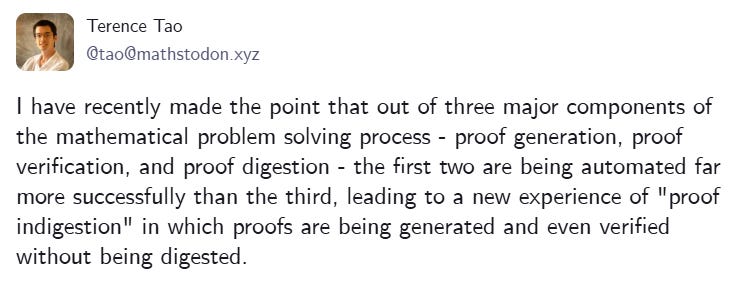
Consider the implications of à la carte low-cost proof generation. It’s great that one guy can provide a counterexample to an 80-year-old conjecture for as much as 20 bucks; it’s the beginning of a new world we will need to adapt to, but besides our hypothetical PhD math student, it’s hard to see how it could be worse than the alternative (i.e., expensive math). However, such an overhaul of the status quo reveals ups and downs when you inspect the second-order consequences.
Just as correct proofs and disproofs being cheap is a priori good, incorrect ones being cheap is a tragedy. As Terence Tao said in a talk in 2024 on this topic, “normally, when a technology . . . produces something bad, you can tell it’s bad . . . but these [AI] weights are chosen specifically so that the answers resemble correct answers as much as possible, so even when they’re wrong, they look very very convincing.” In a more recent talk—a week before the Astra announcement—he said that “we are entering . . . a crisis in the foundations of mathematical values and practices.” He cited Fields medallist William Thurston’s words on how proofs are not mathematics’ main goal:16
We are not trying to meet some abstract production quota of definitions, theorems and proofs. The measure of our success is whether what we do enables people to understand and think more clearly and effectively about math.
And I add this other quote from Thurston in the same vein:
The product of mathematics is clarity and understanding. Not theorems, by themselves . . . . There is no way to run out of ideas in need of clarification. The question of who is the first person to ever set foot on some square meter of land is really secondary.
Tao closes by saying that “we will transition from an era of proof scarcity to an era of proof abundance,” without solving for all the other required steps to have a complete digestion of a mathematical finding. This is the perfect recipe for AI-manufactured struggle.
This tweet below by a machine learning professor summarizes the idea:

Not only will the poetry of mathematics be lost to AI, as Hampshire writes in his essay, but also the logistical ability to filter brilliance from bullshit or value from excess. As the rate of false positives increases, the toll of human work will shift from discovery to verification, to exposition to digestion; mathematics will face a problem it’s profoundly unprepared for.
Before modern AI, mathematical research being hard and “expensive” (at least in human hours and human cognitive power) was a natural filter for the number of proofs to be verified (and even then, the incentives of academia were pushing this filter to the limit). When one AI-generated proof is submitted, you need to pay close attention; when thousands do, you need a revolution.17
This would be less troubling if Hilbert’s Entscheidungsproblem had turned out to be solvable.
In 1928, David Hilbert asked whether there could be an algorithm that, given a mathematical statement, would determine whether it was valid (”yes”) or not valid (”no”). Turing and Church proved it didn’t exist, shattering Hilbert’s dream, in 1936. AI models nevertheless look like a strange, partial return of that dream. You give it a prompt, it gives you a proof.
What neither Hilbert nor Turing could have imagined was that the machine wouldn’t be built but grown, like flowers in a garden. AI’s unreliability is so consequential in mathematical research because the same system that can extend the frontier by proving non-sofic groups exist can also manufacture errors with enough fluency to survive serious inspection. The implications of the machine that we ultimately created run as much in the bad direction as they do in the good one.
All in all, we have that 1) AI will produce too many potential proofs and disproofs for professionals to handle, 2) the scientific conditions around these findings are at best imperfect and at worst missing, 3) proofs themselves are not all that important to the purpose of math without understanding, and 4) AI will make a lot of mistakes that look like “plausible but ultimately wrong solutions.”
The combined impact of both these avalanches will saturate whatever bulwarks are still standing on the human side of mathematical research. How can the mathematics community digest the situation? Hardly so.
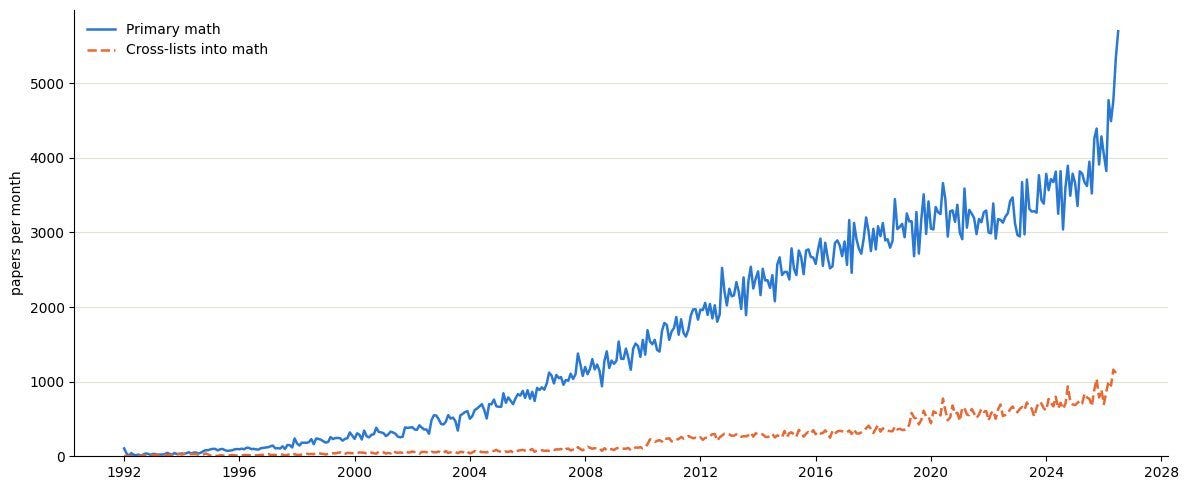
That’s why a group of mathematicians from Leiden University, on behalf of the global community and with extensive feedback from it as well as an endorsement from the International Mathematical Union, Terence Tao, and many other distinguished mathematicians, published a Declaration on Artificial Intelligence and Mathematics. One of their points is precisely that also understanding, and not just a body of results, is what mathematics is about:
Mathematics produces not only a body of results, but also understanding, clarity, and judgment among the communities of mathematicians who have shaped them, often in the context of their own autonomously guided research. This expert knowledge is essential, both to effectively use mathematics, and to continue to articulate new and significant research questions. A key source of strength of the discipline has long been the autonomous shaping of the direction of research and the methods used to pursue it.
That said, they can always pivot their career to cracking math jokes online that only math people get.


IX.
Another possibility is to move on.
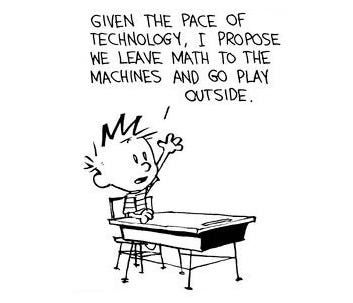
While moving up the ladder of abstraction to play the role of “connective tissue” is not available to everyone but a handful of math geniuses, moving on is available to all.
It’s a terrible thing to be pushed out of your dream life, but rather than remain in denial, angry, or depressed, it’s better to just find something else. Like a job at OpenAI or Anthropic. I’m kidding—partially. How many mathematicians do you think have worked to make these milestones possible? A damn lot. So you can be one of them. Or you can go play outside for a while and leave behind a “moribund academia.” And then find a job in a non-verifiable field, if possible, like sociology.

Tsimerman says we should prepare for math not to be “viable as a professional endeavour” anymore:
I think problem-solving is an immense, and pervasive part of modern mathematical research. Consequently, if human problem-solving disappears by virtue of the AIs becoming strictly and substantially better at it, then most of the time currently spent by modern mathematical researchers will have to be spent on an activity that is altogether pretty different. Whether such an activity is viable as a professional endeavour is something I am unsure of, but strongly encourage others to think about and try to envision, so that if/when the time comes, we can steer such a future into being.
I hope this doesn’t happen, but math might be hollowed out due to both the shrinking career prospects and the perceived status loss.
Appearances matter as much as truth does to young people risking their careers on an imperfect-information bet. What aura is left for a field that’s been meme’d on with “hey there the Jacobian conjecture is false”? Non-mathematicians are calling out “the end of math” and “the most significant single day in the history of mathematics” at the same time. Being squarely opposite in meaning, these assertions reveal an equal amount of contempt and ignorance: they care so little about math that this looks to them both like the first and the last day of the field (death or rebirth). But it doesn’t matter if they’re wrong and math is fine: to be willing to choose math, a young student has to witness it from the outside before experiencing it from the inside; I wouldn’t bargain with my future like that from what I’m seeing right now. Math is not software development.18
Kids that would’ve otherwise been future brilliant mathematicians may as well just move on. If AI will nevertheless get all the credit in the eyes of the world, why bother?

Do you think that AI taking the credit is an outlandish possibility? Here’s what the Leiden Declaration has to say about that:
Technologies that draw extensively on the published mathematical commons undermine the traditional system of attribution. Models trained on published works frequently return outputs that do not properly cite the human works they synthesize. Many current models are also built on data obtained by systematically exploiting licenses and access arrangements that were not made with artificial intelligence in mind, or indeed by simply violating copyright protections
If a model finds a half-worked proof that was discarded, who deserves attribution for the correct result? AI can explore as many abandoned corridors as it wants, but those corridors were once explored by humans. A human would know how to credit, but AI’s sourcing is often sloppy. OpenAI actually responded to this point by the Leiden Declaration on the Astra blog post:
We believe attribution should honestly reflect how a result was produced: claiming human authorship for a proof generated entirely by an AI system would misrepresent both the system’s contribution and the nature of genuine human intellectual work. We helped prepare the manuscripts and formalize the proofs in Lean, and we take responsibility for their correctness, while the mathematical arguments themselves were generated by our system.
I will note explicitly the irony here: it’s inspiration when AI is trained on the entire corpus of human knowledge but misrepresentation if a human claims authorship for a proof generated with the help of an AI tool. Even if we take this seriously, then whose attribution is it? The AI? The company? Will OpenAI train its tools to ensure proper attribution and sourcing of the literature? Will they make sure to clarify how much of a generated proof is extended or resurfaced from existing work? I don’t think they are in a position to make such a petition.
As I was finishing this piece, I found an interesting paper published on August 4th. Group theory mathematician Francesco Fournier-Facio qualifies OpenAI’s discovery of a non-sofic group, citing previous work, saying that it invalidates “the claim in the OpenAI announcement on 1 August that there has been ‘no progress on the main result for at least a decade.’” OpenAI eventually redacted the claim, but it took one day for someone to find a clear case of bad sourcing and misattribution.19

I understand why some mathematicians are extremely happy.
I also understand why some mathematicians are mad and sad.

X.
I find it impossible to accept any reduction of this news to either “this is hell on Earth” or “so good, the Singularity is here.” There’s so much nuance to be disentangled and debated and understood that those comments respond more to the speaker’s emotional reaction than to any sober reflection. (This piece took 10,000 words and I left out so much I’m not doing justice to the story.)
I end with this.
We may be closing the distance between ourselves and the future, but the oldest advice still holds. Technology might alter the face of the world beyond recognition, but it cannot spare us our human condition. OpenAI, in an attempt at removing the difficulty of being human, called its model Astra, but I put us back where we belong: Per aspera, ad astra. Through hardship, to the stars.
Not everyone thinks a “library of Babel for mathematics” is a bad thing. Sometimes you value more the output, sometimes you value more the process. My take is that you’d ideally want both to experience the magic and to understand it.
Here’s a good primer on the problem and the solution.
Apparently, a GPT model by OpenAI (likely the mysterious internal model that solved the unit-distance problem) had disproved it the same day, using the same counterexample. Weird, right?
In chess, having a sufficiently high ELO means no one can beat you anymore, as is the case for engines; they are so good that human players teaming up with the AIs are unequivocally a hindrance. As I wrote elsewhere: “In the span of little more than 20 years, computers went from ‘brute-force methods may solve chess’ to ‘[it’s] impossible for humans to compete,’ to ‘impossible for humans to help.’”
There’s a rather dystopian future in which my assertion is false, and there’s no hope left whatsoever, namely one in which we’ve handed over everything to AI; a future in which AI is architect, sense-maker, direction-setter, enjoyer, etc., and we’re just pets or some other form of unwitting witness to a world unfolding for us but without us. I’m not quite looking forward to that. (Don’t blame me, I voted for DeepMind.)
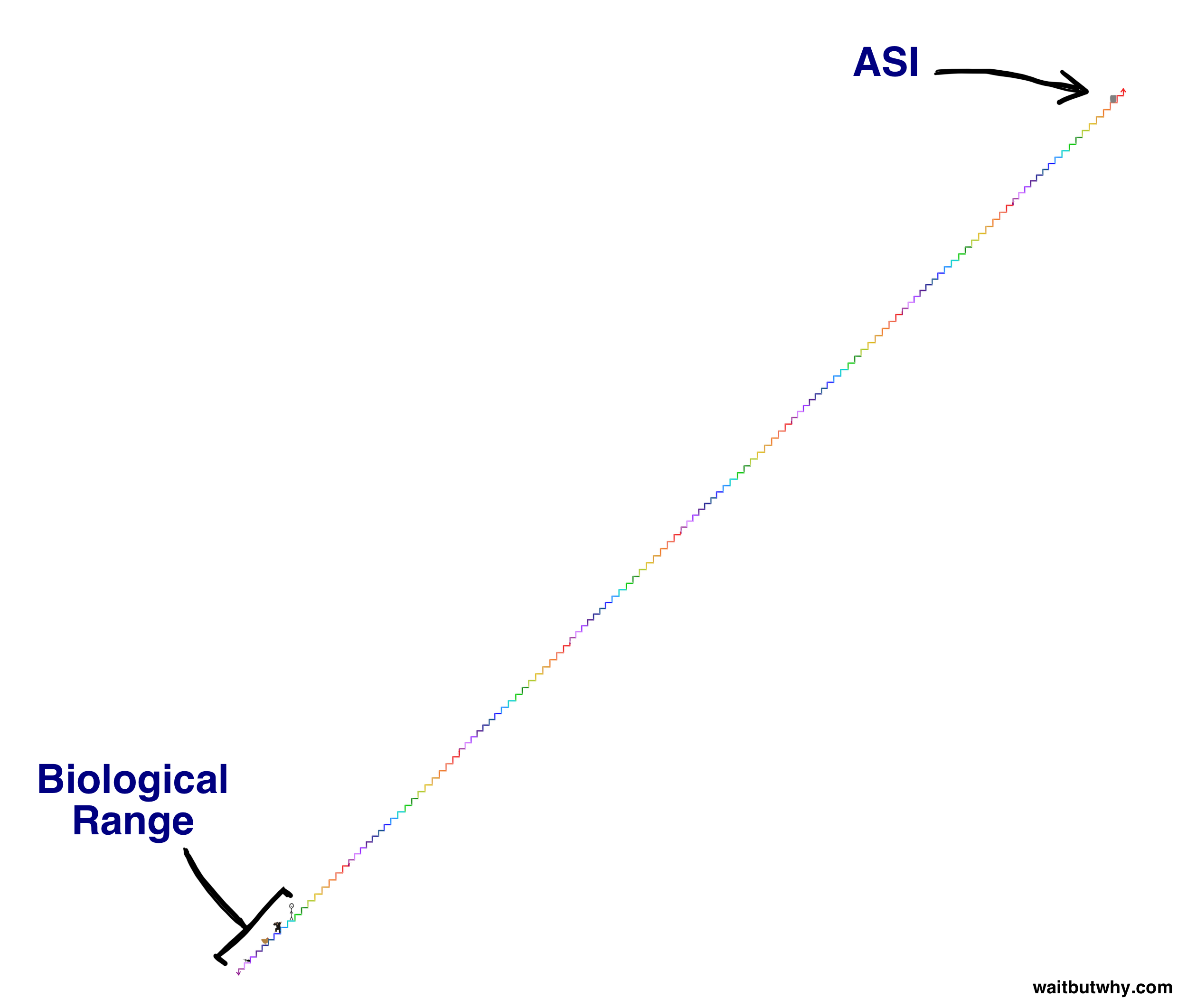
I interpret Tao’s “understands” as referring to the often gibberish output of AI models. I don’t think he’d say he can’t understand one such proof due to its length or complexity. So this note is to clarify that I’m pushing his meaning of “understands” further in my assertion: what if, even once the proof is well-written, almost no one can grasp the math? I imagine that me saying this about Tao sounds preposterous, but consider that Wait But Why chart where the distance between a chimp and a smart human is nothing compared to a superintelligence. At some point, if AI keeps getting better and better, it will go deeper and further than any human can follow—invent new math, new concepts, whatever—even Tao. That is a narrow version of a superintelligence (a mathmaster, if you will). And I contend that that sort of superhuman research wouldn’t have ~any effect in the world because it needs humans playing the role of connective tissue to bridge the gap between knowledge and reality. A proof needs to be generated, then verified, then presented, and finally, understood and applied.

E.g., only 3.4% of Spain’s population works in agriculture compared to ~65% in 1900, and agriculture is arguably more important now than it was back then. This repeats across sectors of the economy. The hope is that AI creates more jobs and whatnot, but in math particularly, there are not that many that normal, human minds can do (he can go work at a journal deciding whether to accept AI-generated submissions).
This will be contentious, but I genuinely think we should aim to peak as a civilization right at the end of civilization. You either die a hero or live long enough to see yourself become… what? You guessed it: A push-button world.
Not everyone agrees that non-verifiability is safe harbor. I do, but I wouldn’t be surprised to be wrong. Recursive self-improvement is like exponentials; you always fall short in your predictions.
The explanation of why a disproof is “less impressive” or “less worrisome” than a proof is best explained by Tim Gowers’s reaction to the unit-distance conjecture disproof: “I spent the evening adjusting my world view: if the AI could come up with a proof like that, then maybe it would be all over for mathematicians very soon.” And then he learned it had been disproved instead and wrote that it “came as a big relief.” In general, it’s assumed that finding a counterexample that disproves a conjecture is much easier than proving that there are no counterexamples. (I think this is intuitively true for non-mathematicians as well.)
A good definition of world model is: “the internal latent representation humans and animals’ brains encode of how reality works.” Google DeepMind is working on this, but also high-profile startups like AMI Labs and World Labs.
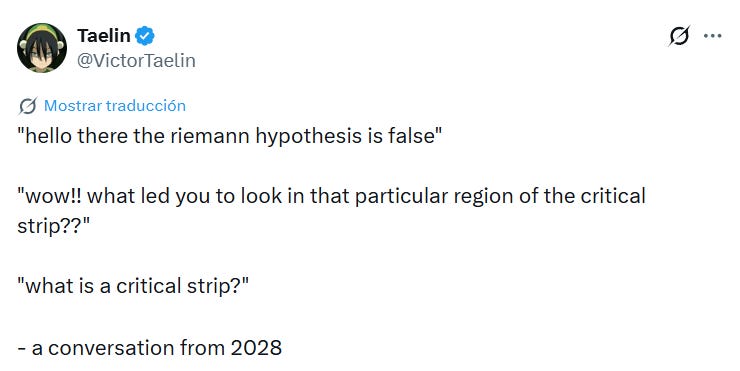
This is the perfect spot to add an important data point: Google DeepMind is also working in AI applied to math. They had a model win the IMO gold last year, just like OpenAI. There’s also Aletheia, an entire research project dedicated to advancing math with AI (they found the solutions to some Erdős open problems as well), but the company-level approaches of DeepMind vs OpenAI/Anthropic are so different as to not even be comparable. Here’s my high-level analysis. DeepMind wants to respect the existing institutions; it moves and acts like one. It wants to move forward without toppling anything in its way; slow, careful, considerate. Anthropic and OpenAI are like a meteor shower: “hello there the Jacobian conjecture is false” is a tweet of the times, because it just doesn’t care about anything except advancing the state of science, like a revolution; They have the power to disrupt the status quo, and so they do. I’m not judging which is better. Anthropic and OpenAI have the power to effectively say: “hello there adapt to us or perish in vain resistance by trying to anchor this unique time to your comfortable seats.” In practice, they’re ahead of DeepMind precisely because of this rather reckless attitude (what if not “reckless” is a fitting adjective for the Singularity, right?). But in the long term, the world they’re enacting is best characterized as an overhaul of the current one rather than as a robust, stable place to replace it with. “Catch us if you can” will be the motto of this era. A human body steps into the event horizon of a black hole, one foot stretching thin like an infinite spaghetti, the other waiting, still, in space. This human body is humanity: Anthropic and OpenAI have stepped in; the rest of us are here waiting for whiplash.
Not everyone agrees with the idea that “AI may solve problems, but it can’t build theories,” or that one is harder than the other for a sufficiently smart AI. Kai Williams reports on a conversation with Fields medallist Jacob Tsimerman (now at OpenAI) where he states that this kind of statement is nothing more than goalpost-moving applied to math. This is the belief that the trajectory of AI rules over whatever qualm you may have; what seems like obstacles today are not such, just like what seemed like obstacles one year, two years, three years ago were not such.
The first comment in Hampshire’s essay says this: “It happened to chess. Did it kill the game?” Using chess as a comparison point to visualize what could happen to math is reasonable but ultimately unfair. Chess—as well as other games AI has mastered like Go, poker, StarCraft, etc.—has an intrinsic value in being a sport. Humans extract value from it in the form of pleasure and satisfaction just exercising their skill and knowledge against another human (or watching humans compete against each other). It doesn’t matter how good an AI is or how far it advances the theory of the game because chess’s enjoyment is not really linked to discovering new openings or stronger late-game heuristics. Math, in contrast, is—if it can be at all likened to a game—one against the universe itself. One where knowledge (whether in the form of solutions or theories), which is a one-way road, is the goal. Once knowledge is unveiled, there’s no pleasure left in it being unveiled again; you need more knowledge to be unveiled to keep enjoying the game of math. If I were to compare math to a game, I would have to choose one from the “metroidbrainia” class, like Outer Wilds. In those games, the pleasure and satisfaction come from understanding, exploration, and knowledge. The filters to advance in the game are knowledge-based (vs skill-based). Once you have all the knowledge, there’s no game left. No competition or further discovery. What’s the point of playing a game like this a second time? Mathematics—more so even than the hard sciences—is just like Outer Wilds. As AI plays it for us, better than us, it threatens to spoil us the ending.
If you think far enough into the future, there’s not much you can do, though.
Not everyone in the field agrees. Tsimerman says that “my math career has almost entirely been ‘solve this problem’ . . . for 80%+ of my time, I know what problem I’m trying to solve and am just trying to solve it.” Then you have Michael Atiyah, also a Fields medallist, say this: “I have practically never started off with any idea of what I’m going to be doing or where it’s going to go. . . . I have never started off with a particular goal, except the goal of understanding mathematics.” And then you have Paul Erdős, who just liked making problems and solving them. Neither Tao or Thurston’s account nor Atiyah’s insights invalidates Erdős’s preferences or Tsimerman’s experience; nor the other way around. They say there are two cultures in mathematics—the theory builders and the problem solvers—but even if mathematicians can be kind of sorted in one or another, I don’t think anyone perfectly aligns with either. Still, the “two cultures” framework is useful because many disagreements over what AI means for the field can be traced back to this divide.
I’ve put forward this argument before about the tragedy of cheating-at-scale on universities: “Cheating is as old as studying, though, and so we seem to be dealing with a matter of degree, not kind. Society is, after all, well prepared to deal with the occasional cheater. It has natural filters to protect itself against that: the professor himself, the inherent hardship of cheating without being caught, etc. But when a new technology overwhelms those natural filters in a society unready to create new ones overnight, all the requirements for cheating—time, risk, effort, subtlety, a sort of bravery—go out the window. It’s easy to see how, when you can simply open ChatGPT, paste the entire problem, and get a perfect solution in seconds, what appeared to be a matter of degree becomes a matter of kind: One student cheats and you issue an admonition but if the entire class does, then you need a revolution.”
With this I mean that 1) math is harder and 2) it pays worse.
Noam Brown, who works at OpenAI, made a comment that I interpret to be against the statements made by his employer: “In any intro class to a field, there are trivial results named after people who happened to be in the field early and grabbed the low-hanging fruit.” So go get your prize and stamp your name on it.
This is the best piece i have read on substack. As you said, some people like the progress, some not so much. A lot of people need purpose in their lives, and if we just allow AI to take over all the tasks in our society, whether its research or driving the busses, we are going to have a lot of people that are miserable. We have not solved much if people are not happy living their lives.
This is a good summary of the current state of math! I just finished a slightly different roundup (trying to talk to mathematicians directly) so this has been top of mind for me. (I hope you don't mind the link: https://www.understandingai.org/p/mathematicians-are-grappling-with)
One thing that surprised me when I talked with a bunch of mathematicians is that some of them believe that AI will eat the rest of the ladder of abstraction fairly quickly. Humans can jump up a level, but only so many times. AI may end up being better at digestion as well as problem solving and verification. This may seem unlikely today, but I think it's a possibility worth considering seriously. Especially as AI systems grow more autonomous.