


Hey there, I’m Alberto! 👋 Each week, I publish long-form AI analysis covering culture, philosophy, and business for The Algorithmic Bridge. Paid subscribers also get Monday news commentary and Friday how-to guides. I publish occasional extra articles. If you’d like to become a paid subscriber, here’s a button for that:
Today, I bring you a practical guide about why the gap between AI power users and everyone else is so vast, why the standard playbook for closing it fails, and what actually works, whether you're a company trying to drive adoption or an employee trying to figure out what you're missing.

I. LET’S TALK ABOUT THE 99%
OpenAI published a super important chart that should embarrass everyone in the AI industry, most of all OpenAI itself (although, in another sense, they should also feel proud of it). The chart (shown below) reveals that power users of ChatGPT—above the 95th percentile in terms of usage—use 7 times more “thinking capabilities” (where true productivity lies) than the typical (median) paid user.
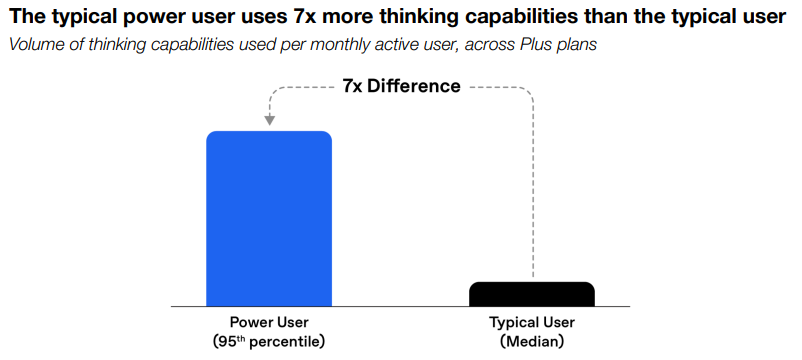
There are two possible lectures here. One, the majority of people remain, three and a half years later, unconvinced of the immense value of AI tools. We can see this as a failure of the world to recognize the signs of the future—not everyone can read the shapes on the tea leaves or the cracks in oracle bones—but there’s another lecture: this huge discrepancy is a consequence of broken expectations. That is, only the experience of the power users matches the over-hype everyone witnessed, which is why I say this chart should embarrass the AI industry.
But before attributing responsibility and analyzing the implications of this bipolar reality, let me reiterate the chart’s implications: power users use AI’s most powerful features 7x the median-paying user! (When someone mentions the median, what always comes to mind is a dumbfounded: “Half are below that?”) Let’s break this down further. ChatGPT had around 800 million weekly active users in June 2025; it’s around the 900 million mark right now (up or down a few million due to the exodus to Claude), and I bet that by mid-2026, it will be over 1 billion users (yes, despite QuitGPT).
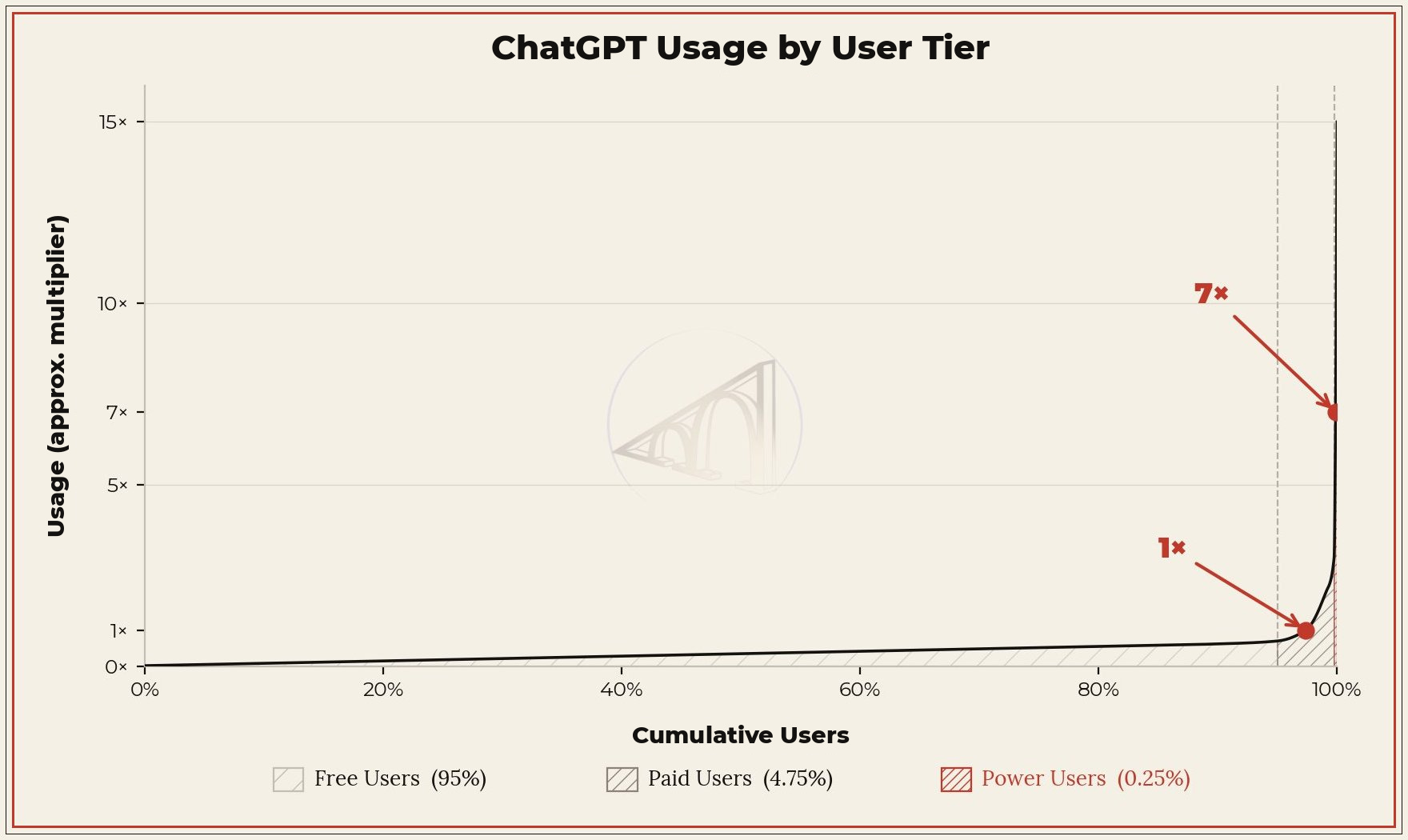
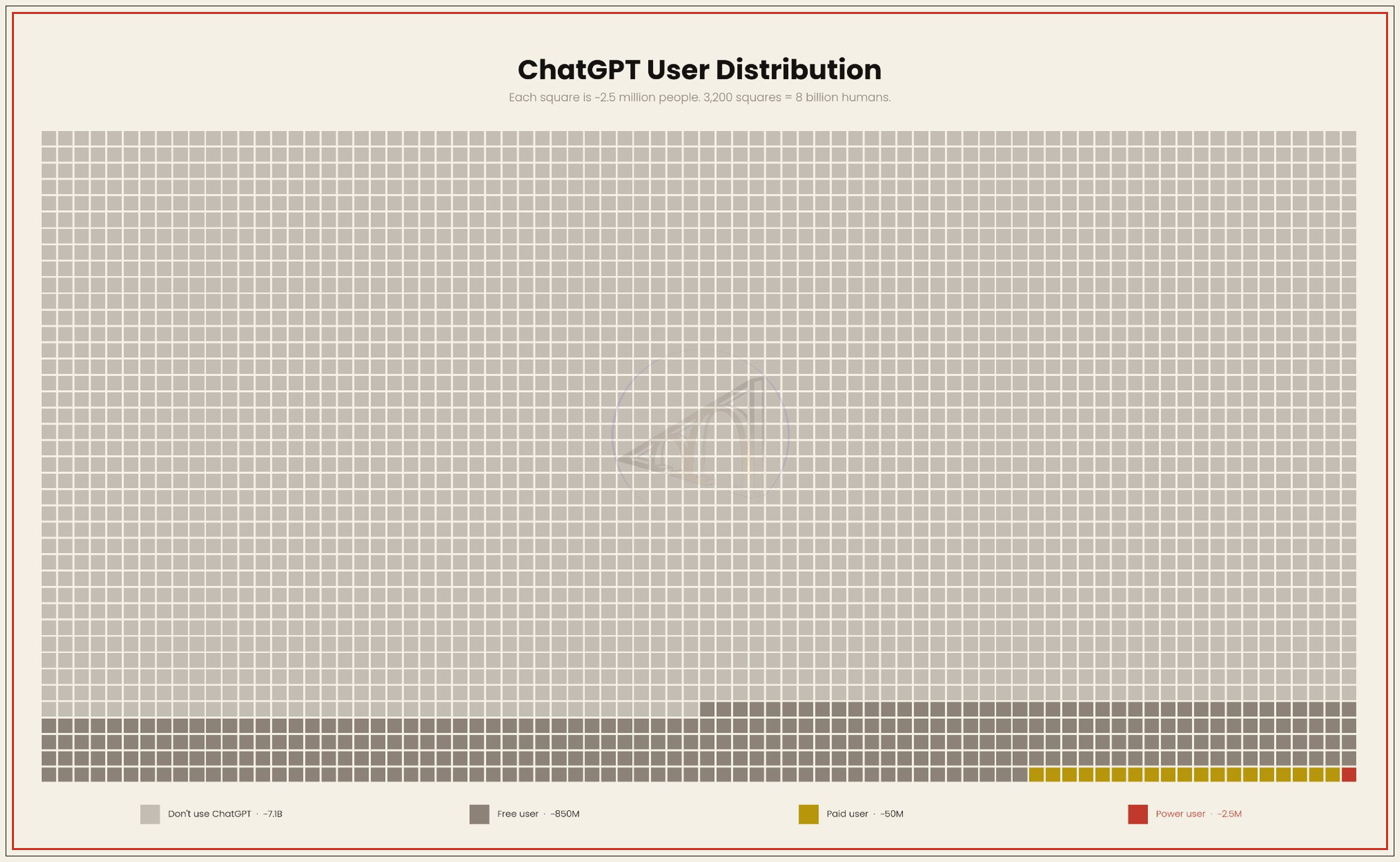
50 million people are paying (slightly above 5% of total users). But then again, the 5% who use it most (power users) among those 50 million are getting 7x more use than the median, which means that the 5% of the 5%—”only” 2.5 million people!—are, right now, getting superhuman performance out of AI agents, whereas the rest are, at best, using ChatGPT as a friend or as an Excel replacement and, at worst, stuck at psychosis, 9.11>9.9, and water-wasting. To put it the other way around: 99.75% of people who are already ChatGPT users use it so little compared to those who are getting real value out of it that their usage numbers are virtually negligible.
I don’t know what this means for OpenAI’s financials (although the decision to run ads presumably answers that question), but I know what it means for the world: the AI-rich and the AI-poor have become a reality sooner than I thought, and the chasm is way more severe. This is what that looks like: 1) a curve measuring usage as a function of the user ranking and 2) a grid representing the entire world population, the entire ChatGPT userbase, and the power users.
II. AN UNEVENLY DISTRIBUTED FUTURE
Around this date last year, I wrote an article I’m quite proud of, which I titled *AGI Is Already Here—It’s Just Not Evenly Distributed.* The basic idea is that there’s a huge gap separating casual users from power users that stretches all the way from innovation to diffusion, to adoption, and finally to competence and mastery. Last year, it was a hypothesis; today it’s empirical data. I made the chart below to represent how prompt quality influences model performance. (Although the other two measure usage numbers, quantity and quality are interrelated in people at the top.)
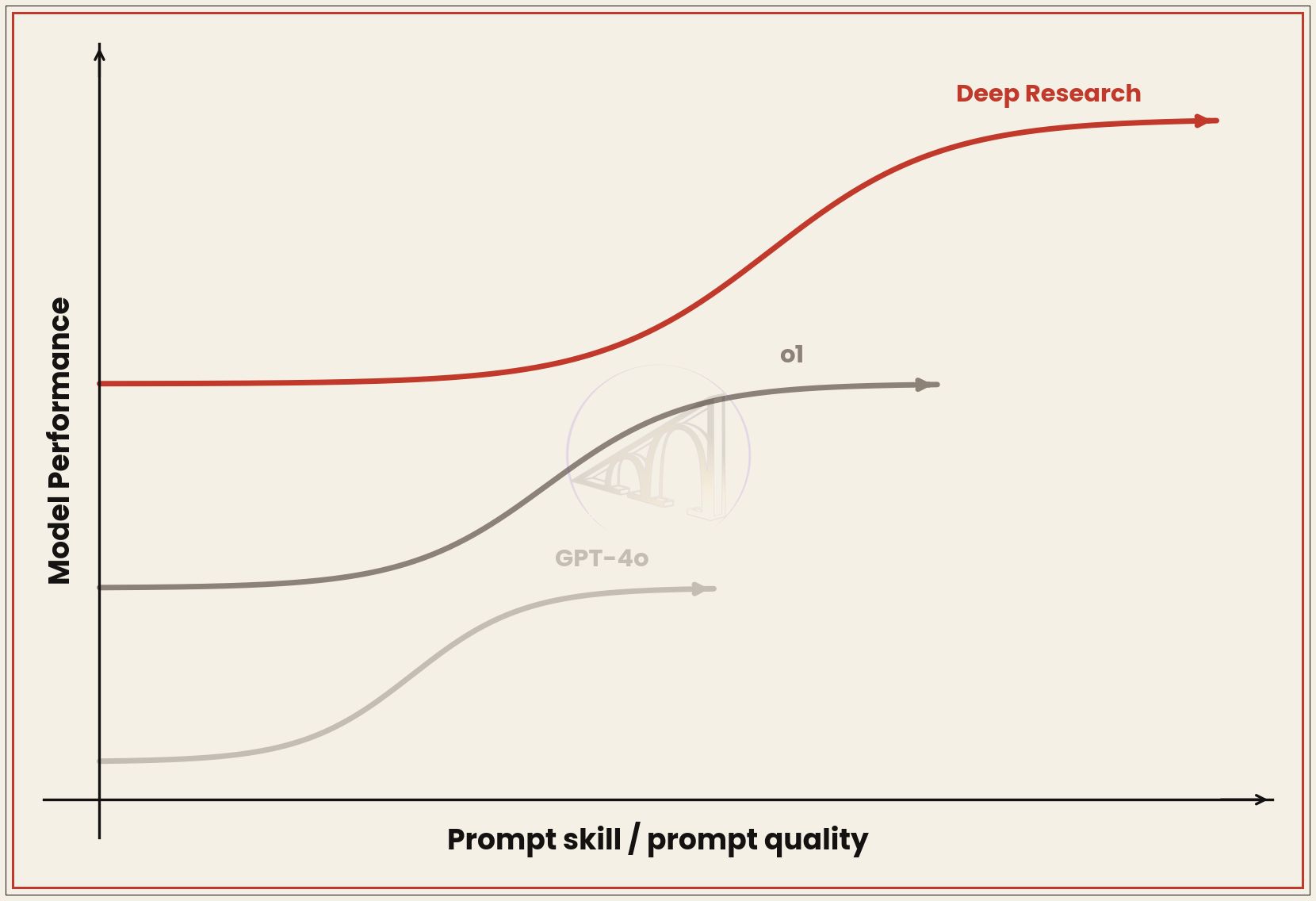
This chart means: skill differences make AI tools feel unevenly distributed. The two above mean: practice differences make AI tools feel unevenly distributed. Basically, the people at the very top keep accumulating and compounding fundamental traits (skill and practice, and add to those curiosity, agency, taste and even second-order ideas like “how to avoid cognitive surrender” or “when to stop using AI”) that multiply one another into an inexorable outcome: they’re at the better end of an unevenly distributed future.
Taken together, these charts tell two stories. First, they tell a story about AI lagging behind the hype—900 million people are not stupid; if only the 5% of the 5% are using your product to its maximum value, the problem is you—but this story requires nuance. For instance, I use AI daily (now Claude, before Gemini, before ChatGPT). I have always been a paid user (likely close to being a power user), and it saves me roughly 30-50% of my working time between editing, research, translation, etc. To me, the capabilities are real. (You can believe it or not, I have nothing to sell.)
The other story is about distribution. At Davos in January, Anthropic CEO Dario Amodei described his biggest concern: a “zeroth-world country” of ten million power users centralized in Silicon Valley with 50% GDP growth, decoupled from the global economy. That’s Dario’s “country of geniuses in a datacenter,” except it is available only for another country of (human) geniuses outside of it. AI usage is unevenly distributed among users but also across geographies, creating “decoupled” centers of extreme growth. There’s immense value concentrated in a bunch of users who live close to each other either physically (Bay Area, Mumbai, perhaps London) or virtually.
Meanwhile, you get anecdotal evidence that suggests most big companies—Fortune 500, no less—use no AI tools whatsoever in a way that improves productivity rather than public relations. Kevin Roose from the New York Times corroborates the story, saying that he has “never seen such a yawning inside/outside gap.” I guess AI is a little bit like sex in this sense: by reading the news, one would have the impression that everyone is going at it non-stop and you’re the only fool missing out on it, but then you go out and ask people, and they will say: “I just don’t know how to plug it in!”
That’s a joke, but that’s genuinely the main reason why there are so few power users: most users don’t know how to plug AI into their existing workflows.
This is a hurdle for the AI industry. Microsoft CEO, Satya Nadella, warned, also at Davos, that either people start using AI meaningfully or the bubble will pop (which, ok, why not). But he said that “if only tech groups were benefiting from the rise of AI, rather than companies in other sectors,” then we would for sure get the bubble scenario people keep talking about. That’s also a problem for the companies trying to adopt AI to enhance productivity but failing to do so, which goes well beyond the AI industry at this point.
While Dario’s speech was directed to governments (they should ensure the gains from AI are shared; I agree), I speak directly to you: if you’re one such company—if you’ve tried to get your employees to adopt AI and it hasn’t worked, if you want them to become legendary power users—this thorough guide is for you. If you’re one such employee—if you don’t know how to make AI work for you and you want to belong to the top 0.25% rather than the 99.75%—this guide is for you, too. I will explain why you are stuck and how to change that. Believe me when I say that you don’t want to inhabit the wrong end of an unevenly distributed future.
III. WHY THE STANDARD PLAYBOOK FAILS
So what do companies do when they realize they’re on the wrong side of this divide? Exactly what you’d expect them to do.
