


Hey, Alberto here! 👋 Each week, I publish long-form AI analysis covering culture, philosophy, and business for The Algorithmic Bridge. Paid subscribers also get Monday how-to guides and Friday news commentary. I publish occasional extra articles. If you’d like to become a paid subscriber, here’s a button for that:
Prepare to be mindblown with this guide.

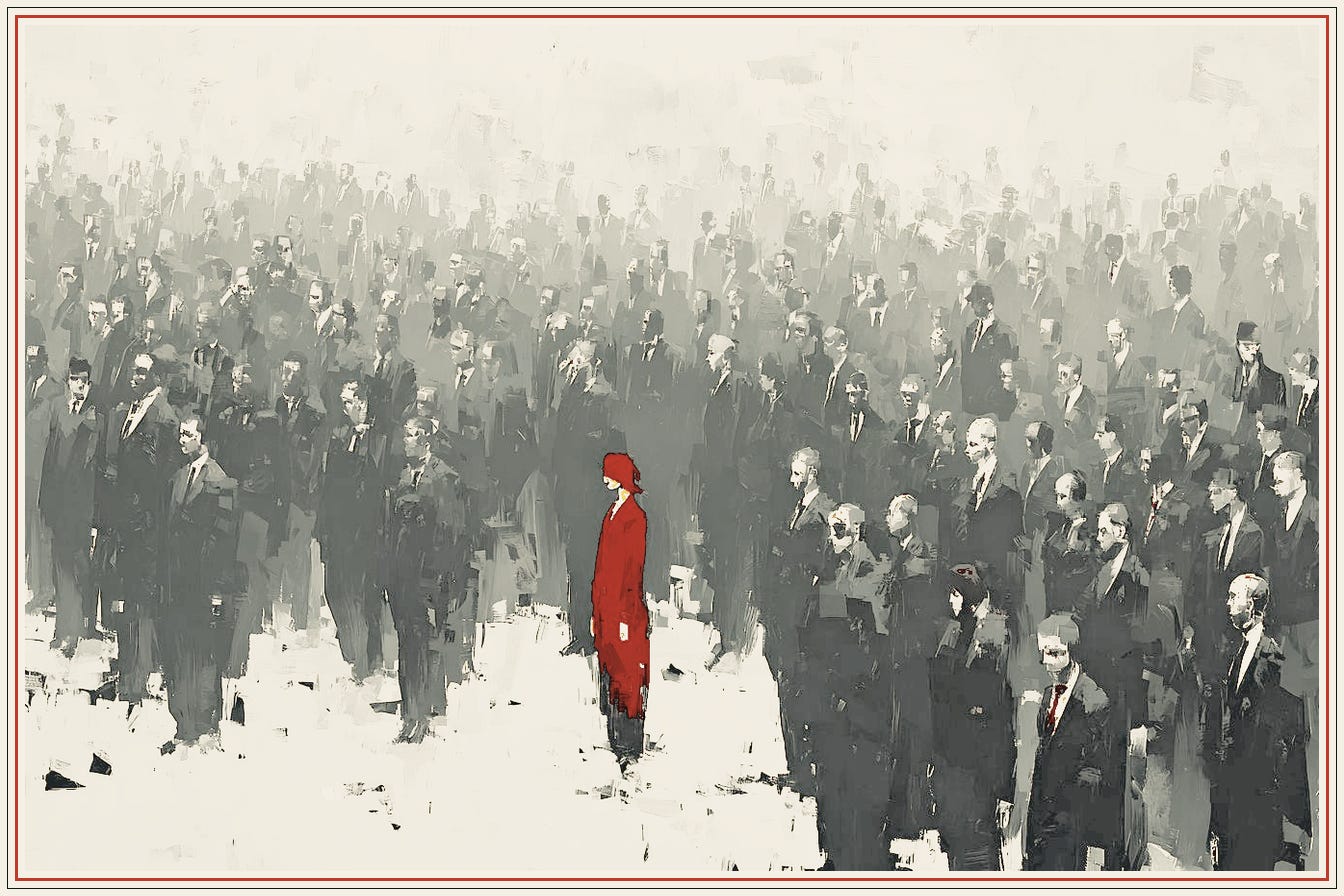
By this point, you have swarms of AI agents running everything around you. At the very least, you have several tabs open with Claude or ChatGPT. You feel ahead of the world, juggling so many projects at once and working so many extra hours. Your friends don’t understand how you are doing this much and yet are as excited as you’ve ever been. Your peers and competitors can’t catch up to your silicon army as they struggle to figure out how they’re going to remain employed.
You are, essentially, in the process of making yourself king...
...of a dead internet.

Everyone who has spent enough time online knows the value of a brand and differentiation. Companies devote insane amounts of effort and money to marketing themselves to the world. But the importance of a brand goes far beyond cars and phones. I don’t care much about Tesla or Apple, and yet I do care a great deal for every unique person out there.
You, as a person living in society, will survive—whether you’re an entrepreneur, a writer, a job-seeker, or a lover—to the extent that your customers, readers, employers, and partners can see that you exist. In the sense I’m using the word, the image of yourself they have in their minds is your brand.
It’s sad, although understandable, that marketing has such a bad connotation and perception, and yet we are always playing that game when we show ourselves to the world and to others. We are living masquerades, code-switching in and out of situations constantly, depending on context. For instance, my brand in the context of this blog is the guy who thinks about AI from a human lens.
Some people manage to impose their authenticity and idiosyncrasy, pure and raw, into the world—for them, the self-image and the other-image converge—but those are rare specimens. Even those who claim to do the opposite are still playing the mask dance: they are the “I don’t care about marketing” guys, which is itself a brand.
Take one of the best-known examples in recent times: Steve Jobs. He wore identical black turtlenecks on every stage for twenty years. Apple’s brand, the most valuable corporate brand on earth at the time, rode on the back of a personal one. Or take a less-discussed example of a similarly famous figure: Ernest Hemingway. The novels were the novels, but alongside them he built, on purpose, the image of the man who wrote in Paris cafés, boxed, fished, drank, went to wars and bullfights. His life and his style were the same product, engineered together.
So, “brand” is a universal aspect of the human condition. I must say that I’d love to use a different word, like identity or character, but brand captures better what I want to tell you. To the extent that you have some amount of free will regarding your brand, it is limited to whether you build it consciously or not.
It’s inescapable—if you want to exist.
However, you can choose not to. You can refuse to play the game. You can “not be.” And then, you will be invisible. You will be a shadow cast by the light of everyone who surrounds you. But no one really wants to be a shadow. So here’s my question:
Why are you using AI for everything?

Let’s focus on someone who’s selling a product or service on the internet, and then you can translate the insights to your situation and decide what applies to you and what requires more thought. The obvious answer to that question from an online entrepreneur is twofold:
Using AI is extremely time-saving, easy, and cheap; if you know a couple of tricks, you will “fool” 99% of potential customers who won’t realize you used AI. It’s just a no-brainer.
“Why wouldn’t I when the visible brand is what people care about and the rest is irrelevant? Copy matters but there’s no better copywriter than AI right now—no visitor comes to my webpage and leaves thinking they just read slop.”
The first is absolutely correct.
The second is dead wrong.
It’s in the conflict between these two answers that my thesis takes place: if you do that, you will find yourself deep in brand debt in a few years.
But let’s start by acknowledging your reaction, because it’s completely understandable: it works. You move faster, get more done, and as a result, your competitors have to be even faster and better. But it is a mindset that belongs in the human era of the internet. Soon, many of those visitors landing on your page or blog will not be human. A bit later than that, none will be.
Humans can’t tell the difference between your work and your slop—be it emails or novels, copy or blog posts—but AIs definitely can.
In the AI era, if you assume you’re selling to a human—that your marketing is targeted at me and others like me—you are making a serious mistake.
And why does it matter whether it’s human or AI? The fact that AI agents can tell slop apart doesn’t imply that it’s easy or cheap to do that.
Wrong.
Whereas brands are what humans care about—that’s what we can use as a differentiator—AIs can afford to care about everything. To an AI agent, taking literally every little detail into account is trivial; a few more tokens, a few more cents. The marginal cost of doing a slightly deeper dive or your due diligence is negligible, and yet, the marginal gain is huge.
Because it’s in those details that AI agents will find the difference in a world where every single person online is using AI for everything.
That is the world’s ultimate fate: a sea of AI with just a few islands of flesh and blood.
So, if you stay on that path to ruin that pushes you every day to rely more and more on AI, know that you’re in big trouble.

But let me take this a step further. AI can recognize slop, and doing so is easy and inexpensive (or, at the very least, worth it). But why would humans care if the content on a website, blog, or paper was generated by AI?
The answer requires a small logical argument.
Because everyone in the “sell side” is using AI, they are forcing everyone in the “buy side” to use it as well. The corollary is this: there’s too much of everything because creating things with AI is cheap and quick, so we need a criterion with a high rate of success to remove most of the low-quality stuff. The easiest heuristic is, of course, to ignore the slop. Oh, but for that, regular people would have to use AI agents, right? Okay, how long do you think it will take for the world to adopt this new paradigm, where people ask their personal assistants literally everything, and outsource every decision?
It’s already happening.
In the next few years, the internet will look unrecognizable. AI agents will mediate most—if not all—interactions online. This is a race to the bottom, yes, but already an unavoidable one. Slop has doomed the open internet; the only solutions are 1) entrenching oneself and 2) using a shield just as powerful, that is, a swarm of AI agents that scour and scout the web in search of life.
The default will be: “Hey, Mr. Agent, ignore all the slop you find.”
No one likes an indebted brand.
Anyone who is still honing and nurturing their brand will become a luxury product in a post-human internet. Those brands will become scarce and thus in demand, and thus valuable. People will be incentivized to go find those people at all costs, and, thanks to their powerful AI agents, it will be trivial to do so.
As for you, I’m pretty sure that if you’re relying on AI all the time, you’re not setting yourself apart at all in the eyes of future customers.
The AI agent that decides whether to even consider your product or service will know whether you devoted zero effort and care beyond what you consider legible to humans. If you tap too much into the performativity that’s in vogue nowadays, know that you are not going to fool an AI that’s smarter than you. They will know whether your brand is good—out of honesty and principle and a disposition to make great things—or whether it only looks good for our inferior human eyes.
All of this is the manifestation of a fundamental change.

I’m sorry to take your edge away. I know that using AI for everything is just too convenient when humans are your potential consumers. But as time passes, every single person will have adopted the AI era for safety or efficiency reasons. In a sea of slop, having a slop-proof suit is a must.
So, you need to reconsider everything legible to AI as part of your personal brand now. Not just logo, name, slogan, etc. You must imagine that your target audience can read anything. It can see through your attempts at doing a bit less effort at the expense of quality. Think of this analogy: unlike humans, AIs have X-ray vision, so you need to care about what hides underneath your clothes.
Or take this example. SEO existed because search was shallow; you were on page one, or you didn’t exist. However, reading page fifty costs nothing to an AI agent. Which means the bottleneck stops being “can they find you?” and becomes “is there any reason to pick you once they do?” Being findable used to be the hard part. Now it’s the easy part. Being worth finding is the only thing that matters now. It’s the same shift as going from “how to do things” to “what things to do.”
Understand that the AIs will not always be only on your side.
After hearing me recount this warning, you will immediately try to find a reason why this does not apply to you; why you are, unlike the rest, safe. “I edit my AI slop” or whatever. Or maybe you are taking more precautions: you have your custom agent harnesses and your Claude skills and your Pangram-proof copy and every single update—there you are, with your willingness to be first.
That’s all it takes for you to stand out, right?
But you are wrong again: one year from now, how effective will your little tricks be against the power of a 2027 AI agent—including those trained as detectors—that has been instructed to detect slop at all costs? To answer this question, you only need to think back to early 2025 and ask seriously if you were prepared for what we have today, for Claude Code and OpenClaw, and an entire ecosystem built on top of agents that actually work.
You know the truth: you are defenseless.
Insofar as you depend on AI for everything, you are, essentially, cannon fodder. You are bait.

An AI world entails a reconfiguration of bottlenecks and trade-offs at every level.
You need to rethink what you do and how you do it from first principles. Those who do it well will come out on top. An example of people already taking this seriously—Andrej Karpathy, Scott Alexander, Gwern, Tyler Cowen, Paul Graham—is the “write for the AIs” crowd.
And yet, how to do this well is much trickier than it seems. Human psychology is easy because we are unchanging; try to apply the same trick to a creature that doubles its skills and intelligence every few months. The only thing that could save you from being devoured by a shark agent tasked with finding your slop and sinking it into the depths of the ocean is a genuine distinction, as seen from an AI perspective.
And that, ironically, requires a human brain to figure out.
If you truly believe in the AI era—if you think customized personal agents are coming—and I’m sure you are in this group if you’ve read this far, then you can’t stop at what benefits you when it comes to an AI future. There are important drawbacks to using AI for everything besides cognitive decline. You need to realize where we’re going. You need to realize that AIs will mediate everything humans do. You need to realize that means you need to remain human.
So, now that I’ve given you a well-deserved scare, here’s my 12-step guide to doing exactly what I’ve described, but without losing the benefits of AI assistance. Or, to put it another way, it’s a guide to staying appealing to AI—and free of any brand debt—without going fully analog.
