


Hey, Alberto here! 👋 Each week, I publish long-form AI analysis covering culture, philosophy, and business. Paid subscribers get Monday how-to guides and Friday news commentary. If you’d like to become a paid subscriber, here’s a button for that:

The AI industry needs one thing to survive: to transform the run-rate revenue that Anthropic and OpenAI claim to have into stable revenue.
Right now, the enterprise world exists in the interim between “oh wow this cool new thing is cool” and “how much are we paying for this again?” The latter scenario can only be mitigated if enterprise clients find it worth paying for AI products in the long run. That’s the only metric that can reveal the future of the AI industry.
The sentiment is pointing down, though. The Information reports that customers are cutting OpenAI and Anthropic’s bills because they’re unaffordable. Microsoft canceled its internal Claude Code licenses. Uber capped the monthly token spending at $1,500 after employees burned the entire 2026 budget by April. Amazon told staff to stop using AI tools without a clear purpose. JPMorgan shared an internal memo on excessive AI spend after some employees reportedly ran up AI bills bigger than their salaries. Meta is not token-maxxing anymore (the more tokens you waste, the better), but token-minimizing (using as few as possible). Engineers everywhere are running agent loops just to climb internal usage leaderboards.
For the looks of it, the entire tech ecosystem is in a bear shape right now—rewarding for AI while hoping for B—and the reason is not just that costs are high and AI budgets are untenable, but that the cost-benefit analysis yields a bleak picture: where it matters, AI is not useful or reliable enough to justify paying for it.
It’s quite possible that the run-rate revenue of both Anthropic and OpenAI—which amounts to ~90% of the entire AI startup ecosystem—converts into stable profit and revenue. So far, the 2026 story of AI can be summarized in one word: exponential.
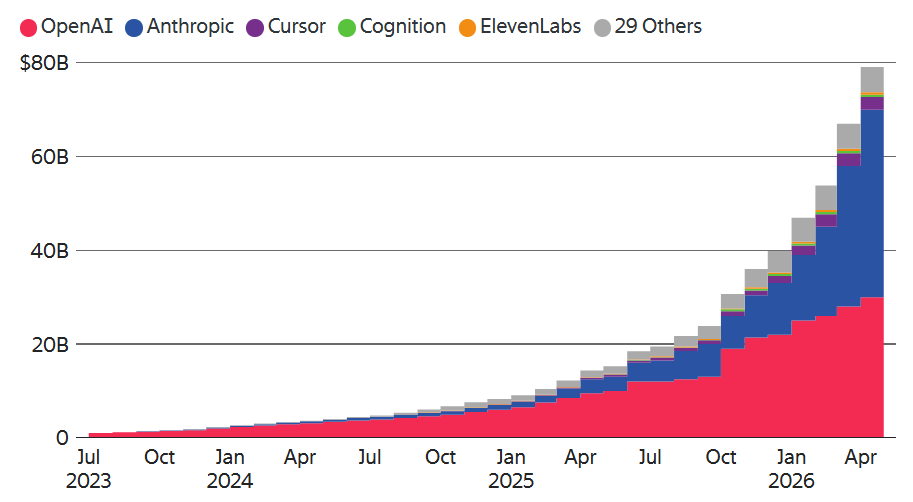
But it’s quite possible that it doesn’t. The math of run-rate revenue can be misleading: it is the monthly revenue x12. If one big client (e.g., Microsoft) stops buying next month, then you assumed 12x more revenue on his part than it will be. But it’s worse: big clients use the API, which can be cut off frictionlessly, unlike subscriptions. Besides, many of those are trying out Claude Code and Codex seriously for the first time. Add to that the fact that a high fraction of Anthropic and OpenAI’s revenue is from other AI companies trying to take a portion of the pie before it implodes. If AI turns out to be disappointing, the top labs and the copycats both go down. The result is that plenty of that revenue is honeymoon revenue.
Do not mistake a honeymoon for a marriage, or you will account for this initial period of “this cool thing is so cool” as if it were a long-term relationship.
But wait, why would revenue dry up at all? That’s the whole story: AI is a very special technology because its potential is huge, and yet it may stay that way, as potential. To see what I mean, let’s use another bubble as a comparison: railroads.
When you launch a rail service from Madrid to Barcelona, you estimate demand, decide how many trains to operate, and assess whether the route can produce a healthy ROI, etc. The thing no one ever asks is: does the train work? Like, yeah, of course it works—you take it for granted because it’s a stupid question. Trains work. But that “stupid” question is why everyone misses what makes AI complicated, because the hardest question to answer is also the most fundamental: Does it work?
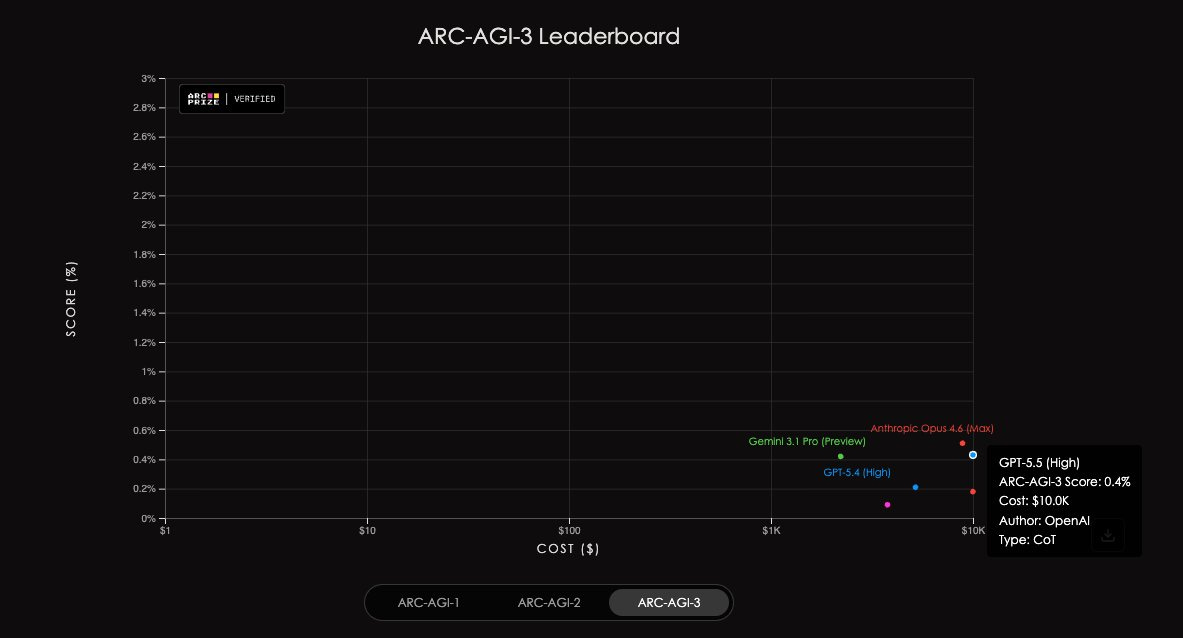
So far, neither Anthropic nor OpenAI can give a solid yes. How come GPT-5.5 can disprove a century-old math conjecture that human mathematicians have been trying to solve for decades and yet it makes trivial mistakes or can’t solve a kid’s game like ARC-AGI-3, or write a half-decent short story? These models are inherently jagged; AI companies can keep building higher mountains, but that won’t fill in the valleys. And it is in the valleys where most people live. I don’t care about the millennium math problems but care dearly about not having to tell Claude the same damn thing 10 times or about not having to clean up its slop, like a botsitter.
Don’t get me wrong, the enthusiasm for AI, if it works, is rightfully high. This cool new thing is indeed very cool! Anthropic’s run-rate revenue is so high that, if we follow the trajectory, Anthropic is on track to be bigger than Alphabet and Apple by EoY.
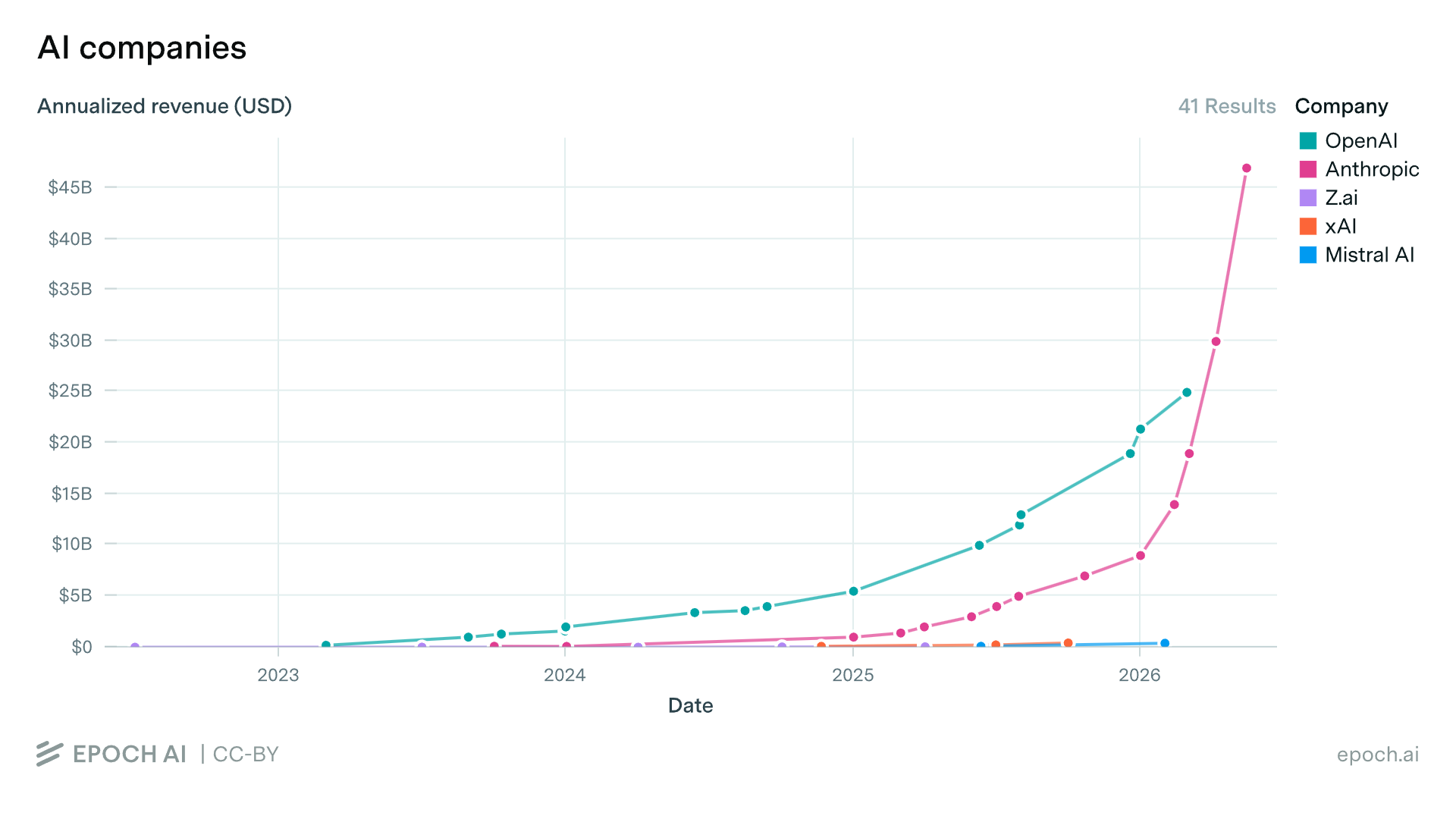
Look at those curves. That’s crazy—so crazy that there must be a catch.
