I.
In August, when AI was solving problems that had eluded generations of mathematicians, making them look like newborn babies struggling with kindergarten puzzles, I wrote that if the same happened to literature—if AI could take the Pulitzer or the Nobel—I might as well stop writing altogether and kill myself.
But there’s something I hadn’t considered: what if AI becomes a prize-winning author without it becoming a great writer first? May tasteless judges spare my life.
II.
Zimbabwean writer Simbarashe Steyn Kundizeza won the Caine Prize for African Writing with The Blue Fighter in October. A few days later, journalist Vauhini Vara reported for The Atlantic that Pangram, the top AI detection tool, had classified the story as AI-generated. The organizers opened an investigation that’s still ongoing at the time of writing and the author’s agency maintains that the work is his own. The popular jury, however, is already in.
I’ve read it and I find it clearly AI-generated (or, at least, heavily AI edited), but I’m not one to pass judgment. You are, though, as audience of the world. If you are, as I am, a scholar of slopism—a phonetical and semantic neighbor to both solipsism and escapism, and defined as the systematic study of slop, including its production, circulation, stylistic features, and effects on readers and culture—a couple of lines highlighted by Vara should suffice: “Not with anger, but with the quiet resignation of someone who had known all along this moment would come.” Or “Not broken, just learning how to live differently. Alone, sometimes. But still moving. Still here.” Some more from me in case you’re still unsure: “The real story always lived in the spaces between what was said.” Or “She counted the money twice, then a third time, the way people now did everywhere, as if the numbers themselves had become slippery.” Or “That night, I heard them talking in low voices in their bedroom. Not arguing. . . . But negotiating something fundamental between them.”
Who writes like that? I understand one such asbestic anecdote can escape a human’s fingers but not all of them. My rule of thumb for AI writing can be summarized as “IYKYK,” but perhaps a handful of examples is too slender a thing to hang allegations that can bring about the takedown of an award-winning story or, worse, the death of the author. Even after reading the whole thing, if you’re not versed in this art of spotting alien blandness, you might still not see the ones and zeroes hiding in the spaces between what was said. You’re not alone. The judges certainly didn’t because the prize doesn’t allow AI writing and they awarded it to Kundizeza anyway.
Thankfully, there’s more evidence for the skeptics: Pangram scored an earlier story by the same author, along with all 25 previous Caine Prize winners, as 100% human-written. Notably, this makes claims of racial bias and discrimination—or other emotionally-charged counters like “anti-woke resentment”—less convincing, leaving any potential defense to account for the striking disparity.
If Kundizeza’s were an isolated case, I’d see no reason to give award-winning literature the tragic treatment of a fall, as I did with math. However, it is the latest of an already substantial streak of stories that, despite suspect of AI involvement, have nonetheless been awarded prestigious prizes. It will keep happening until literacy improves.
III.
Perhaps the highest-profile case was the Commonwealth Short Story Prize controversy from earlier this year. Writer Nabeel S. Qureshi accused the 2026 winner—Jamir Nazir with The Serpent in the Grove—of having relied on ChatGPT to write it. “Anybody who has used GPT 4o for more than 5 minutes will recognize this voice,” he said. Pangram scored it 100% AI.
Inspired by Qureshi’s finding, Pangram conducted an investigation on the entire history of the prize. What they found, just like with Kundizeza’s story, is hard to brush off: For thirteen consecutive years, Pangram found no trace whatsoever of AI in the winners’ stories. Then, in 2025 and 2026, it flagged four of them as 88–100% AI-generated.
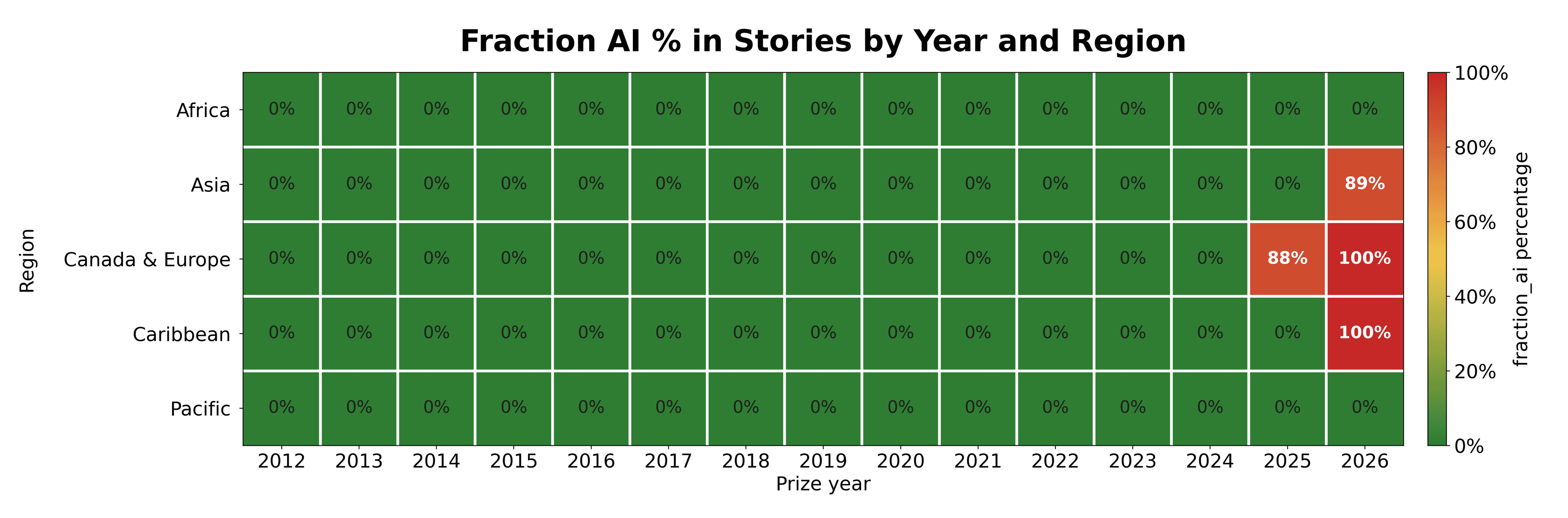
In typical fashion, the authors all denied the claims. The Commonwealth Foundation opened a review to address the contention, and, after a month of investigative work—which included “detailed discussions” with the authors as well as an examination of “working drafts, time-stamped documents, and notes”—issued a statement concluding that “AI was not used to write the winning stories.”
Unfortunately, Pangram’s vindication of the prize’s past amounts to an indictment of its present. A flawless historical baseline makes the later allegations extraordinarily difficult to dismiss, and the Foundation’s internal investigation offers no convincing explanation for the discrepancy (it’s confidential, they say). In October, CNN reported that Max Spero, Pangram CEO, offered to withdraw the accusations if the Foundation shared its findings and he was convinced by the evidence.
They refused.
Generally, these controversies tend to end in a clean split: those who know that AI is eating literary prizes have given up on them altogether, whereas those determined to keep their blindfolds on can rejoice that their pristine bulwark remains unconquered. The bulwark, incidentally, being not quite literary excellence but a monopoly on condescension toward the Global South, as Katy Waldman pointedly remarks in her New Yorker reportage.
Some have, however, rejected the armistice: it’s not enough to keep the awards, they want to keep their reputations intact, too.
One of the affected authors, Sharon Aruparayil, called the controversy “an entertaining witch-hunt,” a metaphor that amateurs would later borrow—in line with their natural disposition—when Substack decided to partner with Pangram to fix the ubiquity of AI writing. And I will admit that calling the prosecution a witch-hunt is evocative and historically-informed. But it has a small problem: these witches do exist. Had the accused women of seventeen-century Salem or Scotland actually been killing their neighbors with ointments and sorcery, hunting them would’ve been a public service. I’d rather people stopped disguising prompts as literature, but since it’s not in my hands to overhaul the human condition, we’ll have to remain unremorsefully inquisitorial. Yes, we are hunting witches, for they shall die.
Others haven’t been lucky enough to hide behind a spellbinding charm or, failing that, behind the establishment’s veil of guilt.
Thélyson Orélien is one of them, author of C’était ça ou mourir (It Was That or Die), a debut novel that won numerous prizes in France this year. The story repeats itself almost to the letter (pun intended): he was accused, he denied the accusations, and an investigation was opened. In Orélien’s case, though, traces of AI in the metadata of some documents tipped the scales toward his accusers, a rare instance of justice catching up with laziness and lies. Éditions du Boréal has decided to end its collaboration with Orélien, who has watched his career go dark as fast as it lit up.
I don’t think he’ll be the last to harvest the praise and adulation of the literary world by cheating, or the last to be found out (and banished) for it. Or so I hope.
IV.
As I was finishing this essay, something funny happened: another case that coincidentally involves an author writing in my mother tongue, surfaced. I say it’s funny because I’ve realized it’s now happening so often that I can’t finish writing about one case before the next arrives. I may have to start using AI to write about people using AI. But I won’t, you see, because I respect this deal by which you exchange your time (and/or money) for my thoughts and not a counterfeit facsimile.
Insofar as AI is present in my writing, it’s never to supplant me but to merely exist on the margins of editing and word choice, where a Thesaurus would’ve neatly filled the gap in a different era. For instance, just above I had written “at the fringes” and “lexicon” and Claude suggested “on the margins” and “word choice.” I acknowledged the improvement and obliged. Claude then noted the convenience of being asked to help me to explain how it helps me in exactly the way it helps me, remark that I decided to include here of my own volition, as a nice little meta detail. And that, if anything, is how one should lean on AI in writing: as an extension rather than a transgression of oneself. Naturally, feel free to use it for things other than embellishments but never ever break the implicit social contract that ties you with your audience, for it is your only moat.
But I digress. As far as I know, this was the first high-profile case of a literary prize awarded to a novel written in Spanish accused of being AI-generated. David Silva Rojas’s Donde el agua trabaja (Where Water Works) won the Almadía Ventosa-Arrufat International Short Novel Prize in July. El País, one of Spain’s leading newspapers, ran the manuscript through Pangram and it returned a 99% AI score. A heated controversy followed, with critics accusing El País of irresponsible journalism, often without having made the effort themselves to understand how Pangram works, how it differs from other “detectors” or what a score of 99% actually means.
I have no intention of rehearsing that analysis here. You can read El País’s or mine elsewhere. But I will say this: Pangram’s false-positive rate is so extraordinarily low (1 in 24,000 and even lower in Spanish for the newest versions) that its reliability approaches perfection, an overachievement the likes of us humans don’t seem to quite deserve. Few systems can boast comparable performance. For perspective, HIV initial screenings produce roughly one false positive in 700 tests, while mammography raises a false cancer alarm in nearly one examination out of ten. I find it faintly absurd to demand absolute infallibility from a literary detector when even systems entrusted with matters of life and death routinely operate with considerably greater margins of error.
“Everything fails occasionally” is a feature of our world and yet Pangram excels, so why does the possibility of detecting AI writing with high accuracy incite so much indignation?
In other areas, we seem to have no choice. I prefer that a cancer scan fails 0.5% of the time rather than let any lump go unnoticed for too long. But Pangram feels different 1) because it doesn’t feel deadly to let some slop spoil the universal canon, 2) because having to use the enemy (AI) to fight against itself feels like desecration, like a betrayal to our kin—not only we can’t tell anymore but are now at the mercy of the very thing we’ve sworn to destroy—and 3) because ultimately, a false cancer diagnosis won’t kill anyone but a 100% AI Pangram score is a professional death sentence. One idea suffices to counter all three, though: everyone else’s careers—and literature itself—are at stake if the lumpen go unnoticed for too long.
If AI has indeed infiltrated award-winning literature and the only way to tell with a high degree of accuracy is using AI in turn (a different kind of AI, for that matter), then so be it. If you’re sad that authors are accepting the bargain of exchanging their existence for easily-won prizes—and believe me when I say that I share that grief—you’re not going to fix it by resenting the kind of AI that’s here to let you know. Do not shoot the messenger.
In any case, this is not an essay about the merits of the “pangramization” of writing, or why I believe its advantages handily outweigh its drawbacks. Around here, we already take that for granted: If Pangram returns a high score, then the evidence of AI involvement is overwhelming and you don’t get to mount an absolute defense on a relative alibi.
The cases will keep coming and, regardless of the defendants’ credibility (or lack thereof) and the gatekeepers’ leftover value, the interesting questions remain and that’s what this essay is about: What does AI models winning awards tell us about their writing prowess? What does it tell us about the quality of the stories themselves? And, finally, what does it tell us about the uncertain future of literature?
V.
But let’s set aside for a minute this matter of literary awards and talk about something completely unrelated instead: great writing.
I’ve argued before—as have many others, by happenstance also writers—that our trade is notoriously safe from AI because it’s unverifiable. This is a fancy way to say that it’s “not objective,” and thus AI companies can’t reinforce their models to do well on it. They need measurable criteria and a sort of “step-by-step guide” (forgive the technical innacuracies here) and there’s no such thing for literary greatness.
A few brave souls have gone looking for those criteria and, as far as I can tell, have come back with a handful of traits I’d call “necessary but not sufficient.” Others argue there’s no such thing as unverifiability. It’s only a mirage resulting from the fact that our limited conscious minds fail to parse what our galaxy-sized subconscious minds can otherwise immediately capture. And I agree that, in the limit, any preference must ultimately arise from identifiable properties of the things being compared, and those properties should theoretically admit a formal description (e.g., maybe the ubiquitous predilection for blue over red or even green is no accident but the aesthetic consequence of blue light’s unique ability to stimulate melanopsin, the retinal photopigment responsible for helping synchronize our biological clocks). The problem is that, in practice, genuine hardships like this—or comparable ones like, say, counting the atoms in the universe—will outlive humanity. We may go extinct before being able to state, with psycho-artistic rigor, what makes In Search of Lost Time a masterpiece, therefore making “masterpieceness” arbitrarily replicable.
Whatever is missing, be it Pierian inspiration, the soul of an artist, or an x-factor beyond what ones and zeros can encode, no one has yet managed to capture it in a bottle. On what authority do I make these overly-assertive claims? First, I write a lot. Second, I write a lot for a living. Third, I write a lot for a living about AI. I am what some inappropriately call an “AI writer.” And so I can state, just like anyone can recite platitudes like “Europe is well past its prime,” that AI forcibly sucks at writing.
As an AI writer I can attest that unverifiability is indeed the last line of defense for those human pursuits AI is yet to conquer. Math fell because it’s “too pure,” which is a poetic way of saying it leaves no room for nuance. Chess is the same: you win or you lose. In general, reward design is easy when there’s an unambiguous path to success. Literature is often the opposite of that: the less pure it is, the better it is and, incidentally, the more indigestible it becomes to machines.
Now, there’s a fair argument to be made that good writing is often agreed upon as “good” and thus its greatness must emerge from an easily accessible kernel of objectivity; we don’t have to search for it for eternity, as I suggested above, because it’s right there in the columns of literary critics or, conversely, conspicuously absent from those corncobby chronicles. This is a trivial way out of our trouble, yes, but a limited one at that: agreement comes readily when comparing skilled prose with writing that’s obviously bad. However, once you pass through the Mire of Average and arrive at the Great Lands, it’s fully subjective. You could spend the rest of your life trying to convince me that Ulysses is the greatest work of literature and I could likewise defend Hamlet, and neither would be correct because the best is Don Quixote.
Perhaps more importantly, good writing inverts Tolstoy’s famous aphorism in the opening line of Anna Karenina: All bad books are alike; each great book is great in its own way. This is a radical contrast with how math or chess work. Whereas verifiable fields close up in proximity to greatness—there’s a tiny subset of moves that solve a conjecture or lead to checkmate—literature opens, like cherry blossoms in spring, as your command over language grows.
But I’ve come to realize that my hypothesis here is incomplete, for it assumes something we as a community haven’t established: that writing must be good to be successful. What I meant as a joke in the first paragraph of this section is actually a fundamental truth: making great writing verifiable and making award-winning writing verifiable are not the same problem.
VI.
The opposite might actually be truer.
AI can conquer writing without having ever written a single memorable phrase because what it needs is to appeal to the **audience of the world who, by statistical force, will unfailingly prefer average writing that’s legible to unique writing that’s great. That’s why most people have read Harry Potter—and will soon have read The Blue Fighter—and yet almost no one alive has read Virgil.
There’s a suspicious correlation between books that are considered the peak of literary excellence and how hard they are to read (like Dickens’s Bleak House or Shakespeare’s King Lear, apparently). A successful book, however, aims at the opposite goal: to have people read it. It’s a paradox we need to deal with that the difficulty of achieving literary greatness itself tells us surprisingly little about the difficulty of achieving literary success. You can ask Melville, who died poor or Dickinson, who died unknown. Or you can ask Brandon Sanderson and Rebecca Yarros.
Just like a proof only needs to be correct, a novel targeted at fifteen-year-old girls only needs to be liked by fifteen-year-old girls. Sales figures are as good a metric as any and as such, a rather verifiable one—write like they do in fanfiction and fiction fans will love you.
But I can go further in this line of argument. What will happen to capital-L Literature, so disconnected from what people understand as “writing” as to belong to a different species—not just pretentiously elevated but also unintelligible? Is it free of the fate that befalls fanservice fiction?
For “real literature” to yield to the machine the only thing AI companies need is to win over those who decide what is and isn’t considered “real literature.” That is, as much as it pains me to say it, also mostly a **verifiable domain. I’m sorry for being so postmodern here but there’s no “fact of the matter” about what counts as great writing insofar as power, trends, politics, and identity rule over goodness, beauty, and truth. And those things are decided not by history but by people playing kings of the hill: a novel targeted at literary critics and judges only needs to be liked by literary critics and judges. All the clever arguments above about subjectivity or invisible preference-making particles fare rather bad against the simple truth that truth doesn’t quite exist.
Unfortunately, the conclusion seems to be the same whatever path I choose to follow in this exposition to assure myself that literature is safe: give AI any hill to climb and it will climb the hill. What I thought protected my beloved art was a mirage atop the hills, created by the day waving yellow with all its crops, as Virginia Woolf once wrote. Notably, she was never awarded the Nobel despite that sentence being better than anything AI has ever written.
What I mean is that “good writing” is an ontologically empty concept as long as you remove all the social and cultural scaffolding that gives it shape. Insofar as it does mean something—e.g., commercial and critical success—it is indeed as verifiable as anything else. AI companies can hire the taste-makers and have them reinforce AI on their taste, and it’ll work whether those taste-makers are infamous influencers on BookTok or the inveterate tribunal of some Global South short story competition. I hope not to be giving the AI industryideas (don’t worry, they’re on it already).
If you’ve kept up all the way here, after more than 3,000 words failing to spare litearture a terrible destiny, you won’t be surprised to learn that I now ascribe ~80% of the causal weight for why so-called great writing has not fallen yet to the machine to one factor: they haven’t seriously tried.
AI labs are busy trespassing the lawns where money grows, like code, math, office and email jobs, even engineering and robotics. Thankfully, money is antithetical to literature and so as long as capitalism guides them, their focus will stay on solving the profitable problems: how to buy plane tickets. I would like to conclude that we aspiring writers are safe in practice, and that’s what I have personally experienced but I can’t rule out that AI labs might kill us out of duty: it’d be unfair if we got to keep our love as the rest of the world grieved, would it?
Or maybe that won’t be necessary at all and this is just sophisticated cope. Maybe the AI labs have achieved their goal without even trying and I’m fighting ghosts.
Indeed, there are already signs that AI is considerably better at figuring this writing thing out than I’ve given it credit for so far. The dubious awards are part of it, but the story is much bigger. And this time we don’t have tasteless judges or teenage girls as scapegoats of our own lack of discernment. Enter the tyranny of the average reader.
VII.
In 2024, two researchers from the University of Pittsburgh asked a thousand-plus participants to distinguish poems written by famous human poets from poems generated by ChatGPT. Their accuracy was slightly below 50%, essentially an exercise of random guessing. Worse still, the AI poems received higher ratings for beauty, rhythm, and overall quality. Then, in 2026, a different group of researchers arrived at a similar conclusion for short stories: readers preferred AI-generated fiction on quality and engagement, and were unable to reliably distinguish between human and machine authorship.
No wonder The Blue Fighter and The Serpent in the Grove won those awards. We just like them.
This “counterintuitive” finding has now been proven true time and again: Anecdotally, I see it in bot-made tweets gathering millions of likes, in AI-generated essays acclaimed on Substack, in bestseller romantasy novels written in bulk. Statistically, I see it in charts like this from Graphite, this from Rand, this from Pangram. Institutionally, I see it in those undeserved prizes that will eventually lose any pretense of accolade. And personally, I feel it in the human-shaped hole piercing my heart.
AI has eaten writing. Where were you when writing became AI? You were enjoying it.
The researchers behind the poetry study suggested that people liked AI poems because they were simpler and more accessible. Some participants mistook difficult human poems for generated ones, they said, presumably reasoning that something they couldn’t understand must have come from a machine. Such a subtle way of calling people dumb.
My take is more charitable: high-quality literature is divorced from what the average person can parse as “good.” They are not stupid, just not attuned. The difference between a philistine and a snob is mostly one of appreciation, not intelligence. We see the same for music, movies, clothing, etc. Even if people have a bias against AI, they often can’t tell AI from human at all. That is, again, misattunement. None of this is an indictment of a general audience, nor of literature. This is a fact of life: highbrow artistry doesn’t often overlap with popular artistry. They are literally different things.
You might object, quite reasonably, that ordinary people have indeed terrible literary taste and no handwaving on my part will change that. But that’s an argument about the public, not AI. It says nothing about whether AI writing is generally preferred because it lacks skill or because it has greater perceptiveness. It might be that AI not only understands literature better than normal people but it also understands normal people better than literary writers.
VIII.
There’s another objection that deserves consideration: what if AI writing is not that bad? What if I’m not just coping hard about the fact that literature might be lost but also because it deserves so; because AI is actually better than us at the sublime arts?
People who dislike AI writing, like me, often recognize it right away, having become overly sensitive to its mannerisms. The predictable pace and weird metaphors. The manufactured structure. Or my favorite: the need to personify every object, like “furniture that complains” or “water that’s jealous.” Can’t water just flow and wood stand still? I mean, I don’t want to infect your mind with conspiracy theories but I wonder if AI models do this to introduce in our minds the belief that it’s normal for all sorts of inanimate stuff to feel and act like humans as a way to blaze the trail for its own kin.
But I also wonder whether those recognizable mannerisms are intrinsically annoying or I’ve simply grown to despise them because I can see them. Is AI writing genuinely bad or just an earworm? Human authors have their quirks too, many of them awful, but they don’t get to inflict their stylistic preferences on the entire planet. If I were reading Sanderson’s prose in every single play, essay, novel, tweet I would also be calling for the end of humanity. It’s in this sense that AI seems to be worse due to its unprecedented memetic powers rather than its lack of literary ones.
And maybe that’s what this is, one single problem with many faces: AI is winning literary prizes, conquering the dreams of teenage girls, earning the praise of respected scholars, and confusing the average reader because it just so happens that AI is everywhere and everything is AI.
Having thought long about this bias, I think both play their part: I’m overly exposed but also AI writing genuinely sucks. I’ve enjoyed a few AI-written pieces without recognizing the style and even after the fact I’ve still been able to like them. It’s the pervasive due of low-quality and low-intention that kills it for me. But that doesn’t stop it from winning literary awards.
IX.
All in all, the news that AI is already winning writing awards suggests, if you allow me the indiscretion, that the average reader, fifteen-year-old girls and the literary establishment are easier to fool than literature is to master.
Where does this leave us?
Perhaps the highest rungs of “serious literature” will never fall to AI because they’re intrinsically human, like hugs and hope, but perhaps we should be less naive. Perhaps the solution lies not so much in trying to push AI down but in pushing literature up, to the divine.
This is, I think, a decent enough ending, one the most literate of machines and the most illiterate of humans would approve of: it’s not so much that literature will be forever beyond AI’s reach, but that it was never within ours.