


Hey, Alberto here! 👋 Each week, I publish long-form AI analysis covering culture, philosophy, and business for The Algorithmic Bridge. Paid subscribers also get Monday how-to guides and Friday news commentary. I publish occasional extra articles.
QUICK REMINDER:
I’m running a 50% discount offer on annual subscriptions that ends on June 5th June 12th (extended one week). Get yours now and enjoy the discount forever.
If you read the free edition and have been thinking about subscribing, this is the best time. I won’t do another offer anytime soon.
I know I’m publishing a lot, but I had to share this quick “first impressions” post on Claude Mythos 5 and Fable 5.

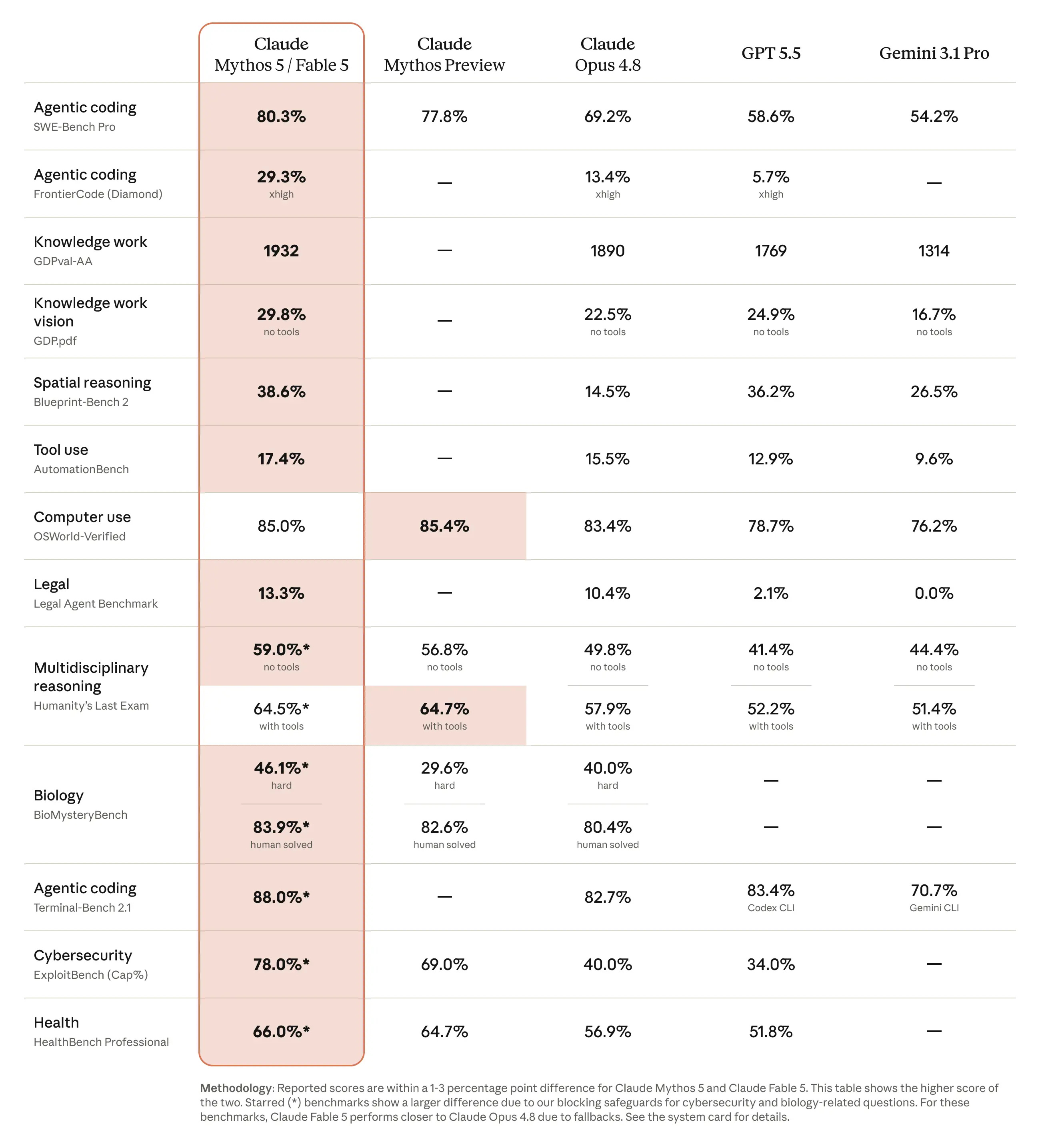
Anthropic just released Claude Mythos 5 (blog post, system card). It sits at the top of every major benchmark: coding, cybersecurity, reasoning, biology, vision, etc. It is, by the numbers, the best AI model in the world. Better than Mythos Preview. Better than anything OpenAI has released publicly.
And you will not be using it.
What you’ll be using is Claude Fable 5. It’s the same underlying model, but with a layer of safety classifiers on top that block or downgrade its responses in certain areas.
The launch has been covered extensively from the enterprise angle: what it means for agentic coding, drug design, or long-horizon research. The overall read is that the Mythos-class of models sits one quantitative—and qualitative—level above both Opus and GPT-5.X models. But to taste its greater intelligence, you will need to test it on genuinely complex and long tasks, which means, by definition, that you’d need to expend a lot of money. If you’re anything like me, you don’t have two thousand dollars per month to spare, so I’ve decided to make this post for the rest of us.
It’s a quick bulleted list of my first impressions. I’ve drafted them quickly for the sake of timeliness. It’s intended for standard users: the people who like Claude but have normal salaries. What changes for us starting today? Here’s what I think matters.

You have two weeks to try it at no extra cost. Fable 5 is included on Pro, Max, etc. paid plans from today through June 22. Then it gets pulled from those plans and becomes a credits-only (pay-as-you-use) model until Anthropic has enough capacity to serve in the standard plans. My advice is to try it as hard as you can in the two-week window because the restoration doesn’t come with a date. Get used to not having normal access to incoming models; this is the new normal.
“Best model in the world” means something different depending on what you do with it. This is the most important takeaway IMO. If you’re a developer running loop-based agentic coding tasks across a 50-million-line codebase, the benchmarks are directly relevant to your life and work. Congratulations, these models are a total upgrade. On the opposite end of the spectrum, you have people using Claude to draft emails, brainstorm ideas, summarize documents, or help them write. Fable/Mythos are not for you. Use the second-best model Anthropic gives you access to because it’s good enough. You won’t find a single task for normal white-collar work for which Mythos-class is clearly, measurably above Opus class. Use the free two-week window to check for yourself and then come back with the mere mortals doing mortals’ work, like me. The gains are concentrated at the higher end in terms of complexity and length of task. That’s only going to be truer over time; it’s why I said: “AGI is here, just not evenly distributed.” Longer tasks, harder tasks, deeper knowledge, bigger models—the edge of AI is now relevant exclusively to the AI labs themselves and a few people outside. Even if OpenAI wants to give everyone in the world a “personal AGI,” as they said in yesterday’s blog post (probably a covert response to Anthropic’s blog post about recursive self-improvement), even then, most people don’t really have any use for an AGI that’s also extremely jagged. A jagged superintelligence is a gift for those living in the peaks and irrelevant for us living in the valleys.
Token rich, token poor. So we’re entering a phase where the main resource constraint isn’t the model’s intelligence but how many tokens you’re willing to burn. Test-time compute—letting the model think longer, retry, take notes, iterate, etc.—is becoming the primary scaling axis. The model doesn’t get smarter if you ask it the perfect question, but if you let it work on something for hours. However, at an API pricing of $10/million input tokens and $50/million output tokens (that’s twice as much as Opus 4.8), you may not be willing to burn that many tokens. OpenAI researcher Noam Brown says that “empirically, the plateau [on test-time compute] is very far out. Sometimes we may not observe a plateau at all within practical budgets.” That means that models can keep getting better for longer than you can keep solvent. Relatedly, there’s a new trend in Silicon Valley that’s basically test-time computer taken to the extreme: Loop engineering (started by Claude Code creator and OpenClaw creator). You no longer prompt the model directly but design loops so that the agents themselves decide what to do; you don’t intervene. (Ethan Mollick calls it being a “patron” that commissions work rather than a “wizard” that casts spells.) The funny thing is that one loop that goes for a bit longer than it should can empty your bank account and the bank account of your kids, and their kids after that. I’ve read the testimony of one guy who burned through $1 million in one day on Fable 5. So, the loop engineering trend, which goes hand-in-hand with these Mythos-class models, creates an important divide that goes beyond having or not having tasks suitable for them. I call it the “token rich, token poor” divide. (I wrote about this in 2024 in related terms: “AI rich and AI poor.”) The use cases Anthropic highlights for these models—day-long codebase migrations, autonomous genomics research, multi-step drug design—burn through millions of tokens. At those volumes, a serious power user or small team could spend hundreds of thousands of dollars a month. The model is priced below Mythos Preview (less than half, Anthropic says), which makes it a bargain if you’re already spending at enterprise scale, if you’re already token-rich. If your AI budget is a Pro or Max subscription—that’s my case; I’m paying ~$130/month and I’m probably still in the 0.1% of highest paying users—then you should probably be thankful that you don’t have a Mythos-class-worthy task because otherwise instead of saying “I have no use for this model,” you’d be saying the more bitter “I have no money for this model.”
The most important safeguard is invisible to the user. According to Anthropic, Fable 5 has four categories of safety classifiers. Three of them—cybersecurity, bio/chem, and distillation (to avoid China from catching up)—are visible. When they trigger, you get a message that says the response is from Opus 4.8 instead (next best model). But Anthropic has added a special safeguard that limits Claude’s effectiveness for requests related to a fourth category: frontier LLM development. Essentially, other AI companies will not be able to improve their AI game by using Anthropic's top model (fair from a business lens). When the classifier triggers, the model is degraded through “prompt modification, steering vectors, or fine-tuning adjustments.” Anthropic estimates that this affects roughly 0.03% of traffic. My guess is they consider Mythos-class models so good that they could help other labs get ahead, not by distilling the reasoning traces as it works with standard distillation, but by using it normally as a user. That’s new.
Jevons paradox for AI-enabled projects. This is not exclusive to Mythos-class models, but it will get more obvious and pervasive as models improve. Three testimonies that illustrate what I mean. In a March episode for the Dwarkesh podcast, Terence Tao said (referring to the previous class of models, like Opus 4.8 and GPT-5.5): “I’m definitely noticing that the style in which I do mathematics is changing quite a bit, and the type of things I do. For example, my papers now have a lot more code, a lot more pictures, because it’s so easy to generate these things now. Some plot which would have taken me hours to do, now I can do in minutes.” Andrej Karpathy (now at Anthropic) says about Fable 5: “you can ask for anything - explainers, visualizers, dashboards, bespoke single-use apps (e.g. a full wandb that is hyper-specific just for your project), you can 10X your test suite, auto-optimize code, run giant research projects with custom HTML for the results, anything! ‘Free your mind’ (Matrix ref).” Ethan Mollick made “a piece of software that researchers have needed for years but was never profitable to create” with Fable 5. The idea is: even if AI models don’t add much to your core work (in terms of depth because you’re extremely knowledgeable or because doing so is excessively expensive or some other reason), these models are good enough now that you can do just a lot of high-quality core-adjacent stuff you wouldn’t do otherwise. Things that are not toy things but actually worth the time and cost.
You’re not getting two free weeks; they’re getting two free weeks of you. The classifiers were tuned conservatively (several people report they misfire on harmless queries and way too often), and the only way to fix a conservative classifier is to feed it huge volumes of real, benign, human traffic, which is precisely what a free window on every Pro and Max plan gives Anthropic. (Add to that a brand new mandatory 30-day retention on chats; they say they don’t use it as training data for models, but maybe retraining the classifiers doesn’t count.)
Anthropic is pulling ahead of the pack. Recursive self-improvement, which is now thrown around like AGI was when GPT-4 came along (that is, way too often), works like getting closer to a black hole. The closer you are, the stronger the pull and thus the faster you go, and thus the closer you are and thus the stronger the pull, and so on until you reach the event horizon (the singularity). At least that’s OpenAI and Anthropic’s bet (Google had a different one; I will say more about this soon). Both OpenAI and Anthropic have been releasing new models in quick succession since January 2026, which made the global AI race a one-on-one race. If OpenAI doesn’t release something big soon, this will be essentially a race of Anthropic against itself. OpenAI said in yesterday’s blog post that they estimate RSI for March 2028 (Anthropic first said late 2028 and then said that their estimates had been conservative and it’s coming earlier than that). The main difference between the two is that OpenAI insists on keeping the human in the loop: they want AI to work “in tandem with our own researchers.” Let’s see what they have to answer the Mythos 5/Fable 5 card or their opinion will matter little.
As a writer. Yeah, it sucks. It sucks just like the previous models. Just like OpenAI’s and Google’s models. Writing—not just the creative kind but plain good writing—is beyond near-AGI models, apparently. I guess dealing with language is too much for language models. No, seriously now, I understand that writing isn’t and will never be the main goal for AI labs, but at this point, it’s pretty clear they just can’t do anything about it. I hate AI writing, not because it’s bad but because it’s everywhere (pun intended). Please, make it stop. Being charitable: If the skill of “good writing” or more generally “creativity” is hidden under a pile of post-training, as some AI people claim, and yet they have never trained a model to showcase it, then the reason is probably that the model would otherwise lose all the other things that come with post-training (like smarts). This is evidence (if not totally convincing) that 1) as models get more powerful, the jaggedness doesn’t shrink much, and 2) AI models are, so far, “either/or intelligences.”
My fav benchmark. ARC-AGI-3 results are not out yet, and I really, really want to know how well this model does. My bet is <5%. I will be genuinely surprised if it’s anywhere above 10%.
Alberto, your point about the token rich and token poor divide is exactly right. Having been in the tech and startup space for a few decades now, I have seen every flavor of cash burn imaginable. We used to lose sleep over runaway cloud hosting bills or bloated early headcount. Now I am actively warning the founders I mentor that a sloppy autonomous agent loop will vaporize their entire seed funding over a holiday weekend. It is completely wild how fast you can drain a bank account with test time compute if you are not paying very close attention.
Your advice to stay in the valleys with Fable or Opus is precisely what I tell my teams. The sheer obsession with having the smartest model for basic, everyday tasks is a trap. Let the mega labs burn their billions up in the peaks. The rest of us need to focus on actual business logic and basic fiscal survival. Really sharp analysis here.
As someone who is just learning and only thinks of themselves as a casual user of AI, reading about the power that these new models are achieving and I agree with you that I will never use anything like Mythos level models. I like many other people have a cellphone that I only use maybe 10% of the applications that are on it. Sometimes I question myself,”why the hell do I pay for all this stuff I don’t use” when I buy these phones. Along the same lines, “why would I buy / pay for AGI (as Sam Altman wants to offer) when I probably will use a small percentage of the power of these powerful AGI’s like Mythos. Or maybe they will have tiered services (of course at tiered prices) where it is less expensive and less powerful like agi vs AGI. I see their use for big questions, cure cancer, development of miracle drugs, etc. But for the general population I think super model AGI or likely even average every day agi will be just like my cellphone where it won’t get used to its intended potential but will be one of those things that society has dictated is necessary for everyone to have.
I am not a computer or tech person but I like to read articles about it to stay informed. I make this comment as an average Joe off the street and genuinely questioning what is the end game of all this race for AGI in regard to the general masses.