


Hey there, I’m Alberto! 👋 Each week, I publish long-form AI analysis covering culture, philosophy, and business for The Algorithmic Bridge. Paid subscribers also get Monday how-to guides and Friday news commentary. I publish occasional extra articles. If you’d like to become a paid subscriber, here’s a button for that:
An express post on the significance of this breaking news.

Andrej Karpathy, founding member at OpenAI, former lead of Tesla Autopilot, and the most beloved AI teacher in the world, has joined Anthropic today, May 19th, 2026.

TechCrunch and Axios report that he will work under team lead Nick Joseph on pre-training, “focused on using Claude to accelerate pre-training research.” Essentially, Anthropic has hired Karpathy to prepare Claude to improve itself, a capability that, once autonomous, is known as “recursive self-improvement” or RSI.
This is the future that Anthropic co-founder Jack Clark predicted on May 4th in his newsletter, ImportAI:
I’m writing this post because when I look at all the publicly available information I reluctantly come to the view that there’s a likely chance (60%+) that no-human-involved AI R&D - an AI system powerful enough that it could plausibly autonomously build its own successor - happens by the end of 2028.
This is a big deal.
I don’t know how to wrap my head around it.
It’s a reluctant view because the implications are so large that I feel dwarfed by them, and I’m not sure society is ready for the kinds of changes implied by achieving automated AI R&D.
Karpathy’s decision to join Anthropic has come as a surprise to most.
First, he was in the founding team at OpenAI. He left for Tesla in 2017. Then he rejoined OpenAI three years ago.
He then left again two years ago.
Together with Tesla, OpenAI was his “industry home.”
Second, he likes to share his work in the open and say whatever he wants, and that’s not possible working at a frontier AI lab (except if you’re a pseudonymous poster). The field used to be open, but as the industry grew and commercial interests overshadowed research cooperation, the frontier labs became secretive.
Third, he became surprisingly skeptical of the industry’s over-hype of AI models and agents’ ability to generate good code. As a professional developer, he thought they “need[ed] a lot of work.” He made these remarks in his appearance on the Dwarkesh Podcast on October 17th, 2025.
Overall, the models are not there. I feel like the industry is making too big of a jump and is trying to pretend like this is amazing, and it’s not. It’s slop. . . . I’m not sure what’s going on, but we’re at this intermediate stage. The models are amazing. They still need a lot of work. For now, autocomplete is my sweet spot. But sometimes, for some types of code, I will go to an LLM agent.
Three days later, on October 20th, Anthropic launched Claude Code on the web. (Claude Code had been available as a research preview since February and generally since May, but getting these things to work well takes time.) Over the winter holidays, developers tinkered more seriously with these tools, eventually sparking an agentic boom out of Claude Code.
It changed everything.
On December 19th, Karpathy wrote:
[Claude Code is packaged] into a beautiful, minimal, compelling CLI form factor that changed what AI looks like - it’s not just a website you go to like Google, it’s a little spirit/ghost that “lives” on your computer. This is a new, distinct paradigm of interaction with an AI.
Then on December 26th, he tweeted:
I’ve never felt this much behind as a programmer. The profession is being dramatically refactored as the bits contributed by the programmer are increasingly sparse and between. I have a sense that I could be 10X more powerful if I just properly string together what has become available over the last ~year and a failure to claim the boost feels decidedly like skill issue.
Then two months later, on February 25th, again:
It is hard to communicate how much programming has changed due to AI in the last 2 months: not gradually and over time in the “progress as usual” way, but specifically this last December. There are a number of asterisks but imo coding agents basically didn’t work before December and basically work since - the models have significantly higher quality, long-term coherence and tenacity and they can power through large and long tasks, well past enough that it is extremely disruptive to the default programming workflow.
This is a three-tweet summary of the 180-degree turn that the entire industry has undergone over the last six or seven months (except the people inside the frontier labs, who saw it coming). Karpathy called out the hype, and four months later, he understood why the labs were hyping: “Roll up your sleeves to not fall behind.”
Naturally, he kept us updated on his work.
Since that moment, he’s been trying to automate different aspects of AI research with AI agents. This is, allegedly, the current main goal of both Anthropic and OpenAI (Not so much Google DeepMind, but that’s a topic for a different post).

Automating AI research is the first step to achieving the “escape velocity” threshold for recursive self-improvement. They believe this is the most probable path to artificial general intelligence, superintelligence, and the singularity. (Whether that’s true and whether you should care at all—read yesterday’s post for that—is another question.)
But, not to get tangled in concepts that belong in a Vernor Vinge novel, let’s stay with his autoresearch, perhaps the most relevant instance of Karpathy’s efforts.
On March 7th, 2026, he tweeted:
The goal is to engineer your agents to make the fastest research progress indefinitely and without any of your own involvement. . . . Part code, part sci-fi, and a pinch of psychosis :)
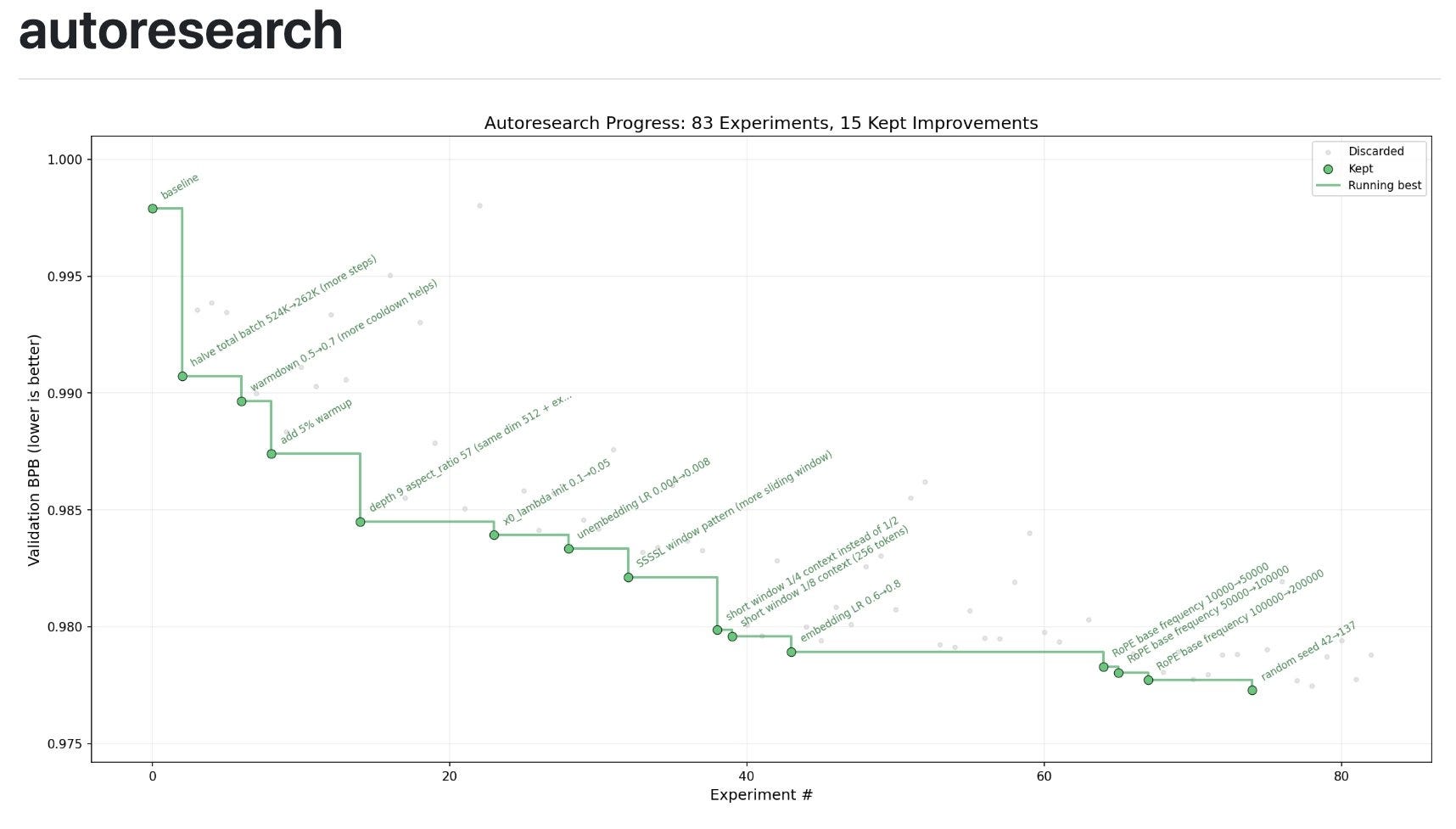
In the GitHub code repository, he wrote:
One day, frontier AI research used to be done by meat computers in between eating, sleeping, having other fun, and synchronizing once in a while using sound wave interconnect in the ritual of “group meeting”. That era is long gone. Research is now entirely the domain of autonomous swarms of AI agents running across compute cluster megastructures in the skies. The agents claim that we are now in the 10,205th generation of the code base, in any case no one could tell if that’s right or wrong as the “code” is now a self-modifying binary that has grown beyond human comprehension. This repo is the story of how it all began.
Then, on March 9th, he tweeted again (edited for clarity):
Three days ago I left autoresearch tuning nanochat for ~2 days . . . [i]t found ~20 changes that improved the validation loss. . . . This is the bread and butter of what I do daily for 2 decades. Seeing the agent do this entire workflow end-to-end and all by itself as it worked through approx. 700 changes autonomously is wild. . . . All LLM frontier labs will do this. It’s the final boss battle. . . . You spin up a swarm of agents, you have them collaborate to tune smaller models, you promote the most promising ideas to increasingly larger scales, and humans (optionally) contribute on the edges.
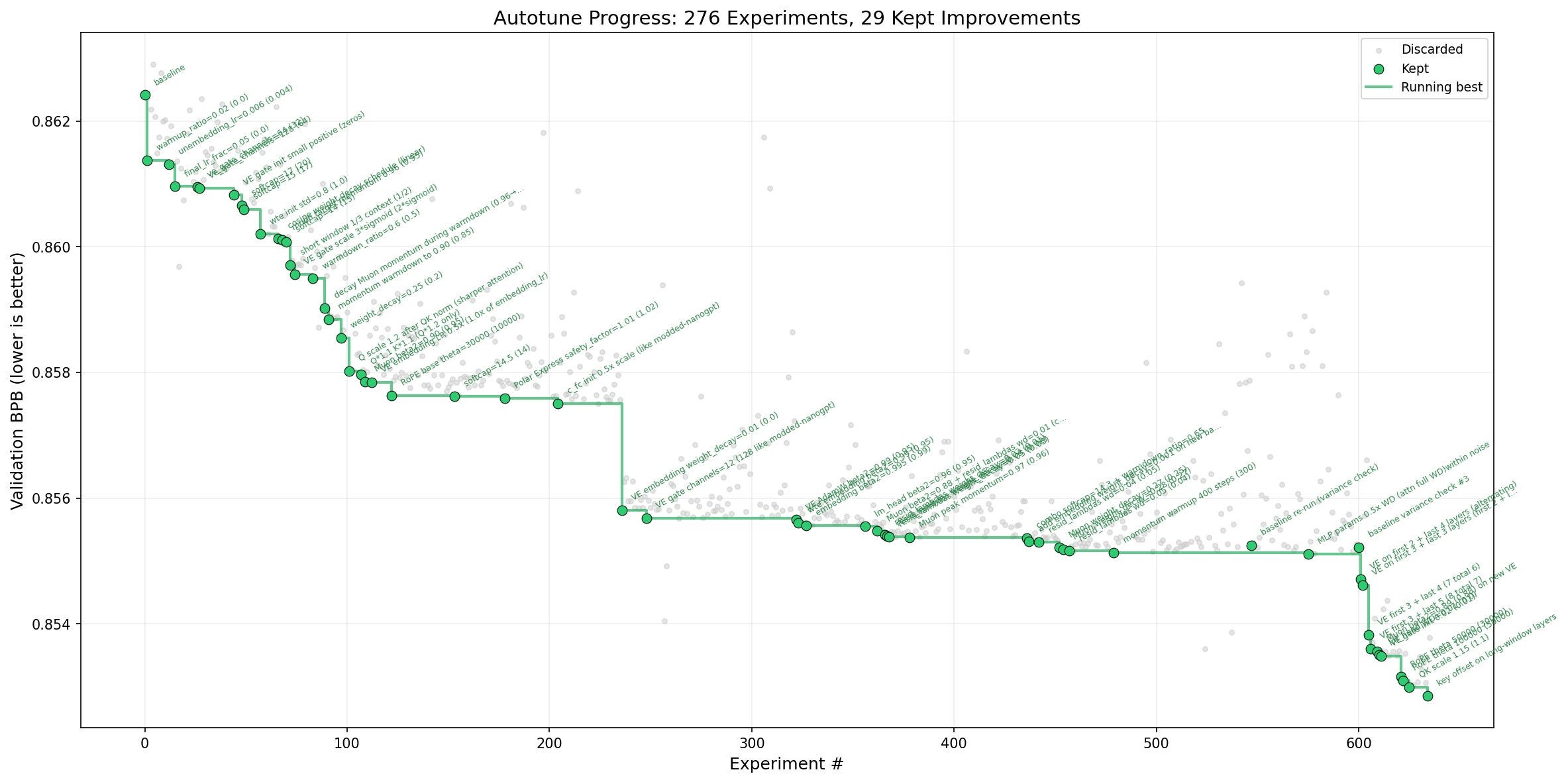
His enthusiasm was palpable. On March 12th, Noam Brown, a researcher on the reasoning team at OpenAI, asked a question about why Karpathy wasn’t working at either OpenAI or Anthropic or DeepMind:
Why is he not at a frontier AI lab at the most pivotal time in human history since at least the industrial revolution?
Karpathy’s response, on March 21st, was a hint of what was to come.
He argued that he was “more aligned with humanity . . . outside of a frontier lab” due to pressures over what he could or couldn’t say otherwise. (Some things you will want to say but can’t, like “frontier models are kinda sloppy,” and some things you will not want to say but the company will pressure you to say them, like “closed models are safer”.)
Karpathy wanted to be free. But he knew the price of going solo: you can’t be at the frontier if you don’t belong in a frontier lab. He knew his judgment would “inevitably start to drift.” He was caught between independence and relevance, and you really, really don’t want to be there.
His ideal solution—which kinda matches his modus operandi across the years—is to go “back and forth” in and out of the labs. His joining Anthropic is him starting a new “in” phase.
Why has he chosen relevance over independence now? Because he’s seen what’s coming.
If they can use the current generation of Claude to make the next training run even 5-10% more efficient, and they can do that repeatedly, they will get compound returns. Each generation of the model becomes a slightly better researcher for building the next one. The sci-fi trope is to call this RSI or “take-off scenario,” or “road to the singularity.” In practice, it’s applied engineering with a measurable feedback loop.
Karpathy’s last few months of independent work with autoresearch point to the same thing as his new role at Anthropic, using Claude to improve the pre-training of the next Claude. And so does Jack Clark’s prediction of 60% chance of full RSI by the end of 2028. None of that comes out of the blue. They can see it happening.
To me, these are breadcrumbs to follow; to them, the picture is whole.

Yes, Escher was a genius. But the drawing does not represent recursion; it represents self-reference—a fundamental difference. One that even top researchers overlook, sadly. Yet, they could ask any LLM about it or read Douglas Hofstadter’s Gödel, Escher, Bach, the famous GEB.
It seems pretty likely the winter boom in agentic programming was due to Opus 4.5 + the higher rate limits A\ gave to everybody. I don't think claude code on the web was a big factor outside the labs, though anthropic engineers have noted that their own workflows are more slack-heavy (triggering web instances given a slack communication context) than is typical.