


Alchemy, physiognomy, humoral medicine were but beautiful vague names, and the total ruin of those worlds had as little significance for us as their very existence. But mathematics, physics, chemistry…these too would be beautiful names. Engineering too, is a beautiful name. And we see now that the abyss of history is deep enough to hold us all. We are aware that a science has the same fragility as a life. The circumstances that could send the works of Euler and Gauss to join the works of Archimedes are no longer inconceivable; they are in the newspapers. . . .
I adapted a passage by Paul Valéry in Crisis of the Mind that he published right after World War I ended, to illustrate how his argument works not only for decaying civilizations, as he intended it, but for anything one might take for granted. “The abyss of history is deep enough to hold us all,” including, as it turns out, serious scientific disciplines characterized by rigorous inquiry.
I’ve long wondered, at least since learning that Isaac Newton pursued alchemy and mysticism with a passion and rigor comparable to how one would pursue large language model post-training today, what a dying field looks like. Or rather, what are the signs one should look out for to recognize, without a shadow of doubt, that one’s own discipline is terminally ill.
I’ve just found my answer:
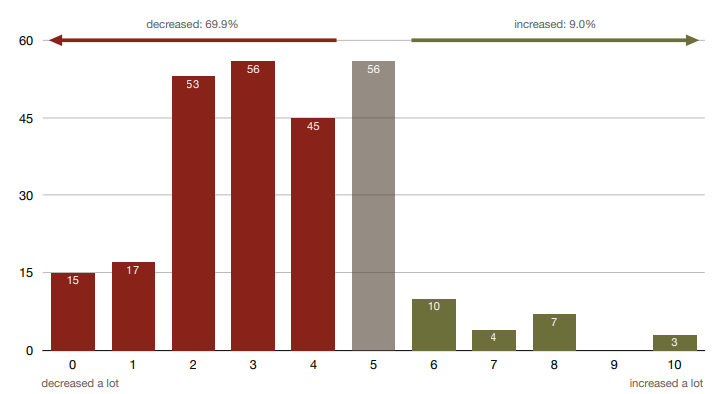
This chart is perhaps the most striking omen of the future of academic mathematics. It was included along with others in a MIT survey published four days ago, in October 29.
268 early-career mathematicians (mostly graduate students and some postdocs) from nearly 60 different institutions participated. They were asked how much the odds of them continuing their math career had changed since mid-July (around the time I was writing my long essay The Month AI Conquered Math). The chart above is their response: ~70% of these young prospects find themselves increasingly doubting their future as mathematicians. Only 9% see it brighter.1
I should qualify both the chart and my interpretation of it before proceeding.
First, I am not suggesting that mathematics will disappear as alchemy did. The comparison is deliberately modest, and made in Valéry’s spirit: we find it easy to contemplate the extinction of things long since consigned to the past, and almost impossible to imagine the same fate befalling those still among us. History, however, has never promised the living any special treatment. It’s in a singular sense that math will disappear, though: it won’t be a human pursuit much longer. We will, as Calvin once begged, leave it to the machines. The best among us will be relegated to connective tissue, may they find peace as meat proxies.
Second, this is not about all mathematicians, it’s not a static posture—sensations are changing by the week; math students might be more optimistic once the dust settles and all the once peripheral work can become meaningful and high-status—and it’s not necessarily a faithful description of what they will end up actually doing but only the change of odds they ascribe to their future.
That said—isn’t it profoundly sad?
I imagine Newton died still believing in the philosopher’s stone (little did he know he would be remembered chiefly for his lesser contributions: calculus, the laws of motion, and the law of universal gravitation). Had he lived to see his beloved pursuit of metal transmutation give way to chemistry, which indifferently established that no chemical reaction could ever turn lead into gold (though nuclear physics would eventually find a way, at a cost rather exceeding the price of gold), he would have been terribly sad.
John Maynard Keynes bought some of Newton’s private papers and, discovering the extent of his devotion to alchemy, echoed his sentiment with the perfect epitaph: “Newton was not the first of the age of reason. He was the last of the magicians.” Had he lived long enough, Newton would have felt, for the millennials in the audience, what it felt like to read Harry Potter and realize, in sheer disillusionment, that your Hogwarts letter was never coming.
But this is not fiction.
When you put down a book that makes you dream and travel to fantasy worlds, you always land back on your feet in the real world. When the real world crumbles, however, there’s no book to close. You still have to get up the next morning and find something to do with the next forty years. Playing games and strolling around, as Dario Amodei seems to suggest, may work for the spiritually aristocratic class but it may not cut it for the intellectual class. What will these wretched souls do once AI eats the imagined future they worked so long for? Will they be forced to work with their hands? In a trade job or the literal fields of dirt and rock? Or worse: an email job.
That I find profoundly sad.
It’s a tragedy to see one’s passion slip through the cracks of time. Those fortunate enough to love their work will understand. Mathematicians found a way to enjoy an existence that’s otherwise quite crude. To me, they peaked as human beings.
The rest of the survey is more of the same. 55% of respondents dislike using AI for research vs 31% who like it. 76% think it’ll be harder for them to secure a tenure job vs 7% who think it’ll be easier. 86 respondents would feel “very unhappy” if AI solved a problem they were working on vs only 6 would feel “very happy.” 77% feel less motivated to work on math research vs 10% feel more motivated.
It’s not only that they feel powerless but also unhappy, unmotivated, overwhelmed, and generally uncomfortable with how things are unfolding. The natural result is that many of the people who would otherwise keep the academic tradition alive will leave. And in doing so, they will prevent others from rescuing it from the mud, for in refusing to climb too steep a ladder, they will be in no position to aid the future generations who might have bravely attempted the challenge.
Perhaps it doesn’t move you to watch the downfall of people so removed from ordinary life, hidden away in their ivory towers among half-open books, scribbled-on blackboards, and far too many formulas in their heads. But the truth is, this essay isn’t at all about mathematicians; they merely have the misfortune of being today’s example. It’s about the life bearing down on all of us. If you still can’t see it, perhaps you’re among the lucky few it hasn’t reached yet. But don’t make the naïve mistake of taking this for an obituary for mathematics—it’s a prognosis for everything else.
So, how are people reacting?
Some, watching the disintegration of math from the fence and extrapolating it to other jobs AI might swallow, seem to believe that things will simply transform (euphemism) and humans will reallocate themselves (also euphemism) according to their comparative advantage or whatnot. Others believe that mathematics, and soon everything else, is undergoing a democratization process: now anyone can pay $200/month for a GPT-6 Astra subscription, they say, and spin up a fleet of agents to tackle whatever open problems the big labs consider beneath them.
This all sounds preposterous to me. Wishful thinking if I’m being charitable. Apparently, economists are starting to agree that it likely won’t happen.
In a paper wonderfully titled We Won’t Be Missed, Yale economist Pascual Restrepo finds that, in an AGI economy, human wages become tied to the cost of reproducing their labor with compute, while labor’s share of total income approaches zero. That is, if GPT can do your work better and cheaper than you, I’m not hiring you. Neither is the next prospective employer. In an essay published just three days ago, also on October 29, Google DeepMind’s economists identify the fundamental asymmetry on which my (admittedly vibes-based) intuition rests: human expertise is scarce, whereas AI can be replicated “at the rental rate of compute.”
Comparative advantage may survive as an economic principle—remember, someone has to roleplay as connective tissue—but what good is it if your boss can simply spin up another instance for less than your salary?
And I don’t think I have to make this point explicit, but not everyone can afford to pay what it takes to be at the frontier of the intelligence revolution. It doesn’t matter how much the labs decrease the cost of generating tokens, the wealthy and the industry will be months ahead of everyone else and, behind them, a wasteland of solved problems left uncared for. This is how math ends.
We are next.
The survey was closed right after OpenAI published the solutions to 372 families of problems on October 6th. The researchers explicitly state that most of these responses don’t account for what is perhaps the most significant development in this story which implies they’d presumably reflect an even more pessimistic outlook now.
Thanks for putting this out there. I disagree with many of its points and claims. But thank you. I'm a long time fan of your work.
I want to take a moment, first, to acknowledge the sadness you expressed, and more importantly the fear that many in the very early stages of their mathematical career must be feeling; namely: the fear of uncertainty. An estimate like P(will quit | starting out) ~= 0.7 from a sample a couple hundred people is pretty disheartening. For those in the earlier stages of their career – ie, working toward a PhD in math or have recently completed one – all of the training and nurturing they have received from advisors and mentors, that familiar paradigm they have been absorbing for years, is suddenly invalidated. Those mentors and advisors are also operating in entirely new territory they've never seen or even imagined. And it will be up to the early-career mathematicians to determine a new paradigm for the field, and to nurture that paradigm into reality.
It's a nice coincidence that I read your essay the same day I listened to a recent Lex Fridman interview with three mathematicians/engineers on the same subject: https://youtu.be/ZAzWPE9CItg. It's complementary to the version of the story you're telling, one ultimately more positive, but your version of the story is certainly in dialogue with theirs. (Lex does long shows, but that one is *really* long, like 3.5 hours long, and I'm not all the way through yet.)
Just to spice things up a bit, the main point of contention I have with your essay is that it focuses too much on *academic* mathematics as a field that's dead as we know it. That may well be true; see my earlier point about paradigm shifts and who will be the Sisyphus behind that stone. But I contend that there are many people who identify as mathematicians, or who functionally operate as mathematicians, but are certainly not academic mathematicians, and it is quite possible that the academics are a minority population among all mathematicians. Maybe even a small minority. For the rest of us, those who have escaped the Sisyphean purgatory where your career advancement is scored by citations of papers and gamified around what counts as a proof, the mathematical possibilities have suddenly gotten a lot more interesting.
One more point to make and I'll stop. There's a quote from Alex Kontorovich very early in Lex's interview that I'll paraphrase: "I think we’re entering a golden period of mathematical knowledge. After millennia of wandering in the woods with a candle, where this is all the further we can see, AI has suddenly given us a flashlight."
Love that metaphor! Even with sudden solutions of Navier-Stokes, quasi-Riemann Hypothesis, and many other instant-Fields-medal-level problems, all within a few weeks of one another, even still, all the woods beyond the narrow cone of the flashlight are still shrouded in darkness.
I remember getting 50's on my math homework. I used a calculator. I refused to write out the problems. My response was that I would never be without a calculator.I was right. I still flunked Algebra and got kicked out of high school.
Yeah, I figured if the A students worked for the B students then everyone worked for the dropouts. Oddly enough it turned out to be right. I Don't recommend it though.
Years after high school I'm 25 and teaching myself calculus so I can pass a plethora of test for various licenses. I can and did use a very sophisticated calculator HP 12C, a relic of the old days.
The problem is without an understanding of the math I did not know what questions to ask. I didn't know what I didn't know. I had to read a lot of books and write out a lot of math.
The moral of the story. The tool is only as good as the tool user.
If human minds atrophy what becomes of the thing we have built from us.
If all we can ask is stupid questions. Where does the leave us.
We need edge thinking madness now more than ever. We must not be afraid to be wrong. Likes on social media cannot be the measure of success. Endless math proofs in service of showing how smart an LLM is gets us no where.
As the edges collapse there will soon be only the homogenized efficient middle where everything goes to die.
The challenge in front of humanity is unlike anything we have faced before. We are not dealing with an external enemy. We are the enemy. This thing we've built is a reflection of us and that should concern everyone.
If we are horrified we need look inward. The battle is within us. We must become better tool users. Right now no one even has a cogent users manual. Right now AI is the hands of the venal and the stupid .or worse the venal and the brilliant.
Good at math. Sure so was my HP12c. What matters is what we apply it too. Want a better tool become a better tool user.
Nice article. Thank you