


Hey there, I’m Alberto! 👋 Each week, I publish long-form AI analysis covering culture, philosophy, and business for The Algorithmic Bridge. Paid subscribers also get Monday how-to guides and Friday news commentary. I publish occasional extra articles. If you’d like to become a paid subscriber, here’s a button for that:
This one is on the house.

San Francisco, Silicon Valley, the Bay Area—epicenters of the AI boom—are crazy places for people who are going crazy. The past Saturday, a tweet by Deedy Das, partner at a venture capital firm based in SF, went viral.
It describes a malaise that afflicts the people building AI. Even if you are not one of them, it is interesting for anthropological reasons (edited for length):
The vibes in SF feel pretty frenetic right now. The divide in outcomes is the worst I’ve ever seen.
Over the last 5yrs, a group of ~10k people - employees at Anthropic, OpenAI, xAI, Nvidia, Meta TBD, founders - have hit retirement wealth of well above $20M (back of the envelope AI estimation).
Everyone outside that group feels like they can work their well-paying (but <$500k) job for their whole life and never get there.
Worse yet, layoffs are in full swing. Many software engineers feel like their life’s skill is no longer useful. The day to day role of most jobs has changed overnight with AI.
. . .
There’s a deep malaise about work (and its future). Why even work at all for “peanuts”? Will my job even exist in a few years? Many feel helpless. You hear the “permanent underclass” conversation a lot, esp from young people.
. . .
Living through a societally transformative gold rush in that environment can be paralyzing. “Am I in the right place? Should I move? Is there time still left? Am I gonna make it?” It psychologically torments many who have moved here in search of “success”.
Ironically, a frequent side effect of this torment is to spin up the very products making everyone rich in hopes that you too can vibecode your path to economic enlightenment.
Das framed this as a job/money thing to make it legible for his audience, but the underlying cause is not so much material anxiety as ontological uncertainty: “who am I in a world that’s about to suffer the greatest transformation in history?”
Nick Cammarata (former OpenAI researcher) and Quiaochu Yuan (a rationalism-adjacent guy) explained what I mean:
I don’t think it has that much to do with outcomes. I know a ton of people who did fabulously well from the ai boom and those adjacent who missed it, and both are frenetic right now. everyone I know believes something very big is coming in the next few yrs and that’s unsettling
people are apparently reading [Deedy’s tweet] as a parable about how money won’t buy you happiness or something? this is a description of the foreshocks of the singularity. SF feels it the hardest because they’re the epicenter. the money is the concrete manifestation of a much larger eldritch hyperobject roaring into existence. the stormclouds gather. the winds whip. the world holds its breath
If you are from there, you probably agree with Deedy and, if you look deep down, also with Cammarata and Yuan (money anxiety always has an existential dread to it).
But if you are not from the land where the sun sets, you probably think what I think: Even if AI is not a bubble, those guys in SF and SV definitely are in one.
To be clear, I don’t doubt Das’s claims. They clearly struck a chord. I trust it’s an accurate portrayal of what it feels like to be the kind of person who breathes in AI tokens for a living. But I live in Europe—which gives me the authority to talk about this—and my perspective is different: you must fight the appeal of the SF bubble.
You want to distill AI into two separate bowls.
On the one hand, you have AI, the tool you can access right now in the form of Claude and ChatGPT, and agents, etc., that allow you to do a good deal of crazy stuff, increase your productivity, etc. Cool tech, nothing more.
On the other hand, there are these weird ideas that leak through SF’s office walls into the world: the singularity, superintelligence, the lightcone, the permanent underclass, the post-work society, post-scarcity, etc. These ideas and predictions all belong to the same bowl, whose label reads: “AI is an unprecedented milestone for humankind, beyond the industrial and agricultural revolutions. Maybe even beyond clever apes, terrestrial mammals, or life itself.”
This second bowl is useless to you. You may discard it.
If the ideas inside it are correct, then you can’t do anything about them. They are psychological infohazards; paralyzing truths that will prevent you from taking advantage of AI as it is now because you’re busy worrying about what AI will become tomorrow. If they are incorrect, then you spent the early days of a standard technological revolution worrying about science fiction stories and will feel like a fool in a few years. If they are half correct, half incorrect, then you’re better off preparing with what you have in front of you anyway.
Essentially, you should think of AI as a normal technology. Whether that’s right or wrong, it’s the pragmatic stance: AI is a tool, not a god.
By thinking like that, you achieve two things.
First, you let go of any anxieties of the existential kind (you may still think about your job, but that’s more affordable than thinking that the world of tomorrow will be incomprehensible). And second, it allows you to use AI for what it is today rather than wait for it to become whatever it might be tomorrow.
You get both calm and utility.
So, how to think about AI as a normal technology? Six principles:

I. The distance between invention and impact is longer than it looks
SF treats every new AI release as a civilizational event. It isn’t, and you shouldn’t.
The agricultural and industrial revolutions terraformed the entire world. It’s hard to find a place on land without a trace of human influence. But it took many years for that to happen. Even one-off inventions like cars changed the world over decades, so we’ve had time to adapt, if not biologically—evolution is slow—at least in terms of how we do things.
The usual counterargument here is twofold: AI is different, and AI is faster.
The first ultimately brings us back to the tool vs. God conundrum, and we already agreed that it’s not useful to think in those terms.
The second is disputable. That’s the main argument by Arvind Narayanan and Sayash Kapoor, who popularized the perspective of AI as normal technology. Even if innovation is quick—as is the case with AI—adoption and diffusion are slow.
Adoption: Almost everyone has heard of AI; most have ever used it, fewer use it regularly, fewer use the best tools available, fewer are getting useful stuff out of them, etc. This might change quickly, but that’s not a given. We’re still very early.
Diffusion: Every technology that changes “how people live” has to deal with human frictions and inertias. I touched on this in “Even God Can’t Skip the Bureaucrats”:
There is unassailable friction between superintelligence and revolution. When you solve intelligence, the bottleneck for effective change doesn’t disappear; it moves somewhere else, and frictions that were less important before become significant.
Even if superintelligence is eventually real, it’s not synonymous with omniscience or omnipotence. Like you and me, it will have to wait for the electrician.
Amara’s law is a useful heuristic here: “People tend to overestimate the effect of a technology in the short run and underestimate its effect in the long run.”

II. If you can’t do anything about it, it’s a parasite thought
Parasite thoughts need to go.
“I might lose my job” is a parasitic thought. “I should acquire AI skills” is not.
“Superintelligent AI will radically worsen society” is a parasitic thought. “What policies can work to manage an AI transition?” is not.
“There will be no purpose in a post-scarcity world” is a parasitic thought. “I love playing the guitar and hiking in the countryside” is not.
If you breathe in these ideas long enough, they poison you. And they spread through your circles, your feeds, your workplace. AI anxiety stops being a passing state and becomes your world.
You have one life. Live it.

III. You have a superpower in your pocket, and you’re not using it
When intelligence is free, you have to pay up in imagination.
With current AI models, you can do so much more than you’re doing. While SF debates the singularity, normal people across the world aren’t even using what already exists. The gap that should keep you up at night is not “What will AGI make of my world once it arrives?” but “What can I do with AI today that I’m not doing?”
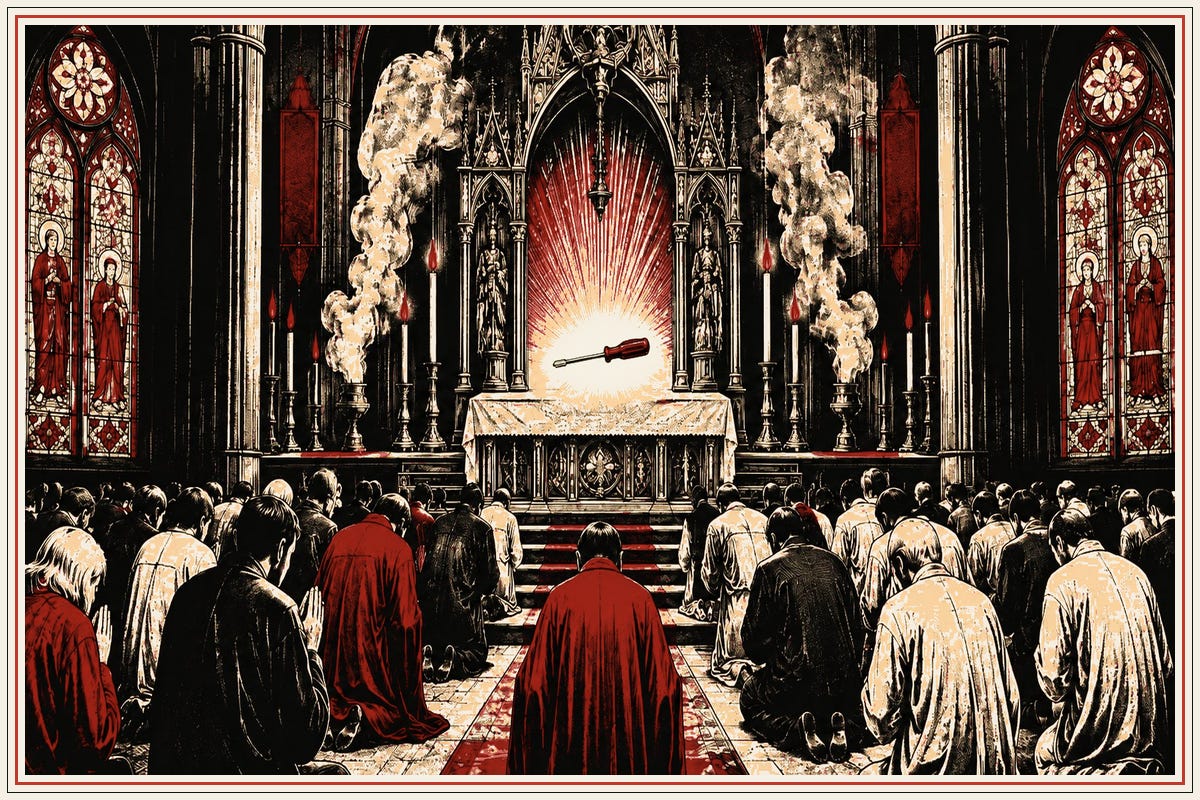
Imagine a screwdriver. No, better, imagine your favorite screwdriver (everyone has one). Really, picture it in your mind. Now, imagine what would happen if, in a distant future, a witch imbues it with consciousness—bear with me: Would that thought stop you today from screwing some screws? Of course not, you will pick it up as you always do, and, going to the nearest screw, you will screw it in.
AI is exactly like that.
Whatever may happen next, it doesn’t retroactively influence what you can do today. People ask me stuff every day that ChatGPT can answer better than I can. My usual reaction is: “Why didn’t you ask ChatGPT?”
Just try the screwdriver, for God’s sake, get familiar with it, mess around, get it wrong, try again, learn which screws it can handle, etc. Every tool is like that.
You can ask me how to use the screwdriver, and I will always tell you the same thing: practice, practice, practice. The lessons are not transmissible.
This habit prepares you for whether AI remains a screwdriver or becomes a God.

IV. The people closest to the technology are often the worst judges of its meaning
Don’t get swayed by the opinion of the people closest to the sun, for their eyes are burnt.
SF is high on its own supply. Dario Amodei can say 10% unemployement incoming and write 20,000 words of concerns about AI, and it doesn’t matter to you. Sam Altman can say that “if this technology goes wrong, it can go quite wrong,” and it doesn’t matter to you.
This hype-y anti-hype that AI CEOs love to do is directed to governments to push them to regulate their competitors, and to investors to push them to inject money.
They live inside the SF bubble, and so they see the future in real time—a distorted one at that—but perceive nothing about the present. They are tone-deaf. They can’t read the room. They won’t touch grass. Etc. Etc. I live in Spain and I go out and I see nothing. There’s literally no trace of AI anywhere.
The world outside my windows and outside my screens looks the same as it did 25 years ago.
Don’t let the fictions coming out of SF, like the movies coming out of Hollywood, blind you to the reality before your eyes. The wind sways the trees all the same.

V. Your job isn’t disappearing tomorrow, but it’s changing today
AI is increasing its accuracy much faster than it is increasing its reliability.
AI models won’t be deployed for long in safety-critical areas until the technology is reliable. That’s why the top three AI companies—Google, OpenAI, and Anthropic—are hiring forward-deployed engineers. The reason is not just that AI is extremely useful but also that it’s extremely brittle.
Revolution or not, enterprises won’t play canary in the coal mine.
If AI doesn’t work, they will roll back the licenses and huge budgets and tokenmaxxing leaderboards. Your boss is crazy about AI but only insofar as the promises materialize as revenue figures.
Profit is the ultimate benchmark.
So it’s dumb to panic about AI killing your job right away.
I don’t see AI taking my job anytime soon. It’s bad at writing, and my job belongs to the relational sector, but more so, because I’m using it to push me upward in ways I couldn’t do myself before. Research, editing, brainstorming, etc. Find your AI-augmentable tasks and use AI for them.
But it’s just as dumb to ignore the trends or your boss’s AI psychosis. Take the opportunity. Take the chance to treat AI as a normal—and thus useful—technology.
Let AI make you better without succumbing to it.

VI. Find humanity’s sacred places
I never answered the question that Das, Cammarata, and Yuan implicitly asked.
Who am I in a world that’s about to suffer the greatest transformation in its entire history? Who am I if AI happens to not be a normal technology?
Well, in that case, you will still be a normal human.
AI can’t conquer the things you actually value. What’s superhuman love or superhuman friendship? What’s superhuman sympathy? What’s a superhuman connection? What’s superhuman belonging? AI would be the new substrate on which all those intrinsically human things will take root.
It’s easy to think that a superhuman AI makes you irrelevant, but, as philosopher Shannon Vallor wrote: “. . . doesn’t granting the label ‘superhuman’ to machines that lack the most vital dimensions of humanity end up obscuring from our view the very things about being human that we care about?”
Yes, it does.
Never forget that AI can’t, by definition, enter those dimensions we really care about. Sometimes—most times—what we want is an equally imperfect human. Humans like humans. I don’t want to kiss a robot, however perfect the robot or the kiss might be.
Perhaps it’s time to stop thinking of ourselves as kings losing our kingdom and begin to relish the imperfections that made us along the way.
We will always have the kisses.
So beautifully expressed! Thanks Alberto.
That's a very sober look - thank you for sharing! I find that a lot of noise about AI right now comes from the excitement/anxiety about AI's capabilities by themselves rather than its real impact or meaning (that'll come with time). It's a bit like a kid who just learned to walk or talk - it's a milestone and a major achievement for the parents, but still a way to go till adulthood.