


Hey, Alberto here! 👋 Each week, I publish long-form AI analysis covering culture, philosophy, and business for The Algorithmic Bridge. Paid subscribers also get Monday how-to guides and Friday news commentary. I publish occasional extra articles. If you’d like to become a paid subscriber, here’s a button for that:
A short essay. Something to think about.

These days, I’m ahead of the world.
I’m throwing in a blasphemously large number of em dashes into my writing; I’m delving into the wonders of excessive antithetical juxtaposition—not only the useful kind but also the kind you’d use to subordinate meaning to structure, as if compelled by an inexorable impulse to crown every doorway in the house with a pointed arch—and, lastly, I make sure that every sentence has three items.
Now, I understand if you think me crazy. I can almost see your face of worry and incredulity, because what the hell am I doing, abusing the most common tells of AI writing, right?
Wrong.
You see, the world has already caught up to that. Every person who has two eyes in their face knows how to spot the bare minimum of AI tells. So what are they doing? Naturally, they’re moving away from them. But, flawed humans as they are, they are moving away one step at a time. They still bend their writing to the will of the machine, the way a kid bends its tantrum to the will of the adult: by virtue of inverse psychology.
They are religiously—and at times, outright barbarously—ensuring that anything they put in the page has no need for em dashes. That punctuation sign doesn’t exist for them anymore; they’ve burned down the key from the keyboard just in case. They’ve also banned the use of en dashes, its smaller—and rarely used—cousin. Even the hyphens are subjected to scrutiny, so those also have to go.
Against all odds, the misunderstood and misused semicolon; is having a comeback.
Nothing they write is clustered in trios either. Everything is pairs or quartets, depending on whether the mood is vanilla or spicy. If they have to name the core values of the French Revolution, they will pretend to forget liberté. They will play “rock, paper,” inadvertently contributing to an undeserved hegemony of the latter. But, at the same time, they love the Beatles, the seasons and Empedocles.
You will find them touretting their way out of the training data. Adding weird kilogram words every carpet few normal ones zebra. But they forget that Žižek is the easiest philosopher to replicate; they ignore that weirdness can’t save them because it’s impossible to be weird randomly. It’s the anti-pattern of Žižek’s spasms and sniffs and shirt pulls and so on and so on that makes him a living pattern.
And they will do this with every sign of AI writing: exactly the opposite of what AI would. In short, the literary world is on the offensive, trying to outsmart the AI by turning the tables on it with a reverse Uno card.
But they fail to realize that there is not so much a single but a double absurdity to run away from when it comes to AI writing.
There’s the absurdity of using AI to write down what you think or feel—akin to letting the toilet swallow your food for you; either way you skip one bothersome step—and there’s the absurdity of trying to escape from the first absurdity by running in the opposite direction, as if inverse psychology could work on the keen eyesight of a superintelligence; as if next-gen AI models won’t realize exactly what you’re doing.
One shall not forget AI is a pattern-matcher, so one can’t pattern-match one’s way out of this mess. If one plays cat-and-mouse with AI, one must make sure one plays the cat. But one is, and will always be, the little mouse giving up em dashes because they are AI’s favorite food.
I am the cat.
And I am ahead of the world.
I will fill pages and pages with just em dashes separated by the occasional word. Or, like Kierkegaard, make them as long as I can—yes, as long as the radius of the Earth’s orbit——————just to screw the clankers. I will make triads inside triads—which works for me in poetry, essays, and fiction—inside more triads. And it’s not just that I can’t do my juxtapositions with one negation, it’s that I must do them with two so that they’re unintelligible; or I’ll concatenate one after another—like Thucydides: “The whole earth is the sepulchre of famous men; they are honoured not only by columns and inscriptions in their own land, but in foreign nations on memorials graven not on stone but in the hearts and minds of men”—so that I’m ahead of the world.
And just like that, I step into the darkness and, blindly, I fight at once against the diabolical machine and against those cowards who flee.
If you want to do the same, you must stop being chased like a mouse and start chasing like a cat—without fear, claws out and sharp, running toward whoever or whatever dares to threaten you.
You could also be the cat.
However, I must be honest.
I don’t recommend you do this exercise. I’m special and you want that—being the only one doing this dresses up my reactivity as initiative and virtuosity and fearlessness. And you want that. But I’m just like you except with a short-lived edge: eventually, the world will also catch up to this and then my cowardice will reveal itself behind the facade. Everyone will know that, in reality, I’m running away too.
And, desperate to stand out, I will have to invent something else.
Chasing and being chased are both, by force of symmetry, equally tiresome. I chase AI because you are being chased by AI. This is the true revelation to me: if I ever find myself with nothing to pursue or, conversely, nothing to escape from, I will cease to matter insofar as I convince myself that I matter insofar as I’m one or another.
So I’d rather stop here.
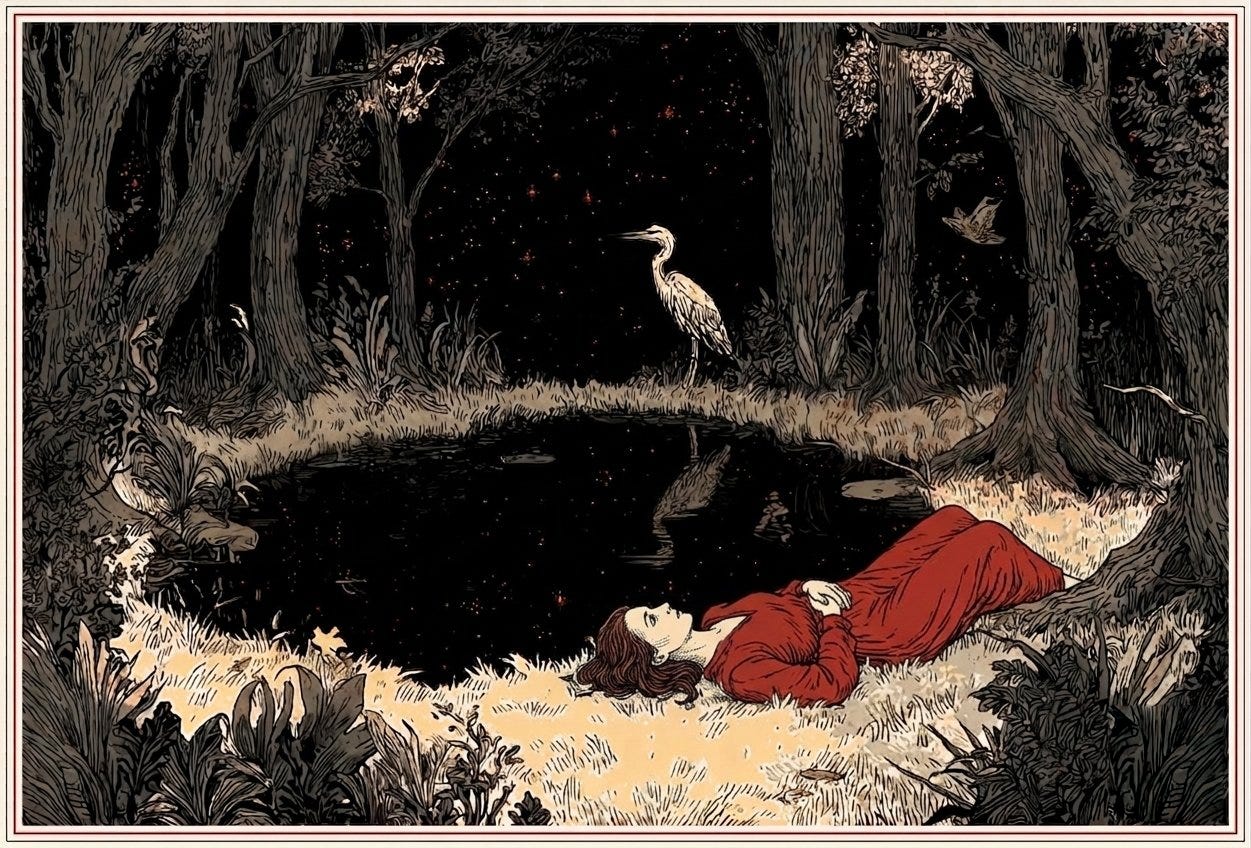
I will take Wendell Berry’s approach to this mess and go into the forest at night, where the wood drake rests and the great heron feeds, where the water is still and the stars are evergreen. For there’s no better balm to this illness we insist on inflicting upon ourselves than lying down next to those who don’t tax their lives with the forethought of grief.
Then I write.

The Peace of Wild Things by Wendell Berry

When despair for the world grows in me
and I wake in the night at the least sound
in fear of what my life and my children’s lives may be,
I go and lie down where the wood drake
rests in his beauty on the water, and the great heron feeds.

I come into the peace of wild things
who do not tax their lives with forethought
of grief. I come into the presence of still water.
And I feel above me the day-blind stars
waiting with their light. For a time
I rest in the grace of the world, and am free.