


Hey there, I’m Alberto!👋
Each week, I publish long-form AI analysis covering culture, philosophy, and business for The Algorithmic Bridge. Paid subscribers also get Monday how-to guides and Friday news commentary. I publish occasional extra articles and essays. If you’d like to become a paid subscriber, here’s a button for that:
Some news I’m excited to share with you:
I just launched El Puente Algorítmico, the Spanish edition of this newsletter. It’s the same price, same writing, same ideas adapted for a Spanish-speaking audience. I will be publishing each article in both places at the same time, so don’t subscribe twice! If you know someone who would love to read my work in Spanish, feel free to share it.

One of the concepts I consider
enormously useful
universally applicable
consistently misunderstood
is compound interest.
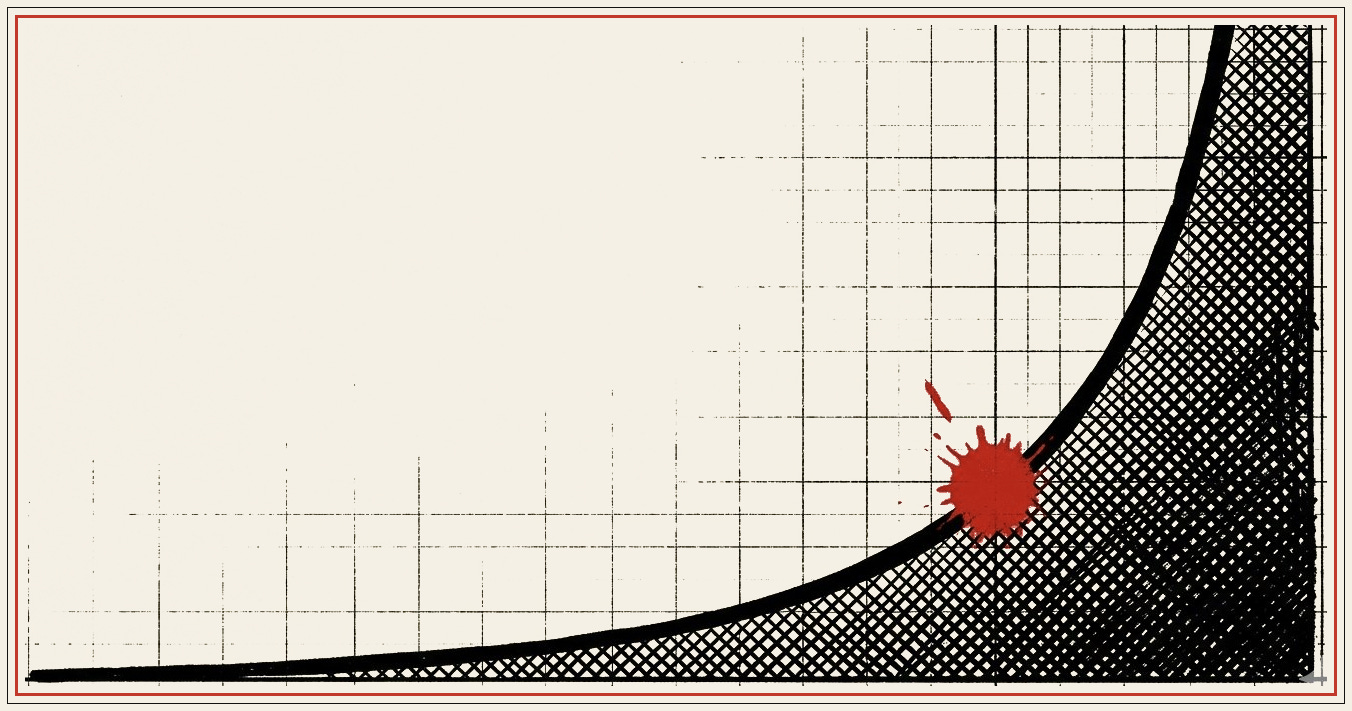
If you know it at all, it’s almost certainly in financial terms. You put a small amount every month into an index fund, and for a few years, you get back a very modest return on your capital. But once you’ve been at it for 20, 25, 30 years, those returns grow faster and faster. Each additional year after you’ve been at it for a long time is far more profitable than each additional year at the beginning.
The compound interest effect is counterintuitive, which is why it gets drilled into investors so relentlessly: don’t rush, don’t time, don’t judge future returns by present returns (or by past returns!), because every minute of consistency you add is the power of compound interest at work.
The most common mistake after not knowing what compound interest is or underestimating its long-term power is assuming it only applies to money.
Compound interest governs your life. Literally anything you can think of, anything you value, is subject to compound interest the same way the universe is subject to entropy, but with opposite valence; civilization exists because knowledge, culture, technology, tradition, etc., compounds across generations. Each of us gets one life; humanity gets all of them. The real power of time isn’t to deteriorate the universe in the long run, but rather to allow its existence as we know it.
But we don’t need to get metaphysical here. You can think of relationships, craftsmanship, hobbies, love—everything compounds.
There’s a phrase that helps me remember why it makes no sense to ignore the value of compound interest: “the years will pass anyway, so you may as well be doing something.” You may as well plant the seed of the tree of life you want to see.
Take my work as a writer.
Do you think every article I write today is worth the same as every article I wrote when I started? Not even close. It takes me approximately the same effort—I write faster, yes, but I also take on more challenging topics or ideas—but that’s just half the story: I’ve accumulated skills like researching, storytelling, structuring, register variation, vocabulary deployment, AI knowledge, plus everything that isn’t directly about writing: running an online business, building a subscription model from scratch, marketing, sales, social media, and on and on. On top of that, there’s the external value: revenue, audience, brand, and reputation.
All of that was tiny in the beginning: it’s huge now. Every new article I publish exists on top of this mountain of value that is only there because all the previous, “not-as-valuable” articles came first. None of those achieved much on their own, and that’s the whole point: together they make my archive; they make every article today extremely worthwhile. That’s compound interest.
The other day, I saw a tweet from Will Manidis, a guy whose writing I enjoy a lot (and whom I recommend you follow). He said: “the greatest regret i have is underestimating the value of long term compounding. friendships, people, places, all get better with decades. beautiful things dont even start to reveal themselves for years. it is entirely what life is about. a few good things for a long time.” The beautiful things in life don’t start revealing themselves as such for years. That´s exactly it.
Think of a tree you plant that won’t bear fruit for five or ten years. Or think of the virtuoso musician or chess grandmaster or Olympic athlete who’s been practicing daily since they were 6 and then boom, becomes an “overnight success” (a concept that, by the way, is the antithesis of compound interest and therefore my declared enemy). It’s so easy to say: “I want to be like them!” “I want to make brilliant sacrifices!” “I want to learn to play All Along the Watchtower!” “I want to jump as far as Michael Jordan or run as fast as Usain Bolt!” But it’s not so easy to practice hours and hours a day while everyone else is having fun with their short-term linear returns.
Nobody gets there without first doing the slow, tedious work of playing scales and studying openings and training over and over. You can’t reach the moon without a ladder.
The elegance of compound interest is that you don’t even have to apply it on purpose. Its strong legs will carry you to the top without you noticing. Paying attention to how your method improves is a good habit, but even if your only goal is pure consistency—never stopping—the method will improve on its own, almost by inertia. You’ll say: When did I get this good? Or maybe you’ll look at others who are just starting and notice the contrast.
There’s a well-known anecdote that captures exactly what I mean. It’s from the book Art & Fear by David Bayles and Ted Orland (popularized by James Clear in Atomic Habits), and it goes like this:
A ceramics teacher divided his students into two groups. He told the first group their grade would depend entirely on the quantity of pieces they produced. The second group only had to submit one piece, but it had to be perfect. At the end of the course, the best pieces—highest quality—had all been made by the quantity group. While they kept producing and learning from every mistake, improving their approach, etc., the quality group had spent the semester theorizing about perfection and ended up with nothing to show for it but a pile of dead clay.
The students in the quantity group weren’t trying to improve. Compound interest took care of it.
That’s what life is about, as Manidis puts it: “a few good things for a long time.” And it turns out that right now, the number one thing to spend a long time on so that it becomes, eventually, “beautiful” and “good for you” is AI.
Now, because I know some of you will feel a rightful resistance at the notion of associating AI with beauty, I will caveat this by saying that I’m not comparing the value of a decades-long friendship to using ChatGPT for a couple of years; that’s patently absurd. What I’m saying is that, if you can get past that resistance, you’ll see that the nature of innovation points to the same principle we´ve been talking about: the real value of AI won’t reveal itself to you until you’ve put in enough time for compound interest to kick in.
Once that happens, you will have long forgotten your grudges, if any, against it.
This is what I’m thinking about when I tell you to put in the effort to build competent “AI skills” even if you hate being force-fed this innovation. Or when I tell you that thinking about “what things to do” is more important now than thinking about “how to do things.” Or when I tell you that if your (future) employer has bought into the AI story, then it’s in your interest to be able to hold your own in an interview or a conversation with your overly enthusiastic boss.
My friends sometimes ask me “what’s the next big thing” (they ask me because I “predicted” the potential of both Bitcoin and AI back in 2016, a year in which I already felt like I was “late”). And I always tell them something along these lines: don’t lose sight of compound interest applied to AI.
Think about it in concrete terms.
Imagine two guys who start using AI on the same day. One uses it for what everyone uses it for: write this email for me. summarize this email for me, flirt with this Hinge girl for me, etc. The other starts the same way but goes a step further: he tries to get AI to help him think through a work problem he’s been stuck on for weeks (instead of using it to “do things for him,” he uses it to “help him do things”). But, oh, bummer, it doesn’t go well. The prompt is decontextualized, the response is bland and generic, like shapeless goo; he wastes two hours and ends up solving it himself. Looks like a waste of time, and he could rightfully give up on AI. It looks like the email guy got more out of it.
Fast forward six months.
The first guy is still doing the same thing. AI saves him fifteen minutes a day, which is fine, but it’s a linear return: minute 90 of use gives him the same thing as minute 1. There’s no compound interest because there’s no skill accumulation. He won’t get laid; he’ll be laid off.
The other guy, the one who “wasted” two hours, now knows how to frame problems; he’s created a mental model of the alien shape of AI. He’s learned which kinds of questions AI answers well and which ones it doesn’t. He knows when a response is plausible and when it’s slop dressed up in impeccable grammar. He’s developed an internal detector that requires you to be wrong many times. Every new project that lands on his desk starts from that accumulated knowledge base, so every new hour he invests yields more than the last. That’s compound interest.
Counterintuitively, the people who will benefit most from AI’s compound interest are the ones who have the hardest time at the beginning. So, if your first month with AI is frustrating—congratulations!
I went through this process in my own work. When I started using AI for research and editing, I swear it used to take me as long to verify what I found as it would have taken to find it myself. Now I have ways of tracking sources, cross-referencing data, and revising drafts that would have seemed like science fiction 18 months ago (AI agents that work well like Claude Code and Codex are to thank for this).
But it was not an overnight success. The way I research and edit today only works because I first learned to tell which sources AI evaluates well and which ones it doesn’t, what prompts work and which don’t, what flaws are common to all AIs and which are idiosyncratic to some but not others. Every failed attempt was an invisible deposit in the compound interest account.
To the person who says, “I’ll wait until AI matures,” you are doing the equivalent of trying to time the market: looking for the perfect moment to get in.
And what we know about time in the market vs. timing the market is that the latter almost always loses. Because while you wait, you’re failing to accumulate, and the cost of entry goes up. AI two years from now will be more powerful, yes, but also more complex, more embedded in everyone else’s workflows and absorbed into their tacit knowledge, and you’ll arrive without the basic vocabulary, skills, or concepts.
The edifice of your skills will be as tall as long is the time you let compound interest guide your life, but only if you’re willing to start with the foundation rather than the roof.
I like it .... but.....losses can compound too - Think doubling your bet to recoup your loss - and the well known definition of insanity - repeatedly doing the same thing and expecting a different outcome.
There's a reason why most aphorism have a converse.
Strong lens. Many firms expect AI gains immediately and abandon efforts when results look modest. The better analogy is long-term investing: workflows, skills, data habits, and trust compound before they become visible. Progress often arrives in Hemingway fashion: gradually, then suddenly.