


Hey there, I’m Alberto! 👋 Each week, I publish long-form AI analysis covering culture, philosophy, and business for The Algorithmic Bridge. Paid subscribers also get Monday news commentary and Friday how-to guides. I publish occasional extra articles. If you’d like to become a paid subscriber, here’s a button for that:
ChatGPT is losing subscribers and market share. Claude is winning on both fronts. But is the boycott an existential threat to OpenAI? How many people have to quit for it to show up in their revenue? And is Anthropic becoming the Google to OpenAI's Yahoo? That’s what I’m trying to answer in today’s extra free article.

I. AN ANTI-OPENAI CAMPAIGN
After OpenAI announced its Pentagon deal this past weekend, ChatGPT mobile app uninstalls in the US spiked 295%. Downloads dropped 13%. One-star reviews surged 775% in a single day; five-star reviews fell by half. The QuitGPT campaign—a grassroots initiative that started in January 2026—claims 2.5 million signatures. My entire X timeline is people urging others to cancel ChatGPT and switch to Claude.
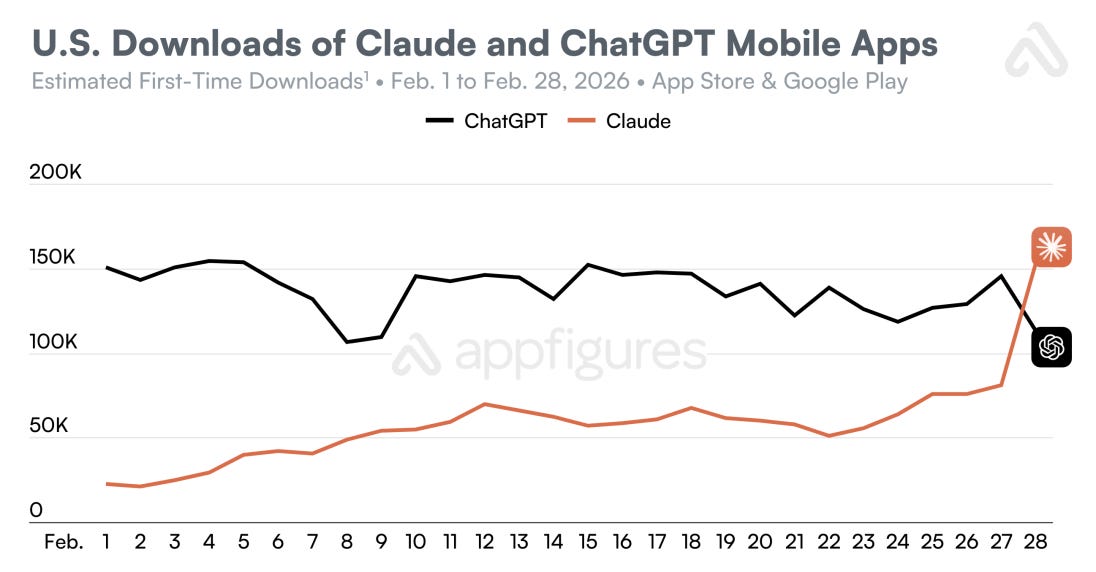
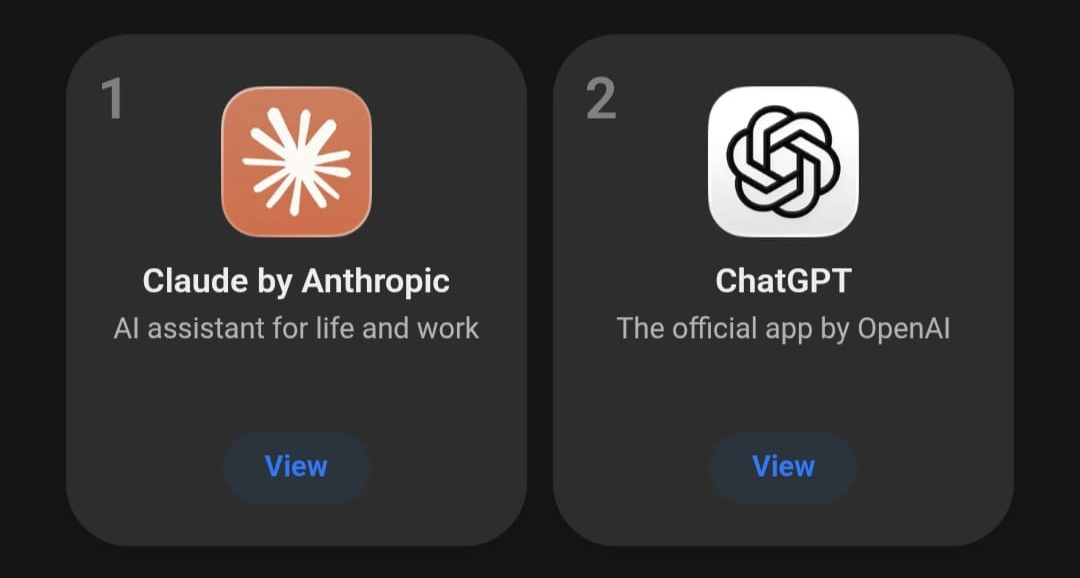
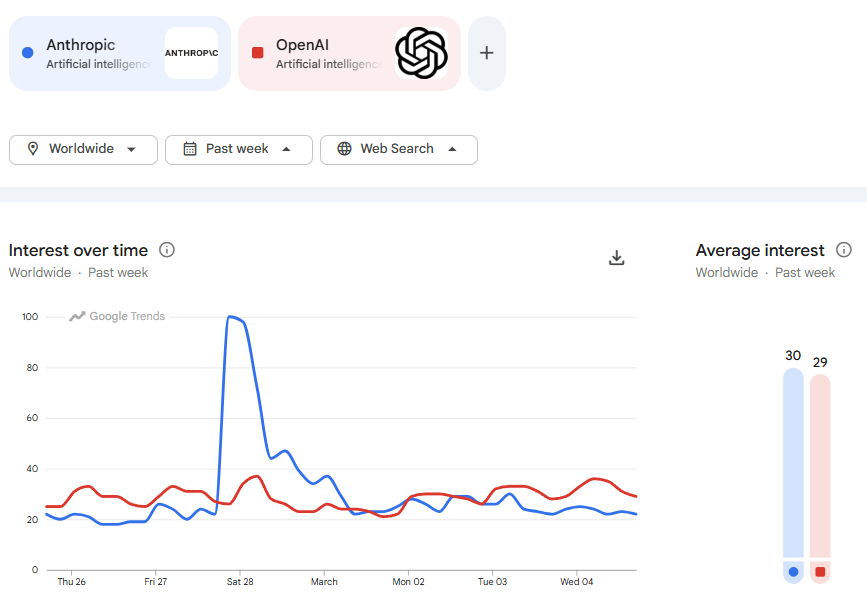
Meanwhile, Claude, Anthropic’s chatbot, jumped from outside the top 100 to #1 on the US App Store and #1 on the Android Store. (TechCrunch also reports that Claude is “the No. 1 free iPhone app in six countries outside the U.S., including Belgium, Canada, Germany, Luxembourg, Norway, Switzerland.”) It’s still there at the time of writing. Downloads have quadrupled in ten days, and the company reported record daily sign-ups every day for the past week, with free users up 60% since January and paid subscribers more than doubling this year (Anthropic's annualized revenue more than doubled from late 2025 to $20 billion). In a final irony, Anthropic momentarily passed OpenAI on Google Trends.
By any normal standard, this is a very significant consumer event. Most of them were free users, but plenty have cancelled Plus/Pro accounts. There’s revenue moving from OpenAI’s pockets to Anthropic’s. Rutger Bregman, a historian who was among the first to promote the initiative, wrote this in The Guardian: “History shows why #QuitGPT has so much potential: effective campaigns such as the 1977 Nestlé boycott and the 2023 Bud Light boycott were successful because they were narrow and easy. They had a clear target, and people had lots of good alternatives.”
The sentiment, from what I’ve been able to gather, is ubiquitous and strong even among people unplugged from the news. But there’s a question I have not seen anyone ask: What does this look like from OpenAI’s side? How does this “international boycott” fare against ChatGPT’s multi-year streak of unprecedented popularity? Is QuitGPT and the Pentagon deal a threat to OpenAI or barely a dent in a mountain?
II. QUITGPT FROM THE OTHER SIDE
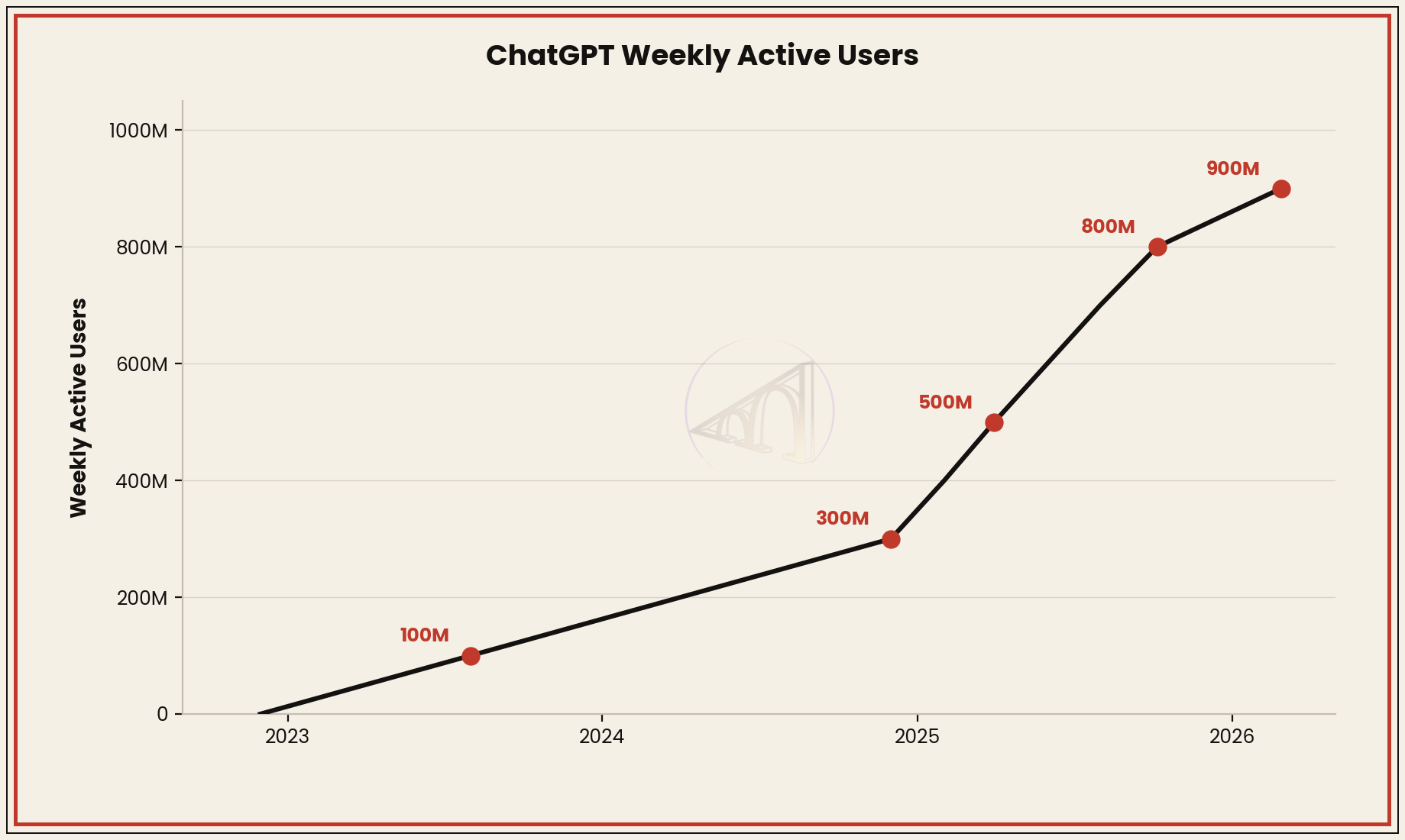
ChatGPT has somewhere around 900 million weekly active users, and it’s been growing rapidly for three and a half years straight. It has roughly 50 million paying subscribers: 35 million individual, 3 million enterprise, 1.6 million Codex, and expects around 220 million by 2030 (although the projection might be corrected down). OpenAI’s annualized revenue exceeded $20 billion in late 2025, and the company is targeting ~$30 billion for 2026.
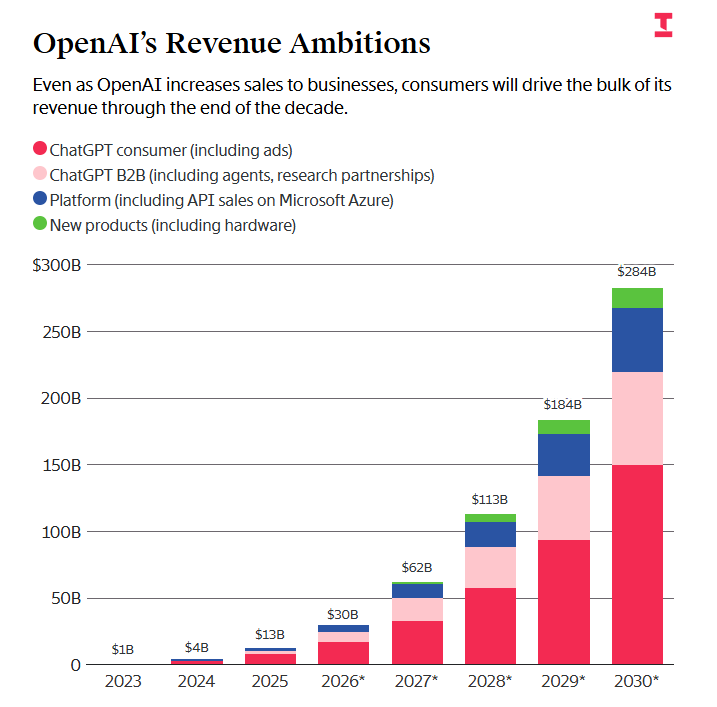
Let’s now imagine a drastic scenario. Say OpenAI finishes this disaster with 10 million free cancellations (to put a high number that, by all accounts, surpasses the current number). At a 5% paid-to-free ratio, it translates to 500k fewer paid subs. That’s about $10 million per month in lost revenue. Against a ~$30 billion annual target, that’s 0.33%. In terms of popularity, 10 million weekly active users represent around 1% of the entire ChatGPT user base.
The boycott might not be meaningless—Claude is suddenly on the map for people outside of the AI circles, which is in itself a milestone for Anthropic, especially given that they’re seen as “the good guys” now—but at its current scale, it’s a rounding error in OpenAI’s business. The company would need to lose this many subs every single month for a year before it showed up in a quarterly earnings conversation.
III. AN EXISTING DOWNTREND
What makes the “QuitGPT” numbers worth looking into is that the current spike is happening on top of an existing trend. ChatGPT’s US mobile app market share fell from 69.1% in January 2025 to 45.3% in January 2026. That’s a 24-point drop in twelve months before any organized boycott. Its share of US daily active users went from 57% in August 2025 to 42% by February 2026, with losses in “four consecutive months.” Globally, the daily active user share fell from 73% to 57%.
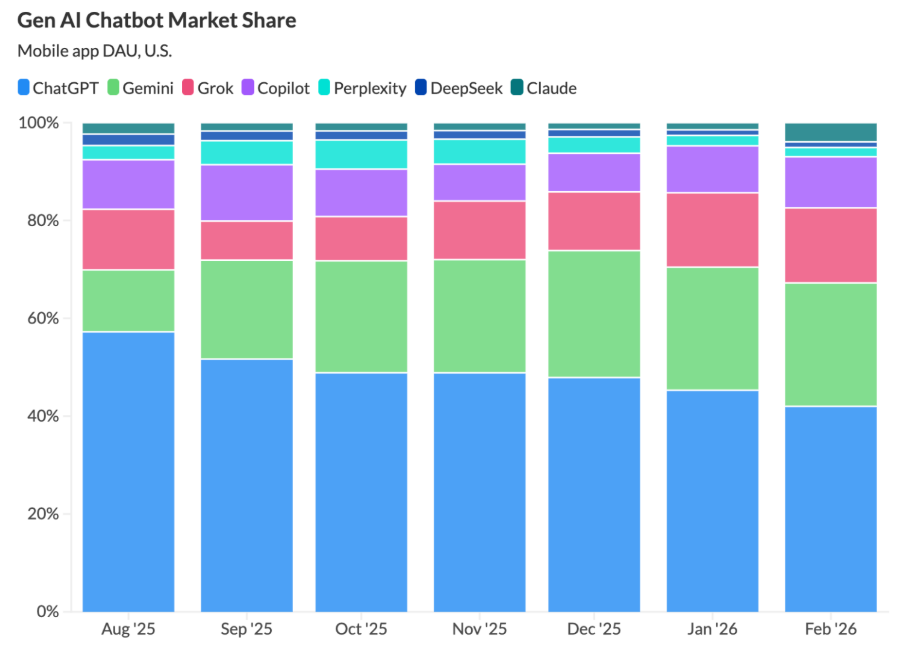
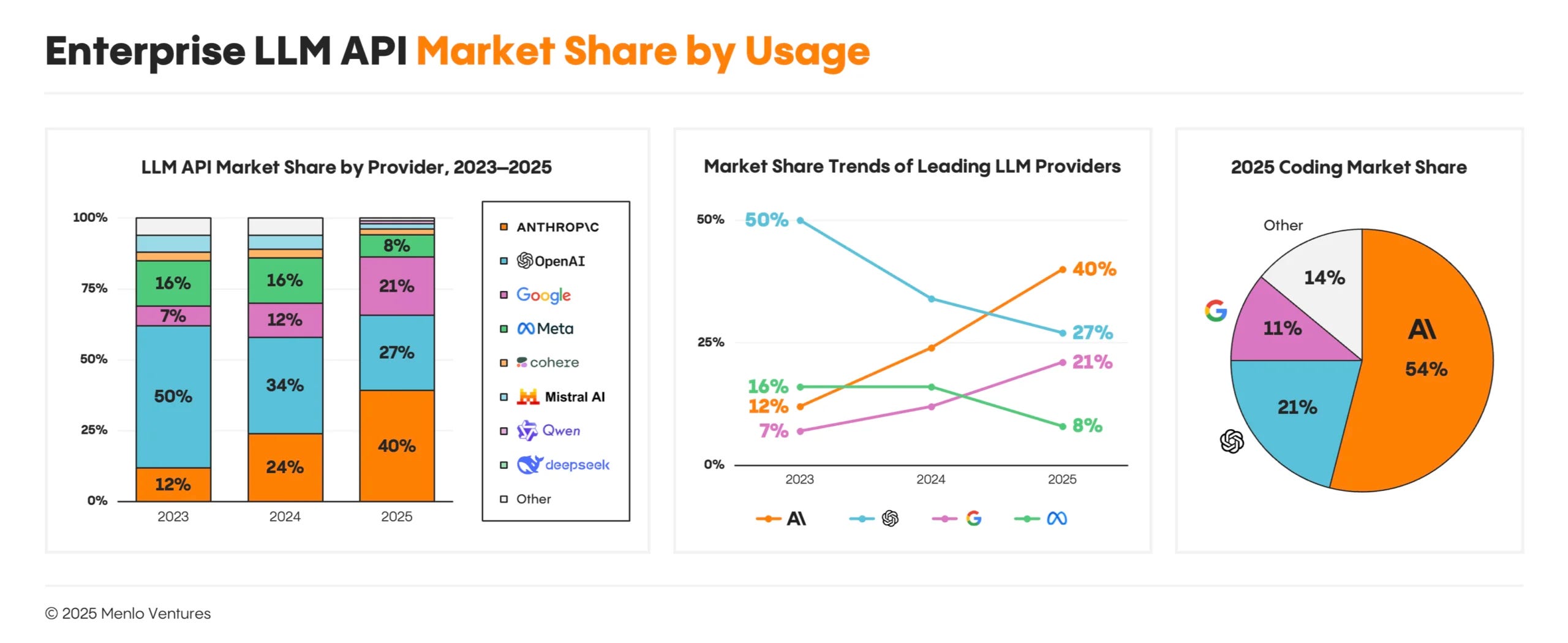
The beneficiaries are spread across the market: the world is starting to realize that ChatGPT is not the only option, that ChatGPT is not synonymous with AI. Google’s Gemini grew from 14.7% to 25.2% in the US app share. Grok went from 1.6% to 15.2%. Claude tripled its US daily active user share in February alone (we know why). In enterprise, the reversal is complete: Anthropic now captures 40% of enterprise LLM spend, up from 12% in 2023, while OpenAI dropped from 50% to 27%. In coding specifically, Anthropic holds 54% to OpenAI’s 21%.
One in five AI chatbot users now has more than one app installed, up from one in twenty at the end of 2023. No single app holds a majority of the US market share anymore. OpenAI is not a monopoly, despite popularity rankings and app ratings. The current boycott should be analyzed in this context. ChatGPT was already losing ground structurally—through product dissatisfaction (who wants ads in their AGI?), rising competition, and near-zero cost of trying alternatives—and now also popularly, thanks to the rushed deal with the Pentagon and the subsequent backlash.
IV. WHAT’D IT TAKE TO KILL IT
Let’s take a look at the science of… snowballs.
In 2018, Damon Centola and colleagues published a study in Science on “tipping points in social conventions” (another name for the snowball effect). His experiment put 10 groups of 20 people each into a coordination game where they’d agreed on a norm, then introduced confederates (participants who are secretly working with the researchers and pretend to be regular subjects), pushing for a change. When the minority pushing for change was below 25% of the group, nothing happened. At 25%, however, the entire group flipped.
In one trial, the difference between four confederates and five—between 20% and 25%—was the difference between zero converts and total conversion. The researchers tested how robust the established norm was by doubling and tripling the financial incentive to stick with it. The 25% minority overturned it anyway.
The good news is that there’s some science backing the tipping point phenomenon, which means ChatGPT could theoretically be dethroned (I don’t think it would be good news for the industry that OpenAI died, by the way). The bad news is that, if we apply that threshold to ChatGPT’s user base, we get that twenty-five percent of 900 million weekly active users is 225 million people.
QuitGPT’s 2.5 million is 0.25%. The figure of 10 million that I made up for illustrative purposes is still barely above 1%. The distance between where the anti-OpenAI movement is right now and where it would need to be to be a genuine threat is not a gap you bridge with social media viral posts, but a two-order-of-magnitude abyss.
(Centola’s study was designed for social norms in small groups, not consumer product markets with nearly zero switching costs, which is what Bregman emphasizes has worked in previous boycotts in history. The threshold for product abandonment is possibly lower. The point stands: the scale of collective action required to threaten a product at ChatGPT’s level of adoption is vastly larger than this.)
V. A SMALL STEP FOR YOU, A GIANT LEAP AGAINST OPENAI
You were never going to kill OpenAI by yourself; your individual cancellation will not show up in OpenAI’s quarterly numbers. Probably not even the entire QuitGPT campaign. Despite my recent attacks on their decision to put ads, I can’t deny that OpenAI has a great product. They have robust support from cloud providers, data vendors, the government, etc., things that are only indirectly reflected in trends and market share stats that change every month. The company’s financial projection remains consistent, if still a bet on an uncertain future.
But there’s a good chance OpenAI dies anyway. I wrote about it in “You Have No Idea How Screwed OpenAI Is,” which is as straightforward a headline as it gets.
QuitGPT is but one factor in a long list of concerns keeping Sam Altman up at night. Anthropic’s enterprise lead is more worrisome for them than $10 million in monthly revenue up or down. So is Google itself, a much more robust company fighting for the same space. Microsoft is as well; an important backer that has expressed differences a few times before and has hinted at the possibility of withdrawing funding or compute. What about Stargate? The ambitious datacenter project is proving too big even for OpenAI. The talent exodus to competitors is doubly problematic: they weaken the company while at the same time strengthening the rest. Even Altman’s decision to over-diversify the efforts of his small-ish startup is itself a risky bet.
All in all, the “anti-OpenAI” campaign is good if only because the AI industry is today more competitive than ever. Because today, there’s an even lower chance that any one company achieves monopoly status in the market of what could be the most consequential technology in recent history. The ecosystem is diverse and the ones who invariably benefit when that happens are us: users and consumers.
The 0.25% math is the most clarifying thing I've read about this whole saga.
Consumer rage is real but it lives in a totally different magnitude than enterprise contracts and weekly active users. What's interesting to me is the 69% to 45% US market share drop over a year, that's not the QuitGPT crowd, that's Claude and Gemini just quietly getting better. The boycott gets the headlines but the actual competitive threat is showing up in product quality, not petitions.
There's this somewhat hidden thread, is how would a company conduct strategy if they actually believe that recursive improvement will lead to takeoff?
One company is conducting themselves one way and the other the other way. If there is a takeoff, small differences in initial conditions will separate operators.