


Hey, Alberto here! 👋 Each week, I publish long-form AI analysis covering culture, philosophy, and business for The Algorithmic Bridge. Paid subscribers also get Monday how-to guides and Friday news commentary. I publish occasional extra articles. If you’d like to become a paid subscriber, here’s a button for that:
Today, I bring you a practical guide in light of a concerning BCG study published in the Harvard Business Review: you are frying your brain with those AI agents. There’s plenty of information out there about how to use your AI agents to get stuff done. This is a follow-up guide that aims to achieve the opposite: how to keep your brain sharp.

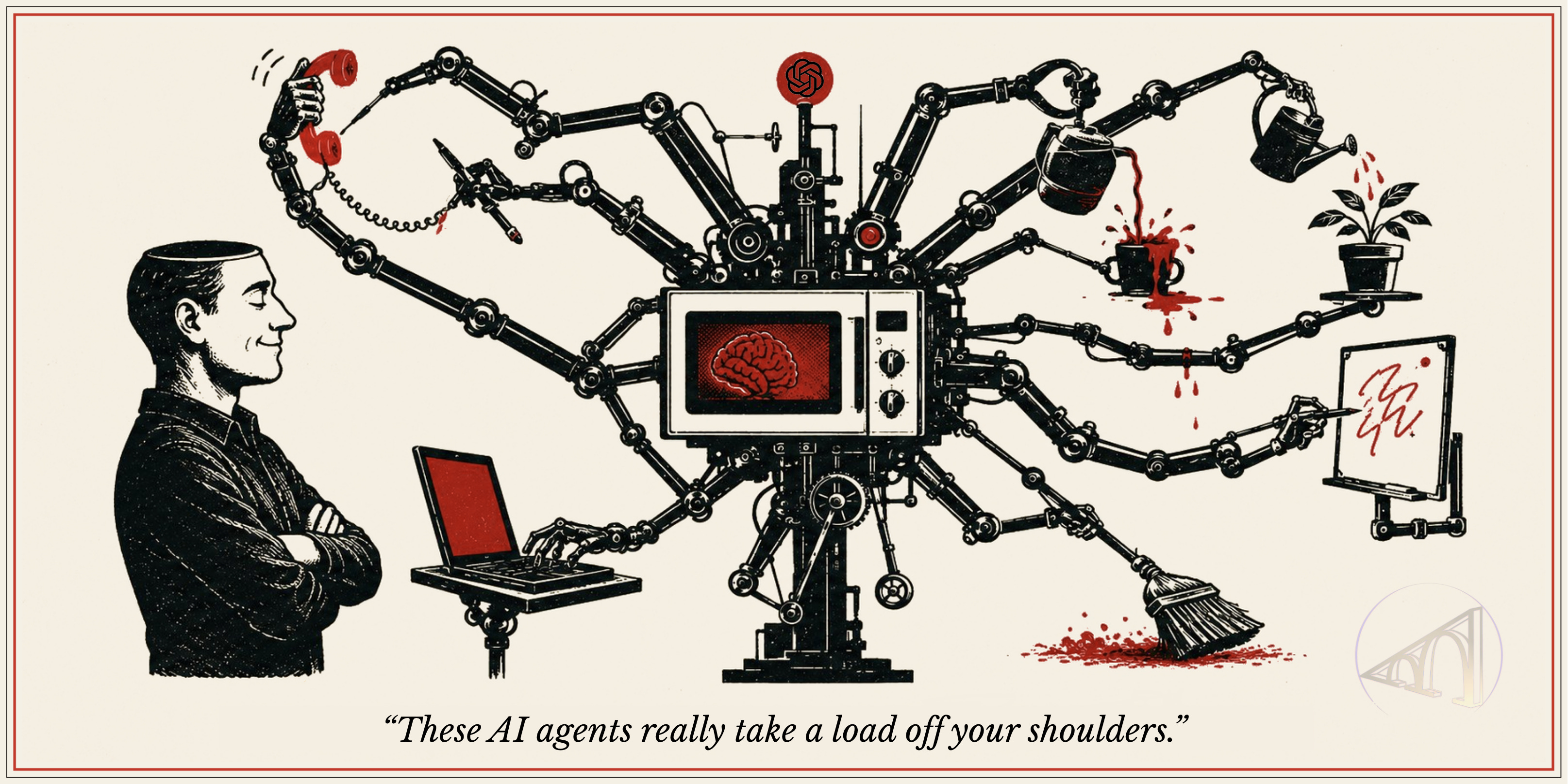
I. AI OVERUSE INDUCES MENTAL FATIGUE
A recent Boston Consulting Group study published in Harvard Business Review found that over-engineered workflows are a prevalent mistake.
Workers using four or more AI agents simultaneously—often doing complex looping tasks with harnesses—reported the opposite: brain fog and a net feeling of being less productive than before. It leads to “employee errors, decision overload, and, ultimately, intent to quit.” Workers using three or fewer, in contrast, reported meaningful productivity gains.
BCG calls it “AI brain fry” (also known as AI-induced mental fatigue). Our biological brains have a limit to how much information they can hold at once. If you surpass this limit you will experience a fog that makes you unable to think clearly, marked by difficulty focusing, slower decisions, and headaches that force you to physically walk away from the screen.
This happens to me a lot nowadays. I’m researching a new topic every day, or asking Claude to explore a new idea. I have several tabs open with agents running, some doing loops on my archive (e.g., what topic have I not covered in a while), others doing a complex analysis task (e.g., what do my best articles have in common?). At some point—this happens every single day—I give up control. My mind “goes blank,” and I feel as if I were speeding down the hill riding a bike, but my feet are no longer on the pedals. Some days, I try to get my mind back on track, but others, I let the bike reach the bottom of the hill, forgetting in the process half the things I’m doing.
I have more Claude skills than I need, more ongoing chats/projects than I can possibly remember, and nearly 1,000 drafts sitting in my draft folder with half-baked ideas that I will never revise. The consequence is that I leave more tasks unfinished every week than I used to start at all before agents were a thing. I could read this as: “My productivity is so high that my short-term memory can no longer hold as many items in the mind at the same time.” Or I could say: “I’m saturating my capacity to keep track of what I’m doing.”
Agents drove to zero the friction to start, but not the friction to keep going.
II. A FINITE POOL OF SHARED RESOURCES
BCG surveyed 1,488 full-time US workers across industries and roles. The study measured several dimensions of how people use AI—number of tools, degree of oversight required, whether AI replaced tasks or added to the workload—and cross-referenced those against cognitive measures. The single strongest predictor of mental fatigue was how much oversight the AI requires.
The people who had to monitor, verify, and babysit their AI tools were the ones getting fried. There’s just “too much going on for you to reasonably comprehend,” said a user of an agent-orchestrating platform. Fourteen percent of the AI-using workers in the study reported experiencing brain fry: 33% more decision fatigue, 39% more major errors at work, and a 39% increase in intent to quit.
You can always not monitor at all, yes, but that’s how you collect insane amounts of technical debt if you’re a developer or intellectual debt if you’re a writer, like me. Do you really want to put your name on something you ship to production without human supervision? AI agents are not there yet.
This is separate from using too many tools, a related but distinct problem that I covered recently. The core problem is that intense AI supervision of simultaneous processes demands exactly the cognitive resources—sustained attention, working memory, executive control—that have hard biological limits. You may be running 10 agent instances, but your brain’s capacity can’t be divided. Nor can it be doubled, like you’d spin up another 10 instances with a bunch of clicks.
But wait, isn’t this the good ol’ burnout? Not really.
Burnout is emotional exhaustion, the kind that builds over months from a bad boss or a toxic culture or work you find meaningless. It can happen with AI if you have to constantly edit wrong outputs or if you’re forced to use it to meet company standards or if you are exposed to too much “workslop.”
Brain fry is, in contrast, an acute cognitive strain. It comes from marshalling attention and working memory beyond their capacity. It happens in hours, sometimes minutes.
Actually, the study found that when AI is used to replace repetitive tasks, burnout scores—but not brain fry scores—go down by 15%. The same technology can reduce emotional exhaustion while simultaneously causing cognitive overload.
III. IS BRAIN FRY GOING AWAY?
I think we’re in a temporary phase in terms of current practices of AI use, particularly agents, but I want to be precise about what makes it temporary (and what might be permanent).
The temporary part: we haven’t yet developed the habits and best practices for managing multiple agents (to be clear, I don’t think we have them for one agent either; we’re learning as we go). AI management is essentially trial and error, a sort of “AI alchemy,” which means we oscillate between too much control (e.g., “nothing ships without my supervision”) and too little (e.g., “the only metric should be how many tokens you’re spending”).
But I’m not worried about this: the best practices will come, the way they came for email and phones, and firearms and cars and every other tech that used to overwhelm us.
The part that might not be temporary, however, and thus worries me a bit, is that the ceiling on how many agents you can oversee is set by a “fixed” human biology, and AI capability is growing faster than human adaptability. (It’s not fixed in absolute terms, but natural selection is damn slow.)
What I mean is that we are not octopi. We didn’t evolve to cope with a swarm of eight moving parts running independently of a central processing unit. Having one agent do one task is mostly manageable. Having a swarm doing several things at once while you try to keep the whole picture in your head will run you into a memory wall and a processing power wall and an energy wall, etc.
Working memory and attentional bandwidth and metabolic rate all have hard biological limits, and unlike AI capability, those limits don’t improve with the next model release.
This is exactly the opposite of what I imagine happens to smart people when their brain goes faster than their hands or their mouth, and so they can’t write or speak as fast as they’d like; it feels like a serious bottleneck. What we’re experiencing is the same thing in reverse: the hands and the mouth now go faster than the brain, which is, in turn, the bottleneck.
AI is pushing our brains to their biological limits.

Inside the rest of this guide, I break down what actually works against AI brain fry: How to cap your agent load before it caps you, why the people with the lowest fatigue scores aren’t the ones using less AI but the ones whose teams built shared norms for it, what your manager should be doing (and what to do if they aren’t), how to read the indirect signals your company is sending about workload expectations, and the single largest protective factor in the BCG study: a 28% reduction on a variable that has nothing to do with AI at all.

