


Hey there, I’m Alberto! 👋 Each week, I publish long-form AI analysis covering culture, philosophy, and business for The Algorithmic Bridge. Paid subscribers also get Monday how-to guides and Friday news commentary. I publish occasional extra articles. If you’d like to become a paid subscriber, here’s a button for that:
This is going to be the hottest topic for the rest of the year.

INTRODUCTION
Between 2024 and 2026, AI datacenters went from obscure municipal zoning topics to front-page political fights. A large number of polls from Gallup, Pew Research Center, NBC News, the Washington Post, Change Research, Marquette Law School, and others have measured what Americans feel and think about AI, datacenters, AI companies, and the people who run them.
Everyone has a vague sense that Americans are turning against AI—more so than in any other country—but no one has put together the full map. It’s lost in fruitless discussions on X, localized anecdotes and repetitive news stories.
This is the full map.
I’ve gathered every major piece of survey data I could find.
The global conclusion that emerges from this compilation is simple and, as far as I can tell, unprecedented: every available measure—partisan, demographic, regional, longitudinal—points in the same direction.
Here’s the outline:
AMERICANS DON’T WANT DATACENTERS NEAR THEM
AMERICANS DON’T TRUST AI IN GENERAL
AMERICANS DON’T LIKE THE PEOPLE BUILDING AI
AI HAS BECOME A BIPARTISAN PROBLEM
WHERE THE AI BACKLASH HAS MATERIALIZED
WHAT WE DON’T KNOW
GLOBAL CONCLUSIONS
When someone asks what we know about the general sentiment against AI, you show them this compilation. When someone argues that anecdotal evidence is not enough, you show them this. When someone says most people actually love this technology, you show them this.

I. AMERICANS DON’T WANT DATACENTERS NEAR THEM
Multiple pollsters have asked versions of this question between 2025 and 2026, with remarkably consistent results. Americans have gone full NIMBY on datacenters.
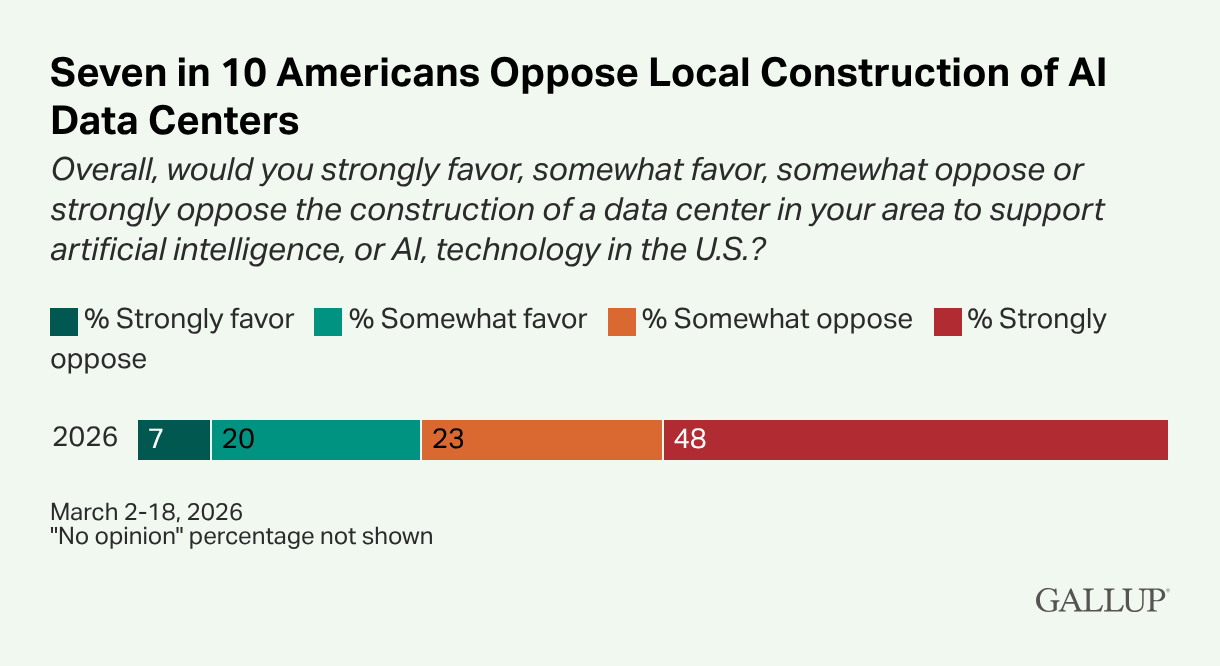
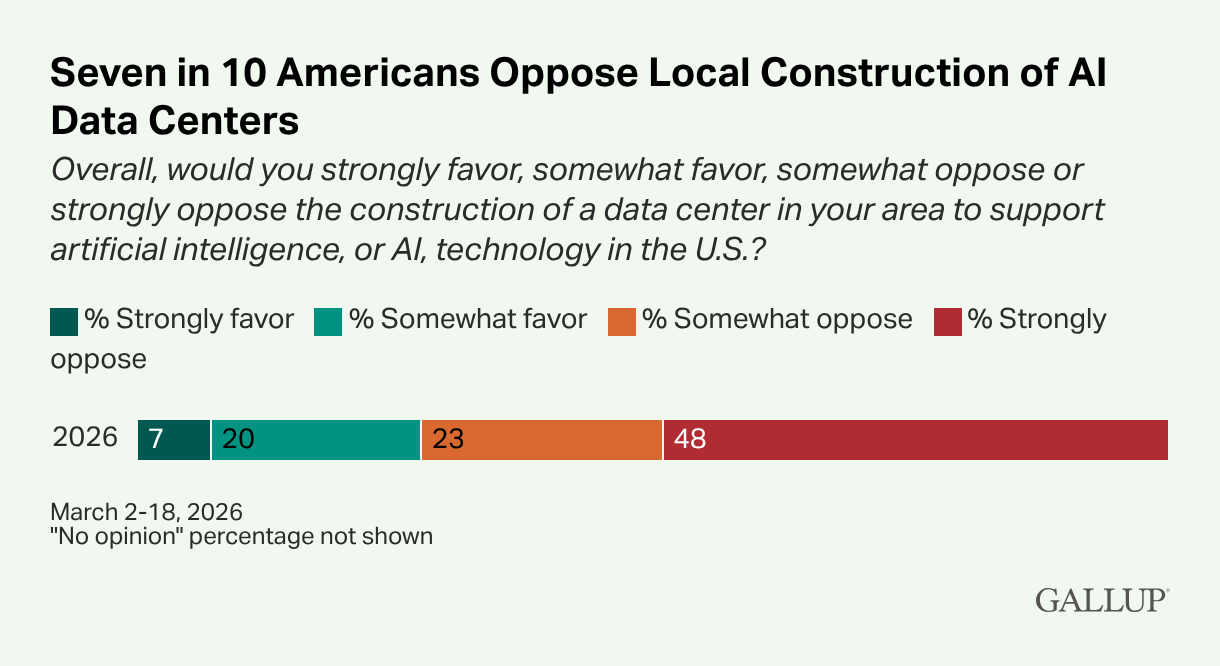
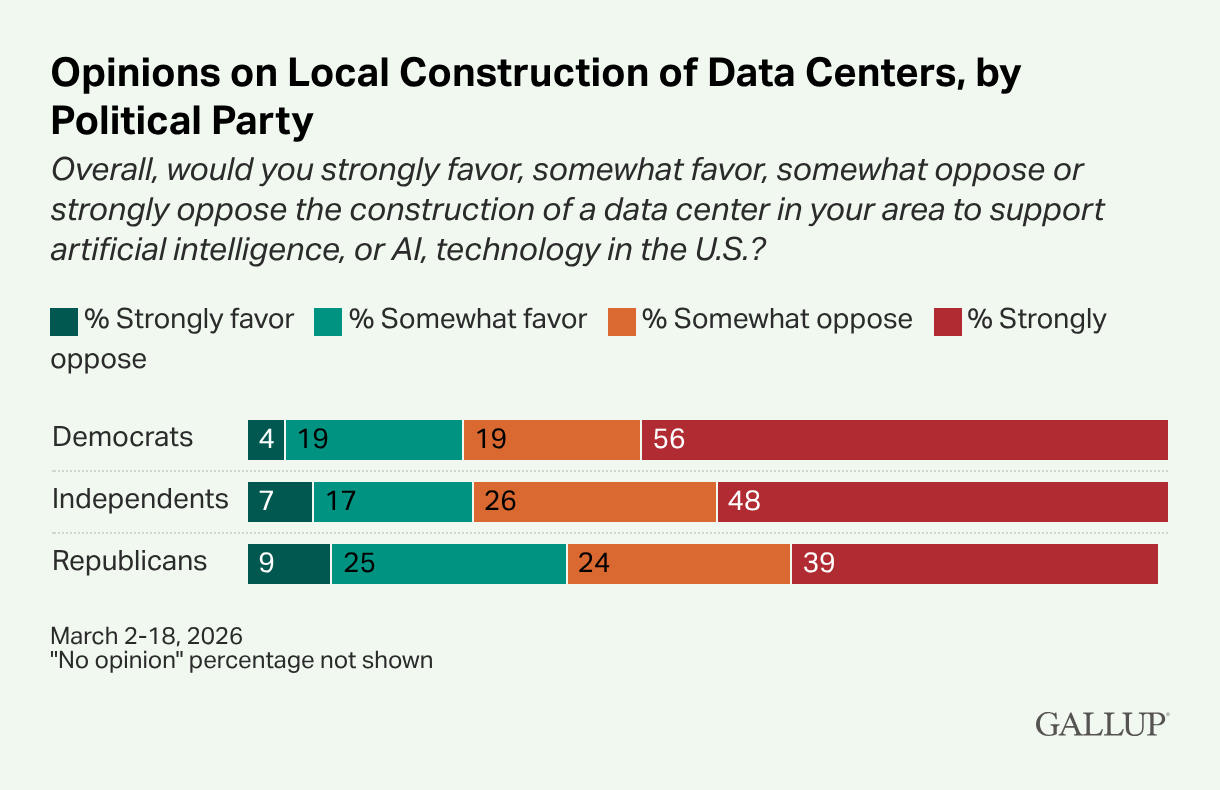
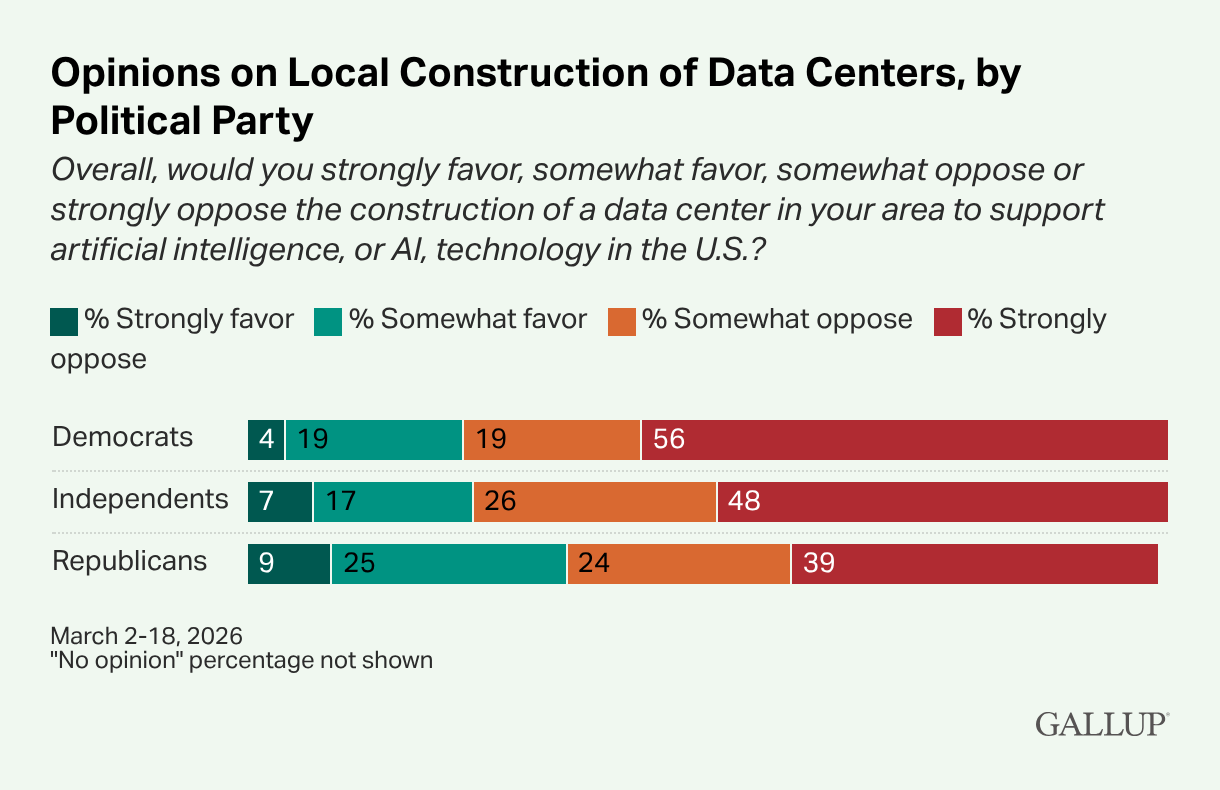
Americans Oppose AI Data Centers in Their Area (Gallup, publication date: May 2026, N=1,000 adults): 71% oppose the construction of an AI datacenter in their local area; 48% are strongly opposed. Only about a quarter favor construction, with just 7% strongly in favor. 70% worry “a great deal” (46%) or “a fair amount” (24%) about the environmental impact of AI datacenters. Among opponents, roughly 50% cited excessive resource use (18% water, 18% energy), ~20% cited quality-of-life concerns, and ~20% cited economic worries. Among supporters, two-thirds cited economic benefits, including 55% who specifically mentioned jobs. (Datacenters have surpassed nuclear as the most-opposed local infrastructure.
Source: Gallup Data Center Costs Outweigh Benefits (Marquette Law School Poll, October 2025 and February 2026, N=818 Wisconsin registered voters): In October 2025, 55% of Wisconsin voters said the costs of large datacenters outweigh their benefits. By February 2026, that number jumped to 70%. Partisan breakdown: Republican opinion barely moved (53% to 55%), independents surged (55% to 76%), and Democrats exploded (56% to 85%).
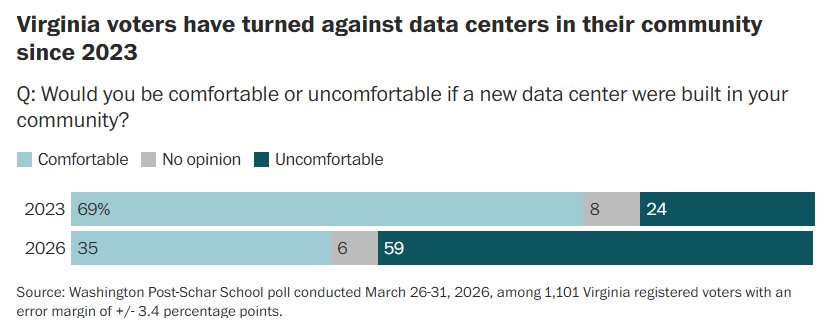
In This U.S. Hot Spot for Data Centers, Voters Have Turned Against Them (Washington Post–Schar School, April 2026, N=1,101 Virginia registered voters): Comfort with a local datacenter collapsed from 69% in 2023 to 35% in 2026. 57% say datacenters negatively affect home energy bills. 59% say they damage the local environment. In Loudoun County, where datacenters directly fund schools and suppress property taxes, 51% believe they are making their tax bills worse.
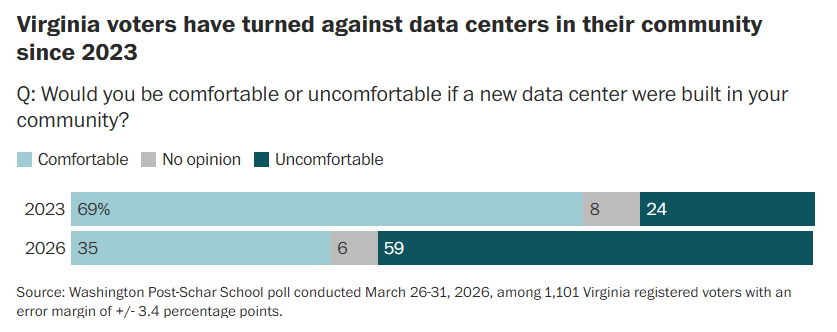
Source: Washington Post
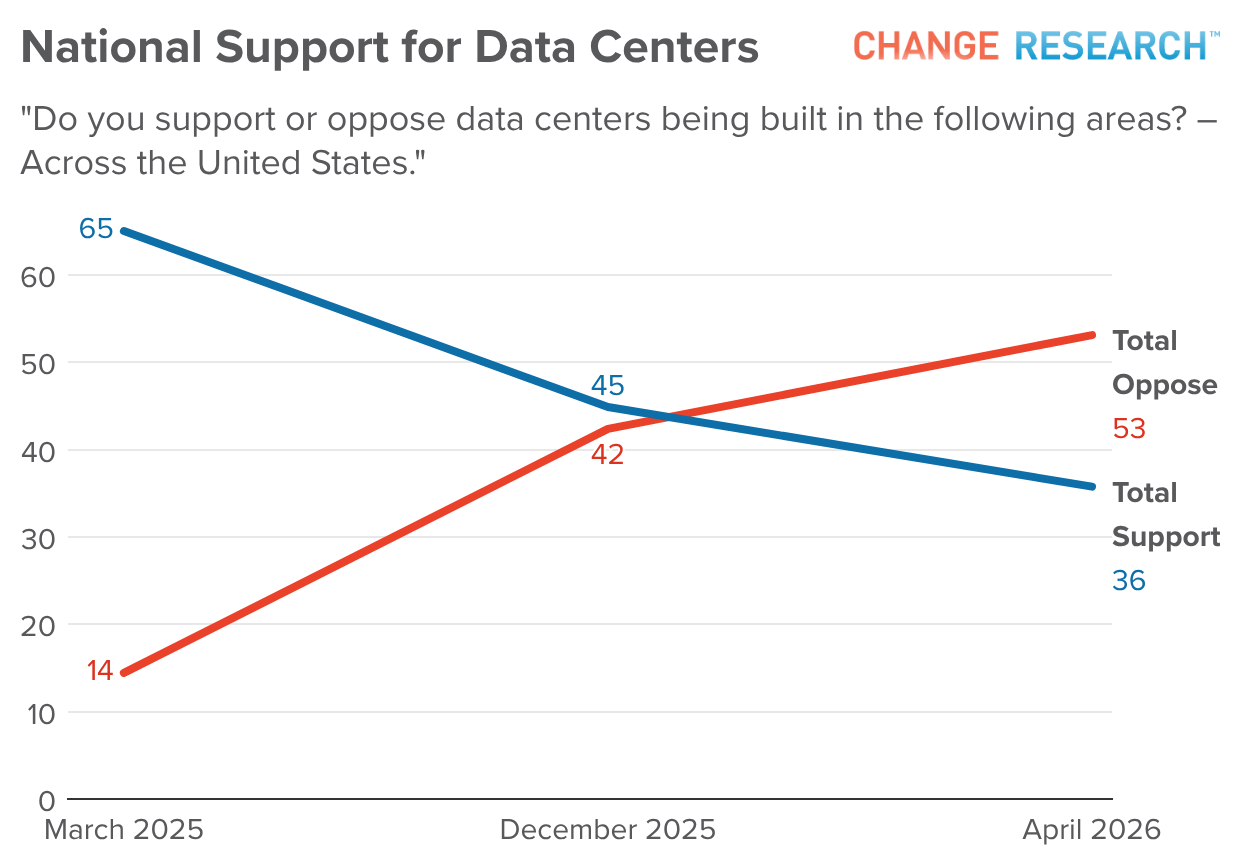
Opposition to Data Centers Has Grown Sharply Since 2025 (Change Research, April 2026, N=2,702 national registered voters): Local support for datacenter construction fell from 51% support / 26% oppose in March 2025 to 25–26% support / 65% oppose in April 2026, a more than 40-point net swing in a year. For construction near respondents’ own homes, the opposition is ~74%.
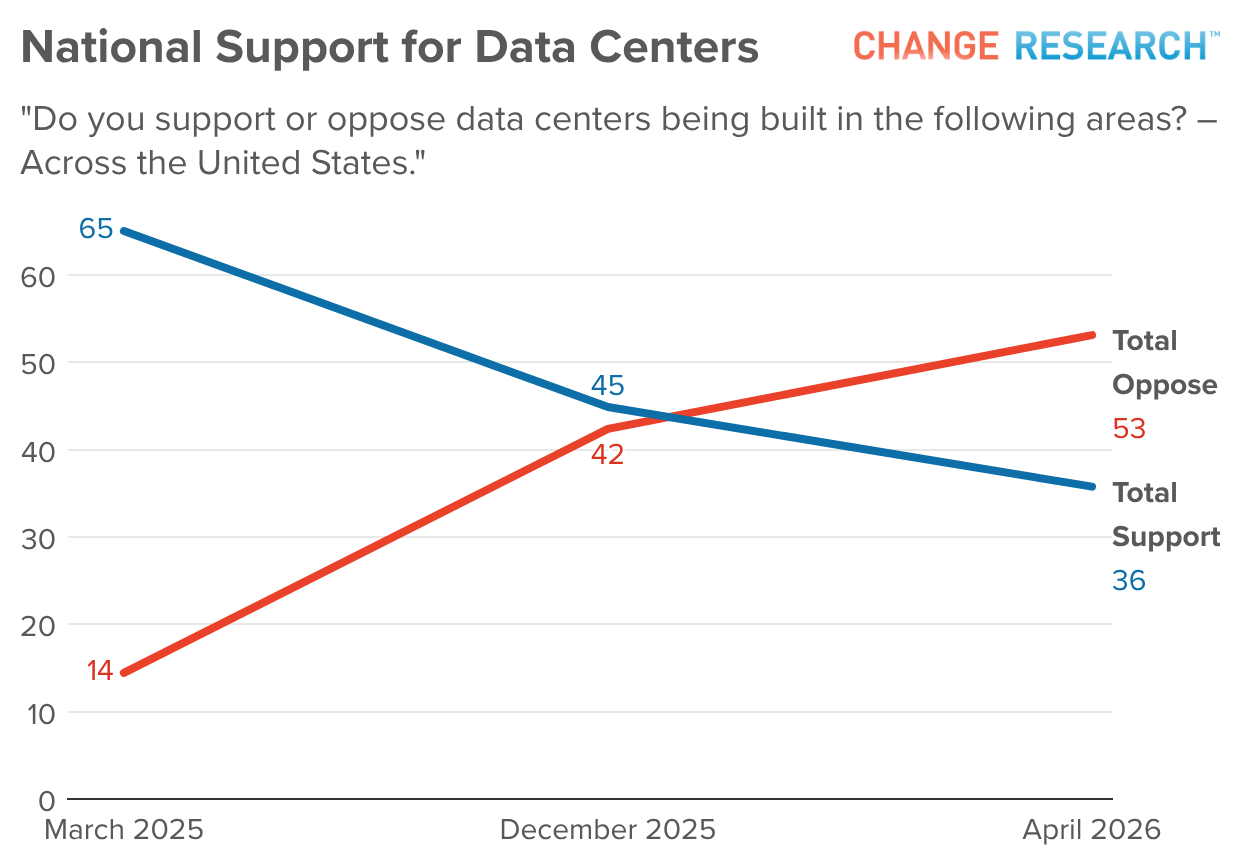
Source: Change Research Only 44% of Americans Would Welcome a Data Center Nearby (Heatmap News / Embold Research, September 2025, N=3,741 registered voters): Only 44% would welcome a datacenter near them, 42% opposed. Datacenters ranked below solar, wind, natural gas, nuclear, and battery storage in local acceptability. A follow-up Heatmap Pro poll in early 2026 found opposition had deepened further, with net support for datacenters at −8% among suburban/urban Republicans and −20% among rural Republicans.
Voters Are Turning on AI Data Center Construction (Morning Consult Intelligence, February 2026, N=~2,200 registered voters): Support for a ban on the construction of AI datacenters near respondents’ communities rose from 37% (October 2025) to 41% (November 2025), while opposition to a ban fell from 39% to 36%. In the same period, the share of voters who said AI datacenters are “very or somewhat responsible” for rising household electricity costs grew from 54% to 58%. 45% of voters said datacenters have adverse effects on the price of electricity—the single most-cited concern.

“Voter support for banning the construction of AI data centers near where they live.” Source: Morning Consult Intelligence

Conclusions: Pollsters, methodologies, and geographies converge. The opposition to AI datacenters is a measurable, replicable fact about American attitudes (it doesn’t necessarily replicate in other countries). To me, the most striking number in this section is that datacenters now exceed nuclear plants in local opposition, an infrastructure category with decades of accumulated fear behind it. Just how badly has the industry botched things to generate such strong opposition?

II. AMERICANS DON’T TRUST AI IN GENERAL
The data center backlash sits inside a broader, older pessimism about AI itself. I don’t think this reflects people’s opinions about the usefulness of the technology, but rather the perception that it’s unreliable and easy to misuse (this applies to both individuals and enterprises).
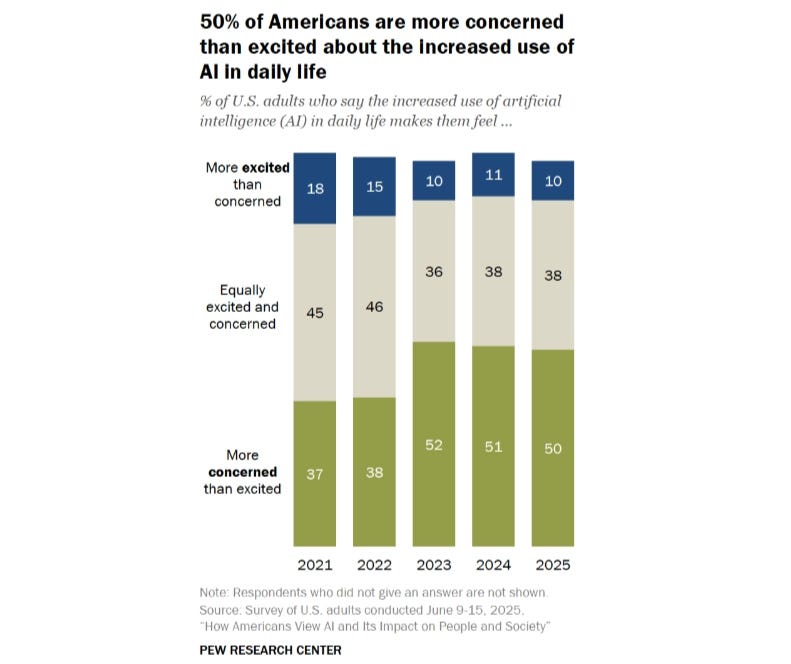
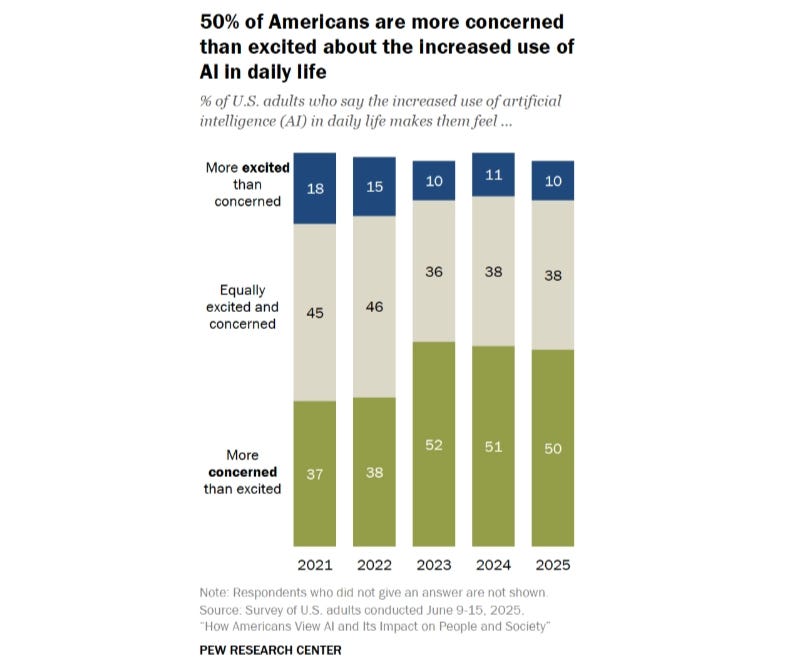
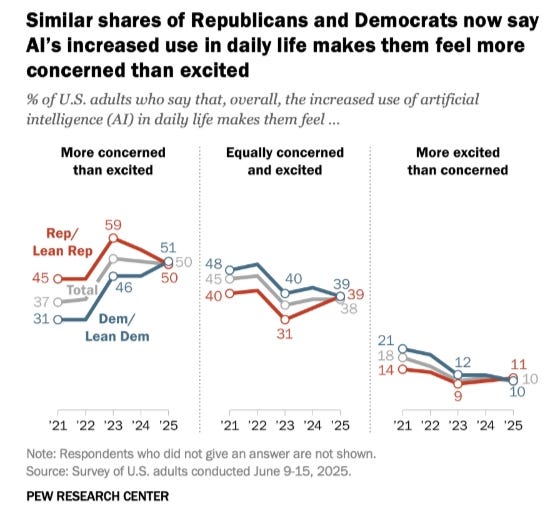
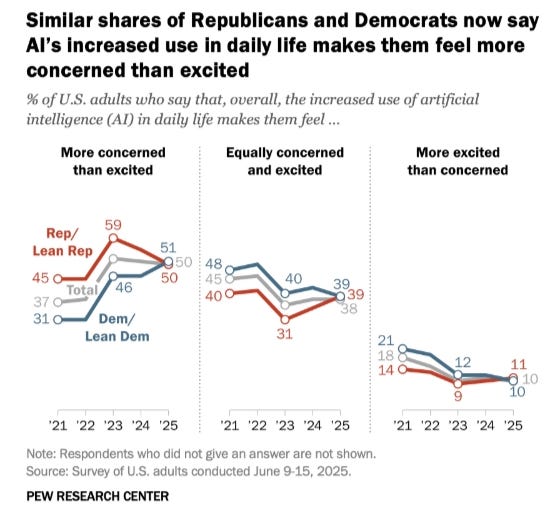
How Americans View AI and Its Impact on People and Society (Pew Research Center, September 2025, N=5,023 adults): 50% of U.S. adults are more concerned than excited about AI in daily life; only 10% are more excited than concerned. Concern was 37% in 2021; a 13-point rise over four years. Majorities believe AI will worsen Americans’ creativity, ability to form meaningful relationships, decision-making, and problem-solving.
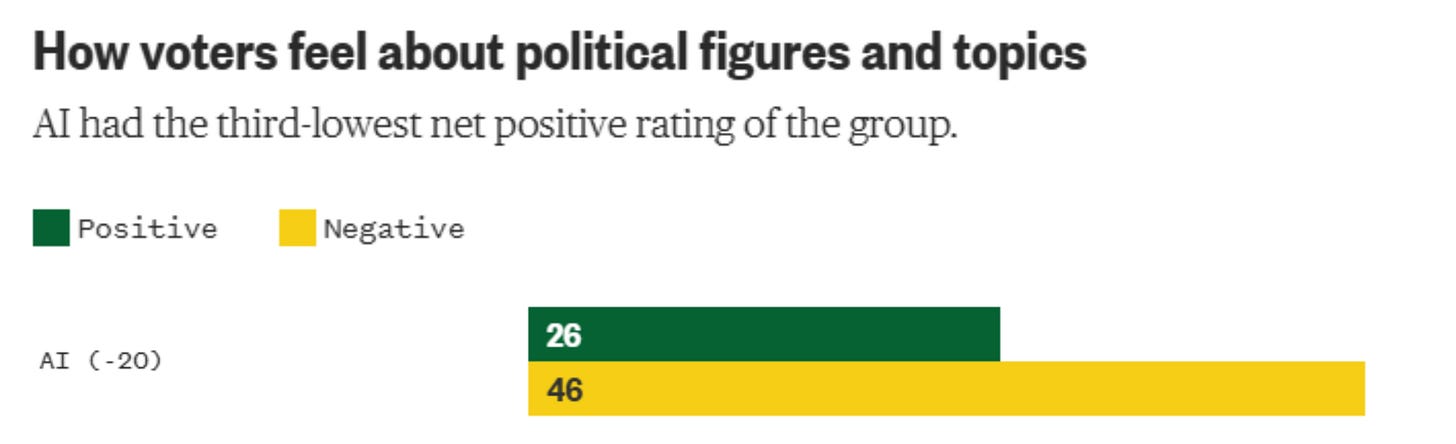
Source: Pew Research Center Majority of Voters Say Risks of AI Outweigh the Benefits (NBC News, March 2026, N=1,000 registered voters): 57% say the risks of AI outweigh the benefits; 34% say the opposite. Net AI favorability: −44 among 18–34-year-olds, −41 among women 18–49.
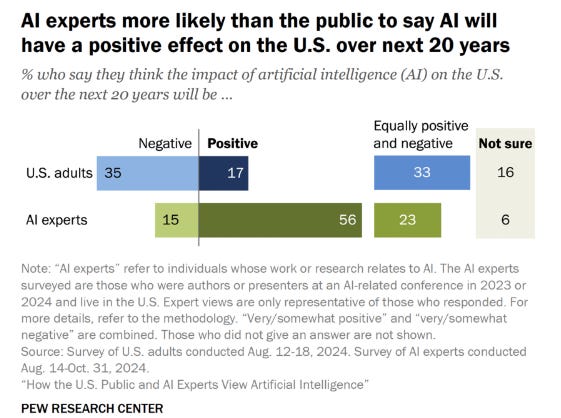
Source: NBC News How the US Public and AI Experts View Artificial Intelligence (Pew Research Center, April 2025, N=1,013 experts, N=5,410 adults): Asked whether AI’s impact on the US over the next 20 years will be positive or negative, only 17% of US adults said positive, while 35% said negative. Among AI experts, the picture is inverted: 56% said positive, 15% said negative. The gap between how the public and the people building AI see its future is one of the largest expert-public divides Pew has measured on any technology topic
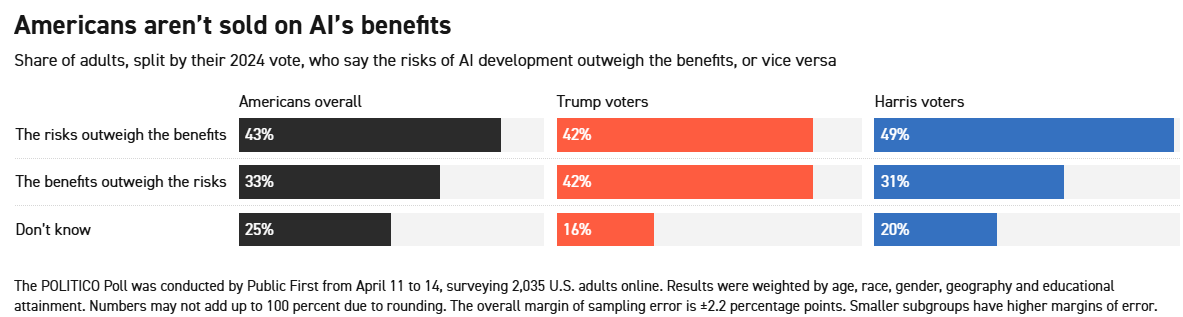
Source: Pew Research Center Americans aren’t sold on AI’s benefits (Politico / Public First, May 2026, N=2,035 adults): 43% say AI’s risks outweigh its benefits; 33% say the opposite. 44% say AI is developing too quickly, a view shared for the most part by 2024 Trump voters (42%) and Harris voters (49%).
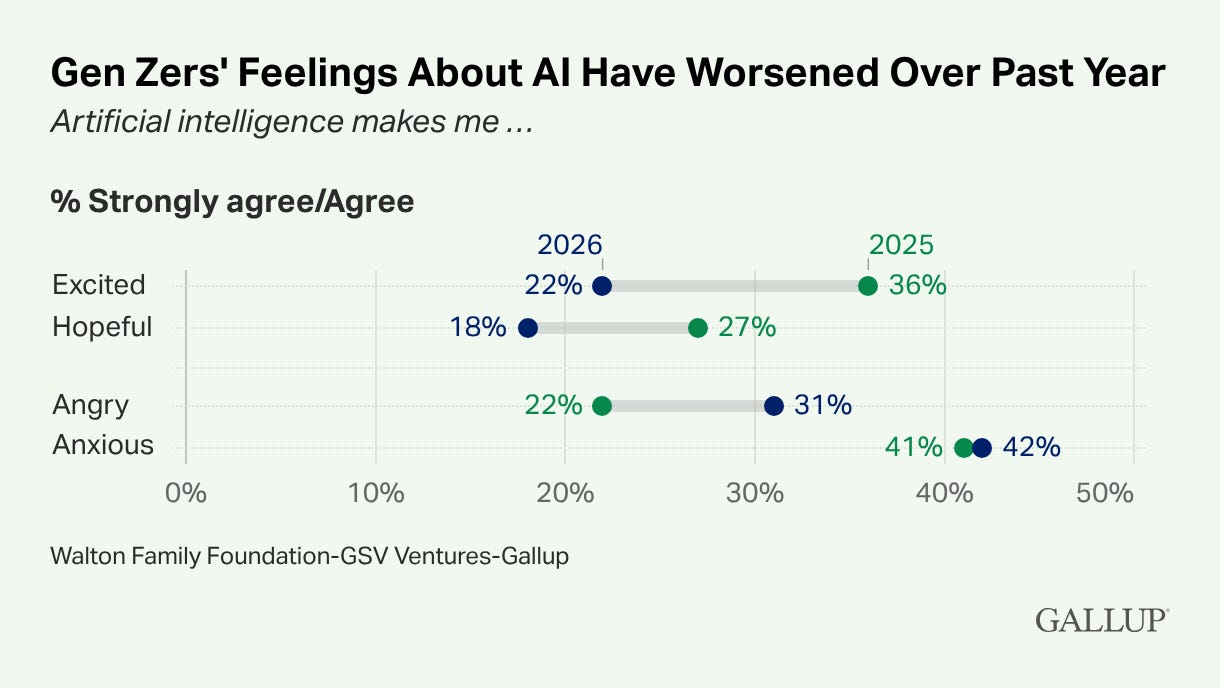
Source: Politico Gen Z’s AI Adoption Steady, but Skepticism Climbs (Gallup / Walton Family Foundation / GSV Ventures, April 2026, N=1,572 ages 14–29): Excitement about AI fell 14 points in one year to 22%. Hopefulness fell 9 points to 18%. Anger rose 9 points to 31%. Even among daily AI users, excitement dropped 18 points year over year. 42% of bachelor’s-degree students have reconsidered their major because of AI. Gen Z uses AI the same amount, but likes it much less.
Source: Gallup
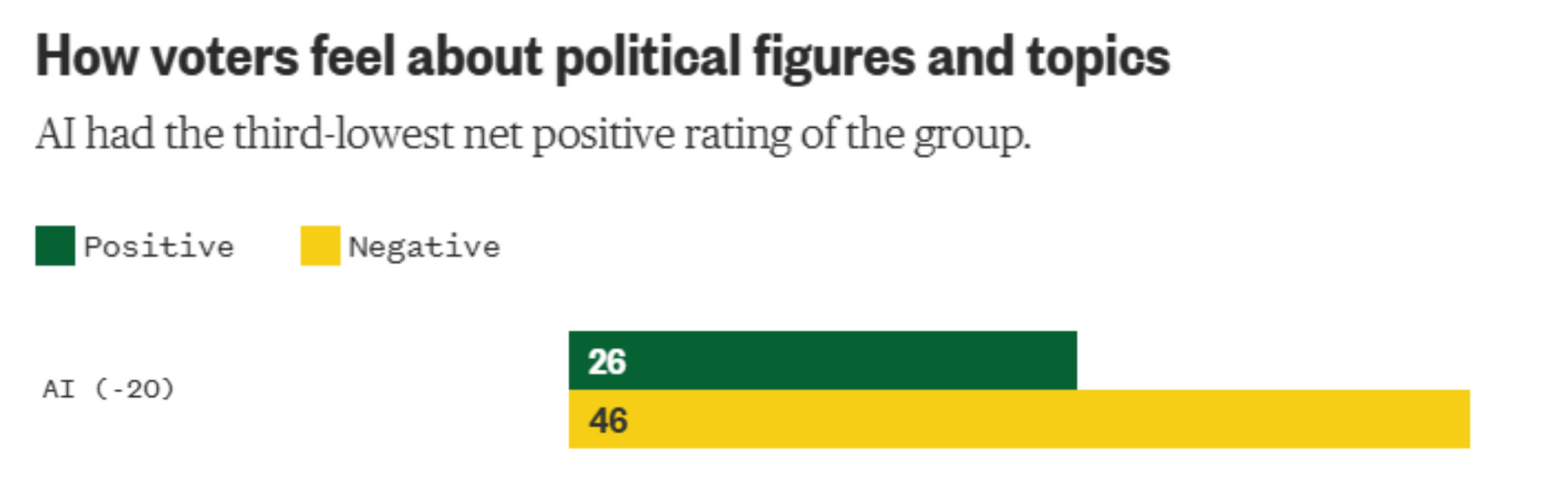
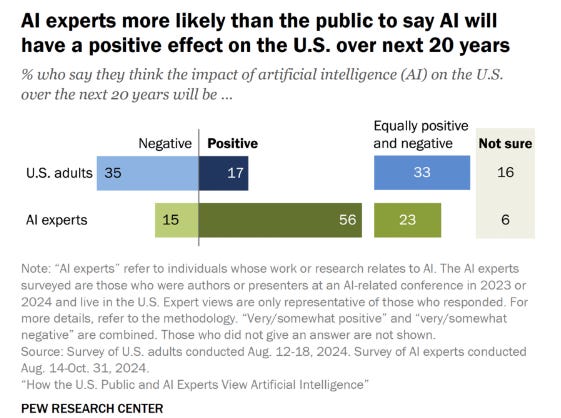
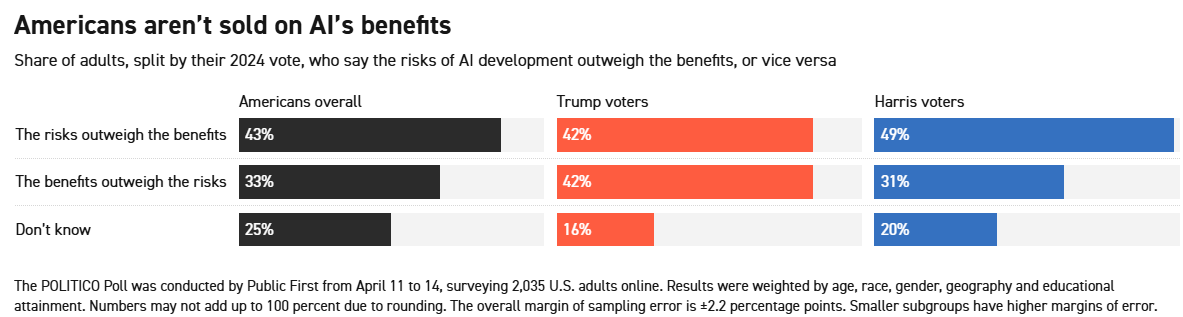
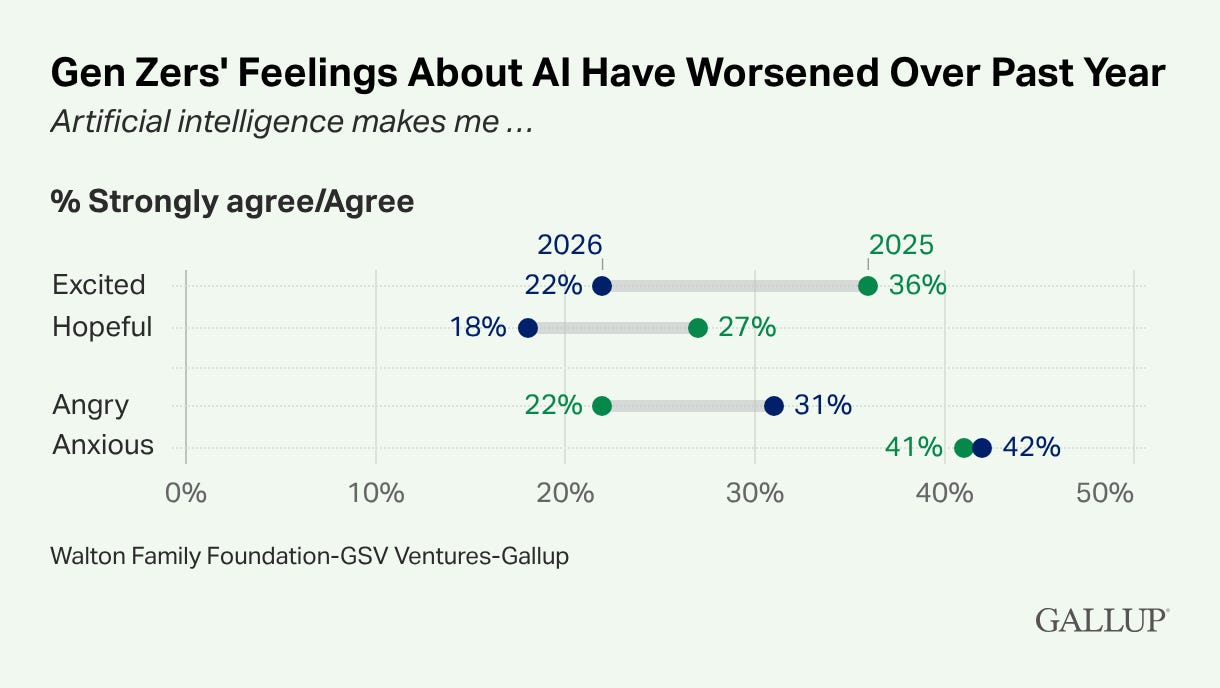
Conclusions: The opposition to datacenters doesn’t exist in a vacuum, but within a broader, deepening pessimism about AI itself that has been building since at least 2021-2022—even as usage has grown, particularly among young people—and has not reversed or plateaued. My reading is that datacenters are the physical manifestation of an abstract anxiety toward the technology.

III. AMERICANS DON’T LIKE THE PEOPLE BUILDING AI
The faces of the AI industry are deeply unpopular, and Americans increasingly view the relationship between tech CEOs and political power with suspicion.
Americans Deeply Critical of Big Tech CEOs (Tech Oversight Project / PPP, June 2025, N=541 registered voters): Every major tech CEO underwater on net favorability—Zuckerberg −41, Pichai −34, Bezos −22, Cook −22, Altman −16. A later polling cycle put Zuckerberg at −59, Pichai −38, Bezos −45, Altman −36. 70% of voters believe Big Tech CEOs are simply trying to appeal to Trump rather than acting on principle.
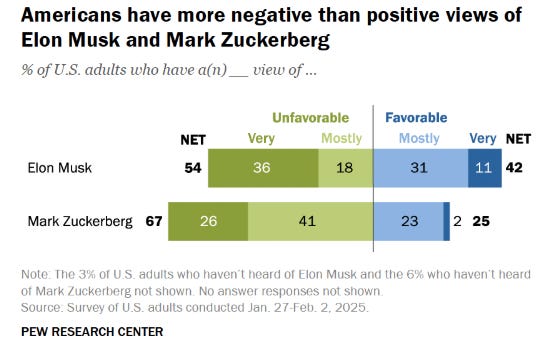
How Americans View Elon Musk and Mark Zuckerberg (Pew Research Center, February 2025, N=5,086 adults): 54% unfavorable view of Musk (36% very unfavorable); 67% unfavorable of Zuckerberg (26% very unfavorable). Musk is sharply polarized by party (R +73 favorable, D 85% unfavorable); Zuckerberg is broadly disliked across parties.
Source: Pew Research Center Majorities Concerned About Big Tech Influence and Corruption (Navigator Research, February 2025, N=1,000 registered voters): 69% of Americans believe tech CEOs (Musk, Zuckerberg, Bezos) will have significant influence in the Trump administration; 50% call that a “bad thing” vs. 37% “good thing.” 41% worry Trump will look after billionaires instead of the middle class because of this influence.
Conclusions: Both messengers and messaging are part of the problem; there’s a category-level credibility catastrophe. Whether the backlash against AI infrastructure would exist without the CEO’s favorability collapse is unknowable, but the correlation is there: as the industry’s public faces became more politically visible—and more unpopular—the infrastructure they were building became less welcome. The AI industry is being judged on 1) the infrastructure enabling it, 2) the products they sell, and 3) the character and political motivations of the people building them.

IV. AI HAS BECOME A BIPARTISAN PROBLEM
Over the past few years, there’s been a collapse of the partisan gap on AI concerns. The standard analytical frame—Democrats worry about safety, Republicans worry about government overreach—no longer describes the data.
Americans Oppose AI Data Centers in Their Area (Gallup, publication date: May 2026, N=1,000 adults): Partisan breakdown: 56% of Democrats are strongly opposed vs. 39% of Republicans (independents 48%). Demographic breakdowns: women 55% strongly opposed vs. men 43%. Regionally: Midwest 76% total opposition, South 75%, East 68%, West 63%. No meaningful differences by age, race, education, income, or urbanicity — this is not a coastal or college-educated phenomenon.
Source: Gallup Republicans, Democrats Now Equally Concerned About AI in Daily Life (Pew Research Center, November 2025, N=5,023 adults): Republicans and Democrats are now essentially tied on “more concerned than excited” about AI (50% vs. 51%). From 2021 to 2024, Republicans had been consistently more concerned; that gap has closed entirely. Where the parties diverge is trust in regulators: 54% of Republicans trust the US to regulate AI effectively vs. 36% of Democrats, an inversion of the typical pattern that reflects partisan control of the White House
Source: Pew Research Center Majorities of Republicans and Democrats Overwhelmingly Favor Regulating AI (University of Maryland Program for Public Consultation, August 2025, N=1,202 adults): Bipartisan supermajorities favor concrete AI regulation. 79% favor requiring AI programs to pass a government test before deployment (R 84%, D 81%). 78% favor allowing government audits of in-use AI systems.
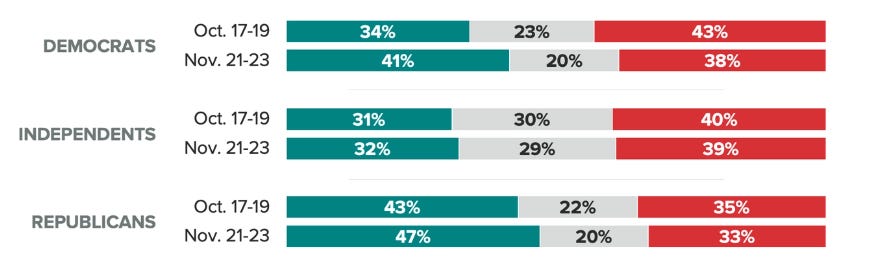
Voters Are Turning on AI Data Center Construction (Morning Consult Intelligence, October and November 2025, N=~2,200 registered voters): Republicans are the most pro-ban at 47% (up from 43%), Democrats at 41% (up from 34%), independents essentially flat at 32%.
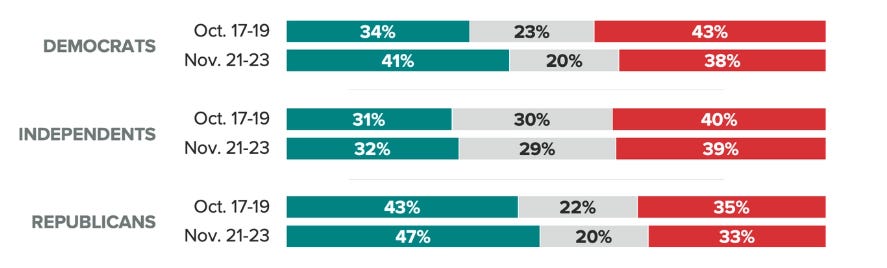
Source: Morning Consult
Conclusions: Both sides worry about the same thing at nearly identical rates. That both Gallup and Pew find majority opposition across party lines defies the assumption that AI skepticism is a progressive phenomenon. AI has achieved something rare in American politics: it has united voters who agree on almost nothing else. Where they diverge is about who should fix it, not whether it needs fixing. Dario Amodei says that “We’re going to find that ideology will not survive the nature of this technology. The things I’m talking about are gonna become bipartisan and universal because everyone will recognize the necessity of it.” I gotta give him that one: both sides do agree.

V. WHERE THE AI BACKLASH HAS MATERIALIZED
This section describes what the attitudes emerging from the polls have already caused in the ground: canceled projects, organized opposition groups, billions of dollars in disrupted investment, and a legislative wave at both the state and federal level, moving the regulatory posture from incentive competition to oversight and restriction.
Data Center Watch Report (Data Center Watch, Q2 2025): $156 billion in U.S. datacenter projects were blocked or delayed in 2025 by local opposition, moratoria, or litigation. 188 active opposition groups tracked across the country, 53 of them newly formed in Q2 2025 alone. (The $156B figure includes both blocked and delayed projects; it should be read as a “disruption” total, not a “cancellation” total.)
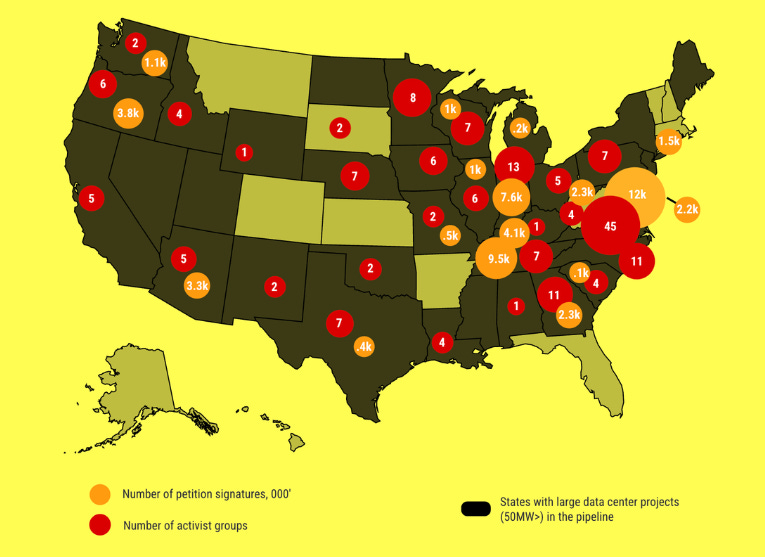
“Map of grassroots groups and petition signatures opposing data centers in Q2 2025.” Source: Data Center Watch Prince William County Drops Legal Fight for Digital Gateway (Virginia, April 2026): The Board of Supervisors voted unanimously to withdraw from litigation defending the Prince William Digital Gateway, a 2,100-acre, 37-building, $24.7 billion campus that would have been the largest datacenter corridor in the world. The county had spent $1.72 million in taxpayer funds fighting its own residents in court. Developer Compass Datacenters formally abandoned the project two weeks later. The site bordered Manassas National Battlefield Park.
Tucson City Council Rejects Project Blue (Arizona, August 2025): A 7-0 unanimous vote killed a 290-acre datacenter campus linked to Amazon Web Services after weeks of public hearings. The developer subsequently bypassed the city by securing county zoning instead, which generated a second wave of opposition. Water consumption in the desert was the central concern.
Prince George’s County Pauses All Datacenter Development (Maryland, September 2025): County Executive Aisha Braveboy signed a moratorium order after a resident, Taylor Frazier McCollum, posted a petition against a proposed datacenter at the former Landover Mall site. It gathered over 20,000 signatures in two weeks. Governor Wes Moore later signed the Utility RELIEF Act requiring datacenters to pay for their own grid upgrades.
Data Center Moratorium Bills Are Spreading in 2026 (Good Jobs First, February 2026): Moratorium bills have been introduced in at least 14 states in 2026. More than 300 datacenter-related state bills were filed in 30+ states in the first six weeks of the year alone.
Artificial Intelligence Data Center Moratorium Act (Sen. Bernie Sanders, March 2025): A federal bill calling for a national pause on datacenter construction. In December 2025, 230+ environmental groups—including Food and Water Watch, Friends of the Earth, and Greenpeace—sent a joint letter to Congress demanding the same.
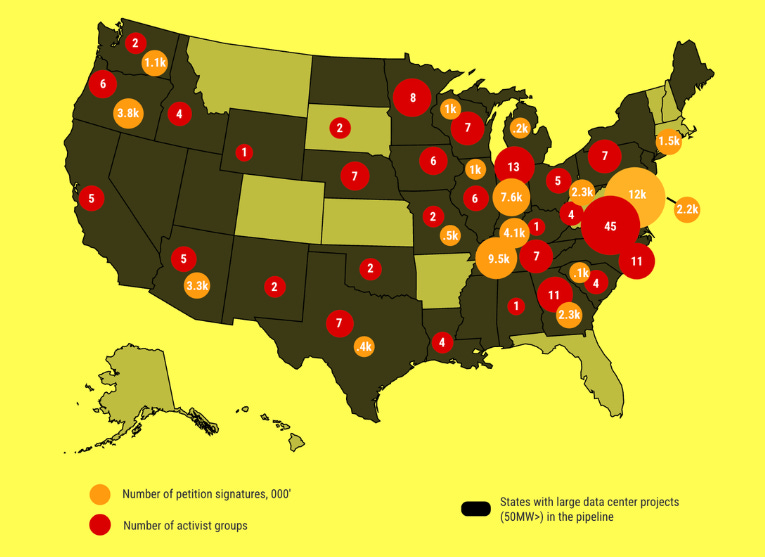
Conclusions: Billions in disrupted investment, community groups multiplying faster than projects can be approved, and a legislative system that moved from incentive competition between states to oversight and restriction in under two years is not the effect of a poll result but the consequences of real-world action. This issue is not staying on social media.

VI. WHAT WE DON’T KNOW
Four critical gaps remain in the data:
No baseline to compare. Gallup’s data-center question was asked for the first time in March 2026, so there’s no trend line. The Change Research and Washington Post–Schar comparisons offer before/after snapshots, but there is no systematic annual tracking of data-center sentiment across the same population over time. We don’t know what the starting point used to look like nationally.
Causation is unmapped. Americans oppose data centers, dislike AI CEOs, and distrust AI broadly, but which is driving which? Did the CEO favorability collapse poison attitudes toward datacenters by repeatedly claiming AI will take everyone’s jobs? Or did local datacenter fights poison attitudes toward CEOs, which were already pretty dismal? Did the broader AI anxiety create the conditions for local opposition, or did local opposition generate the broader anxiety? The correlations are clear but not so much the causal arrows.
An (un)informed opposition. What do opponents actually know about datacenters? I’ve intentionally left this question out: for instance, Gallup’s open-ended responses show people citing water, energy, pollution, and utility bills, but no poll has tested whether respondents can distinguish accurate from inaccurate claims about datacenter impacts. This matters for predicting whether the backlash is durable and immutable or responsive to new evidence, but the opposition is real anyway: it shapes votes and kills projects whether or not it is factually grounded.
The election hypothesis. No American election has yet been won or lost on AI. The 2026 midterms will be the first natural experiment on that. Until the votes are counted, the claim by multiple analysts that AI backlash translates into electoral outcomes is just a prediction. Cost of living still dominates voter priorities, and AI’s role may be as an issue underneath economic anxiety rather than above it.

VII. GLOBAL CONCLUSIONS
Core finding: every available measure converges on a collapse of public opinion
Across every pollster—Gallup, Pew, Change Research, the Washington Post, Marquette, Morning Consult, Heatmap, NBC News, Politico, the University of Maryland—the direction is the same: Americans have soured on AI datacenters, on AI itself, and on the people building it.
It happened faster than the backlash against nuclear power, than the backlash against wind farms, or any comparable infrastructure opposition in the modern polling era. Change Research measured a 40-point net swing in a single year. In three years, the Washington Post–Schar poll captured a 34-point collapse in Virginia, the one state that should be most favorable to data centers due to associated benefits. Morning Consult found support for an outright nationwide ban rising 4 points in one month. This is a collapse of public opinion, not a gradual shift.
The speed makes this story urgent; the convergence makes it important.
When every pollster, using different samples, different question wordings, different modes (telephone, online, in-person), and different time points, finds the same thing, you have a consensus. The opposition to AI infrastructure is bipartisan in composition and only varies slightly in intensity by party, gender, and region. It is not limited to abstract attitudes—it has materialized in $156 billion of disrupted projects, 188+ opposition groups, 300+ state bills, and federal legislation—and even the industry’s own political spending strategy treats the AI brand as too toxic to defend on-message.
When they dare defend it, though, the reaction is as homogeneous as the polls suggest. Below is a video of what happens when a commencement speaker talks to university students about AI (featured: Eric Schmidt, former Google CEO; Scott Borchetta, Big Machine Records CEO; Gloria Caulfield, Tavistock Development VP):
Two things worth noting from this.
This doesn’t happen in STEM schools (might be the only exception). That contrast aligns with the Pew Research data on the divide between experts and the general population.
Students don’t oppose AI from ignorance but experience. This was quite shocking to me: Gallup found that Gen Z high usage has not decreased despite anger having increased. They know what they’re protesting against because they know what AI is doing to them.
It’s booing today, what will be tomorrow? I don’t want to sound alarmist but there’s only one good moment to warn about violence: too soon. As I wrote in “AI Will Be Met With Violence, and Nothing Good Will Come of It”:
There’s a lot of friction to escalating violence, but that friction dissolves the moment this sentiment starts to be common. Normally, it just fades away anyway, but there’s one scenario where I see it inevitably escalating:
If people feel that they have no place in the future.
This is America screaming they are being left behind and they don’t want to be left behind.
But why has the sentiment changed so much so rapidly? Why have the poll results on datacenters and AI degraded so intensely over the past year? Why now?
The underlying dynamic is obscured by the intensity of the backlash but my general reading is this: the sentiment was always there but it only became legible after it reached a certain critical mass. The snowball needs to get big before it starts rolling down the mountain’s side. Once it does, though, it rapidly turns into an unstoppable avalanche.
We’re living through the first moments of that avalanche.
But let me give you a more specific take. I think it can be of value to the industry, if anyone there is hearing the rest of the world anymore or their unprecedented success has fully deafened them.
Americans never got to form an opinion about AI gradually. They didn’t get to see both good and bad over time, balancing them out. There are various reasons for this.
The technology arrived as a cultural event—ChatGPT in November 2022 “took the world by storm,” as they say—and within three or four years, it was everywhere.
The industry has force-fed AI to everyone; companies are cramming it into every existing digital service to retroactively rationalize the massive spending.
They keep warning that we’ll lose our jobs as they keep enthusiastically rolling out the very products responsible for the presumed mass unemployment (Claude Code and Codex and etc.).
They claim to be worried if the full-blown commercial race goes wrong (e.g., recursive self-improvement) but then allude to competition pressures to keep going.
They wreaked havoc on the digital landscape with insane amounts of slop.
And after all of that, they’re asking for permission to reshape the physical world: the landmass, the electrical grid, the water supply, the view from people’s backyards.
The speed of the buildout outpaced the speed at which people could form a considered view and the natural response to sudden change with dangerous undertones is resistance and, to whatever degree possible, organized counterattack. Factuality is an afterthought, if at all.
Social media allows unprecedented speeds for sentiment to spread—as well as information and misinformation—but I believe the AI industry’s unfortunate messaging was the primary cause.
None of this tells us whether the backlash is permanent, though.
The nuclear analogy is instructive but cuts both ways: nuclear power lost public trust in the 1970s and never fully recovered, which suggests infrastructure opposition can be durable for decades. On the other hand, nuclear opposition was reinforced by Three Mile Island and Chernobyl, specific, catastrophic events that validated the fear.
The AI backlash has no equivalent singular disaster (yet); it’s driven by diffuse anxieties about energy, water, jobs, utility bills, corporate power, and the speed of change. Whether the industry course-corrects before a crystallizing event, or whether the diffuse anxiety becomes the crystallizing event through accumulated experience is an open question—one they shouldn’t take long to answer.
Otherwise, these polls will soon be regarded as the beginning of the end.

This compilation took a lot of work. It helps a lot if you share it with people who could be interested or learn something from this. Here’s a button for that:
I've been studying the consumer perception of AI for 3 years ( internally at Google and now externally). Whats still being brushed over, is that most consumer AI products are not seen as super useful to the average tech consumer.
This is a direct (and very predictable) outcome of the playbook the AI labs have been running for product development. They are "launching and learning" and relying on dogfooding and developer feedback. But internal employees are not representative of average users...the developers and early adopters they are asking for feedback from on X are not average users...the "ai influencers" they are inviting to their labs for 'early previews' are not average users. The AI industry has created an echo chamber, which is a great way to build products a single community loves and leaves everyone else behind.
The Gallup study you cited, also found that the majority of Gen Z don't find AI to be helpful for brainstorming, searching for information, or thinking critically...these are *core* use cases for AI, and these numbers are getting worse from last year....and I don't blame them:
1. A chatbot is not an intuitive mental model for the average person to use. People use it like Search, because what other mental model do they have? At this point Claude needs a handbook to figure out. There's just so much you need to know about AI to get meaningful use out it.
2. AI slop and misinformation are taking over peoples news/ content feeds. They associate the AI output from free models with hallucinations and as a result, AI is considered "dumb" technology.
3. Consumers are dealing with a bunch of AI features they didn't ask for, while their favorite products are getting worse over time. The tech industry itself is producing AI-slop.
The reality is the advancements of AI capability have gone to engineers and CEOs, not to the average tech consumer.
Thank you for putting together these different pools and summarising the findings. From casual discussions, I think the underlying cause is more basic than what the pool responses make out.
The vast majority of people have lost faith in / trust in large corporations (often represented by the big 7 techbros) but broadly in the tech industry and large companies as a whole. There was a time when tech had a lot of good will as a positive disruptor to the “establishment”. The establishment was slowing positive change, monopolising and extracting, and focusing on the wrong social problems. Tech was disrupting that.
But now tech is seen as just another, even worse establishment. The truth is likely that they aren’t as bad as some of the abuses of the past. But through the lenses of today, they are monsters.
This has been made worse by the complete sacrifice of any form of corporate social responsibility by these mega companies. Even for people who disagreed with the priorities of ESG, CSR was largely supported and helped monopolistic large companies pretend that they weren’t purely profit seeking. I don’t think CEOs of these companies recognise how much damage they did to themselves and their company’s public credibility by so quickly abandoning any even superficial nod to social obligation.
No one really believes anything a company or CEO says any more. And that together with the reality that the average person has higher bills, concerns about health, and worries about the world yet the establishment solution to this cocktail of human suffering is “build more data centres and talk to more chatbots”.
Aren’t there better things we can burn money on?