


Hey, Alberto here! 👋 Each week, I publish long-form AI analysis covering culture, philosophy, and business for The Algorithmic Bridge. Paid subscribers also get Monday how-to guides and Friday news commentary. I publish occasional extra articles. If you’d like to become a paid subscriber, here’s a button for that:
There’s no weekly review today. One topic stands out in relevance against all others. This article is a must-read if you want to know what’s coming in the next few years. The AI industry has spoken: you are no longer required.
Outline:
CLAUDE OPUS 4.7 VS CLAUDE MYTHOS PREVIEW
THE NON-DEMOCRATIC ERA OF AI HAS STARTED
“AI” STANDS FOR “APPEASING INVESTORS”
WHAT YOU CAN DO AS A USER

I. CLAUDE OPUS 4.7 VS CLAUDE MYTHOS PREVIEW
Anthropic just announced Claude Opus 4.7. The model is what you expect a 0.1 version improvement over the previous one—Opus 4.6—to be. Better generally across benchmarks, clearly focused on agentic and coding skills.
The most notable aspect of this release is not reflected in benchmarks: it’s been two and a half months since Anthropic released Opus 4.6. The pace of launches keeps increasing, and the reason is, to an unknown degree, that the frontier labs—Anthropic, OpenAI, and Google DeepMind (to a lesser degree)—are deep in (RSI) recursive self-improvement territory. Increasingly, the models themselves are playing a role in the training and building of the next generation of models.
Here’s what Opus 4.7 looks like benchmark-wise:
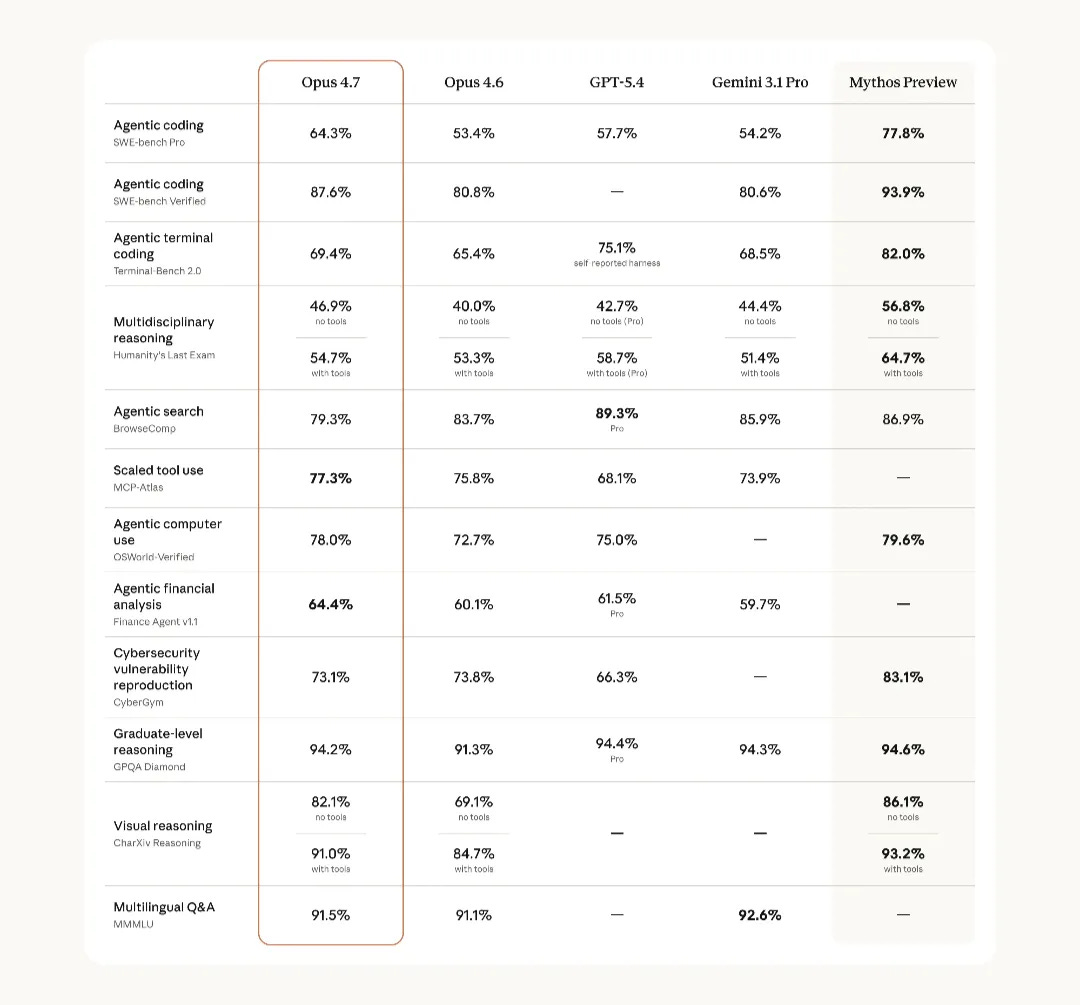
Opus 4.7 beats Opus 4.6 in 12 out of 14 benchmarks that Anthropic showed us.
It seems to be a good model for what Anthropic cares about—agentic and coding tasks, not so much writing, which I care about but isn’t a substantial revenue source—but we will have to wait until the street speaks. (I’m hearing that the model is worse than expected, but again, firsthand experience is the only valid experience with these things; for tips, you can read this thread by Claude Code creator, Boris Cherny.)
But, notably, Opus 4.7 is not the best.
If you look at the right side of the chart, you will find, in a darker cream-colored background, the imposing presence of Mythos Preview, a model that Anthropic announced with much fuss a couple of weeks ago, but that it won’t release due to risks to cybersecurity. I wrote about Mythos last week. My main conclusion was, paraphrasing, that it seems weird that Anthropic made it public at all, only to hold it back from us. If the company only entrusts a few close partners with access—industry and government—then why tell us it exists at all?
Mythos is better than Opus 4.7—11 out of 11 benchmarks—but not for you. The fact that they added it to the chart is significant.
II. THE NON-DEMOCRATIC ERA OF AI HAS STARTED
This is bad news for the loyal user base of the AI industry. We’ve reached the point of no return, a shift in the fundamental dynamics that the industry was built upon. Alas, they were not made to last.
Let me explain what’s going to happen.
