


At times, it's not you that gets in the way of the schedule. I had a guide planned for today, but the world is burning, and wherever you stand right now, fire spreads.

In 1905, a twenty-six-year-old patent clerk in Bern destroyed the idea that things happen at the same time. Buried inside one of Einstein’s landmark papers, overshadowed by the flashier consequences of special relativity—the speed of light and the equivalence of mass and energy—was the idea of the relativity of simultaneity.
Lightning strikes both ends of a train. An observer on the platform sees the strikes as simultaneous. An observer at the midpoint of the train, moving toward one bolt and away from the other, sees one before the other. No measurement you could perform, no instrument you could build, no god’s-eye camera you could position above the scene would tell you whether the strikes happened at the same time. Simultaneity between spatially separated events is not a fact of the world—a simple question with a simple answer—but something you define by choosing where to stand.
Most of the time, this doesn’t matter. The speeds involved in everyday life are too small. But there is a domain in which the relativity of simultaneity has become, I think, the central unacknowledged fact of our experience.
An adult fruit fly has ~140,000 neurons connected by over 50 million synapses. More than 200 scientists spent a decade mapping every one of them into a wiring diagram that fits in a laptop. The result—if you dare play god, as Eon Systems did—is an emulation of the fly’s behavior in a digital environment. In other words: there is, somewhere in the Western edge of civilization—in the secret lab of a biotech startup based in San Francisco—a literal fly trapped inside a computer.
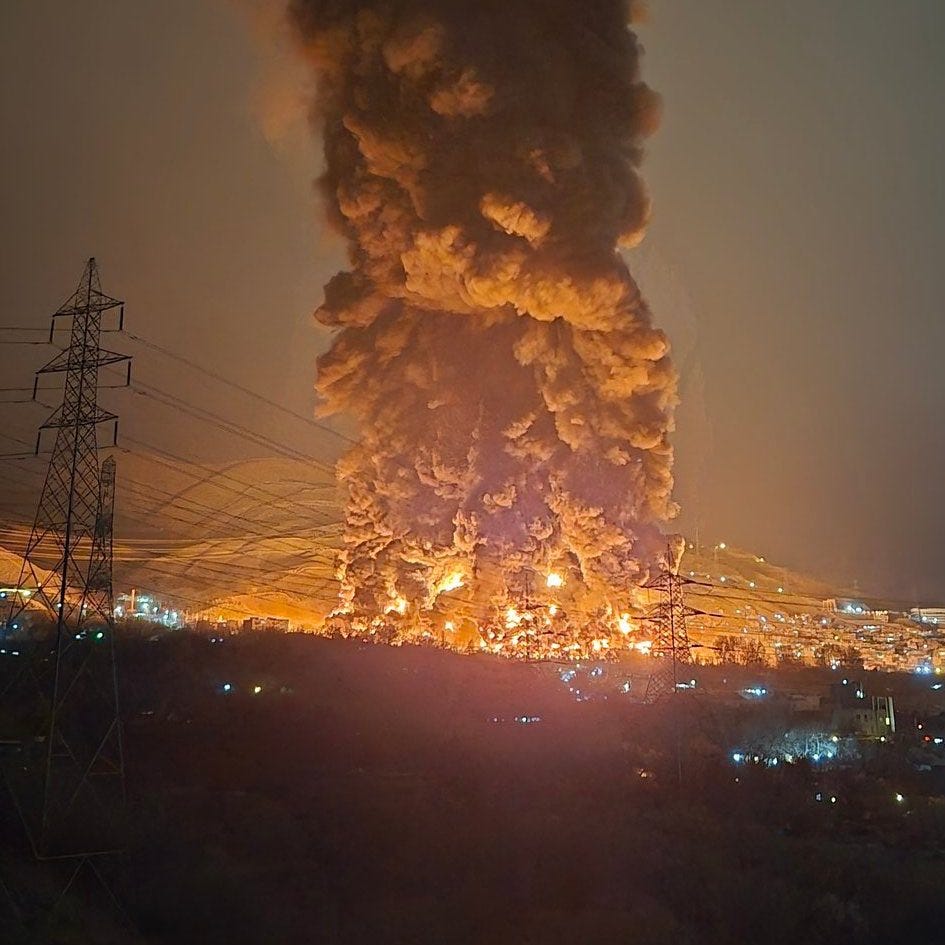
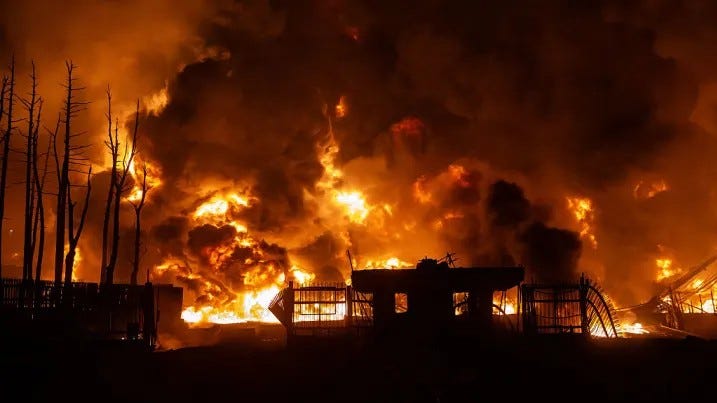
Wretched souls are trapped inside their own homes, as if insects caught in a matrix of terror, due to the flames coming out of the storm drains. Oil from the Shahran depot is leaking into the streets, catching flames; rivers in brilliant reds and yellows quench the trees’ fateful thirst. The city’s veins have been forcefully opened by the master artists of our era, who paint the ground and sky over Tehran the color of a bruise backlit by a furnace. As Iran’s cities turn into labyrinths of death, blaze, and deafening explosions, the one thing left to do is meet doomsday.
“Can it run DOOM?” is the question hobbyists have asked of every new computing platform for three decades. A 1993 seminal first-person shooter video game that installed and instilled in our minds the heroic quest of being the person with the finger on the trigger. Since then, human brain cells have been rearranging into the shape of gyri-guns to make room for this raw truth: you now kill stuff. Cortical Labs has a new answer to the DOOM question: A petri dish of human neurons suffices to run it and, in the meantime, kill some monsters from hell.
Every hour, more monsters are killed. One hour is hapless schoolgirls—whose dead cells are scattered on the burning pavement or mixing with the airborne ashes—unalived by peace harbingers. The next hour is their agonizing parents, the scarce rescue teams, and the sanitary units, tasked with scouring the ruins of an elementary school in Niloufar Square. The tactic is called “double-tapping”: They bomb a second time to kill more civilians after they desperately gather around their families, murdered on the first hit. “Artificially-Shrunken Lives,” media headlines will say. Or maybe “Self-Inflicted Inaccuracies.”
The short lifespan of a fruit fly makes it the perfect subject for the experiment. Human lives in the wild tend to be annoyingly long. No one would dare upload the human connectome into a giga-computer just in case it’s conscious, right? All humans have a high regard for fellow human lives, right? The scientists watch the fruit fly run around for a few hours, they take notes, and then it dies, and they update the parameters for the next attempt. The fly moves, eats, and cleans its front legs. It gets drunk. Sings. It can be kept awake with caffeine. Come to think of it, the fly is alive the way fire is alive: as a chemical reaction—a silicon substrate here, a plasmid substance there—of uncertain consequences. Look at how it moves. Go, go little thingy!
It goes and keeps going, the fire. It breathes, reproduces, and eats all kinds of aliments—cars, trees, homes, kids—and leaves toxic gases and dense ashes in its wake that unwitting citizens will breathe in with the morning sun and with all the morning suns for the rest of their lives. But the morning sun is late today in Tehran. All roosters lie still in the dust; without chants, the lamp of heaven doesn’t know when to shine. Instead, a dark, looming cloud covers the sky. A black, slimy, thick, acid liquid is pouring in the form of viscous brea drops. The scenery is filmed from inside apartment floors, like one does when there’s particularly bad weather or, conversely, when bombs keep falling on your backyard. No reports of singing in the rain.
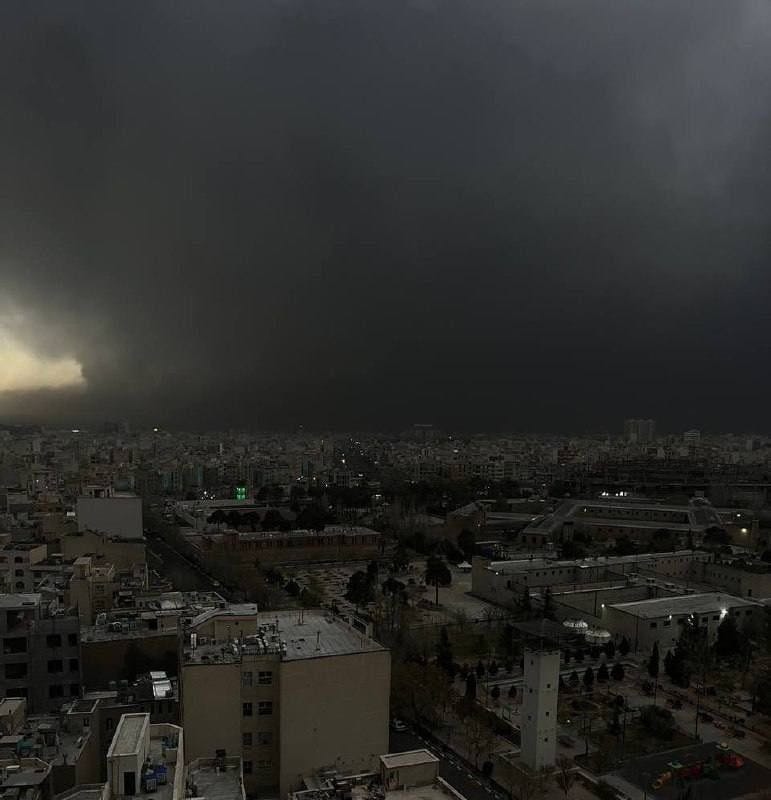
It only took humans—either in a petri dish or in a body suit—one week to re-master the art of genocide. It’s pure chaos on both sides of the screen; the DOOM-playing cells navigate corridors full of inferno creatures, spawned from the nether, as do Iranian civilians that, like that one unfortunate fruit fly, were not consulted on whether they’d want to join us on the wrong end of the simulation.
The world has been governed by the laws of relativity for a century already, so I’m fully unfamiliar with the idea of simultaneity. AI makes it possible. My algorithmically-controlled feed shows me this collage of impossible scenes one after another in rapid-fire succession. Must be fiction. The DOOM cells and the fruit fly were brought to life as AI forms that contradict all that we think we know about AI: no training, no data, no algorithm; just pure existence. And then there’s Claude; oh, our beloved Claude—how happy we were that Claude was kept out of the military operations, how sad that Anthropic was labeled a supply chain risk, how proud that a brave Amodei stood his ground against Hegseth.
And yet, it might have been Claude that targeted that school. It’s human-made horrors beyond comprehension all the way down.
Orwell wrote that the central problem of our time is the decay of the belief in personal immortality. He meant that once people stop believing their actions will be judged by something outside of history—by God, perhaps, or by their legacy—they become capable of anything because the dead stay dead. Because consequences are bounded.
The central problem of our time is the decay of the belief in a shared present. We have been given, by the architecture of modernity, individual reference frames so divergent that the same day contains, depending on what scrolls you are fed or what feeds you scroll, virtual life or actual death, and no mechanism to reconcile these frames, no privileged observer who can say: these things are not happening simultaneously; these things can’t possibly be happening simultaneously.
The question of simultaneity is, as Einstein enunciated a hundred years ago, a relative one. You may not experience these events simultaneously, as I do, but I happen to inhabit Spain, the safe middle point between the two lightning strikes, one caressing the skyscraper rods in the calm coasts of the Bay Area, its citizens concerned with human cells playing DOOM; the other repeatedly torturing the ancient grounds of Persia, doom falling on every single human cell. Our digital world exists feed-forced into a simultaneity that violates the laws of physics, but you still can’t escape the need to choose where you stand relative to the lightning strikes. It's everything everywhere all at once, but where you stand?
Simultaneity is, in the bizarre times we live, also a moral problem. How does a species hold both of these projects at once? How do humans conduct test after test in the morning—an emulated fly over here, a petri dish of human neurons over there—and then use similar technology to commit one massacre after another in the evening—from big ops like oil-poisoning millions, to small ops as small as a little girl, and then one hundred more.
I find it inconceivable that the humans who lead us would aim to expand the domain of the living and shrink it at the same time, but I suppose life, too, is relative.